After the White House Hilton Shooting: Three Curves Behind 22 Months of Assassination Attempts
At 8:34 p.m. on April 25, the magnetometer outside the WHCD ballroom was breached by Cole Tomas Allen, a 31-year-old California tutor. Both his weapons had cleared FBI background checks.

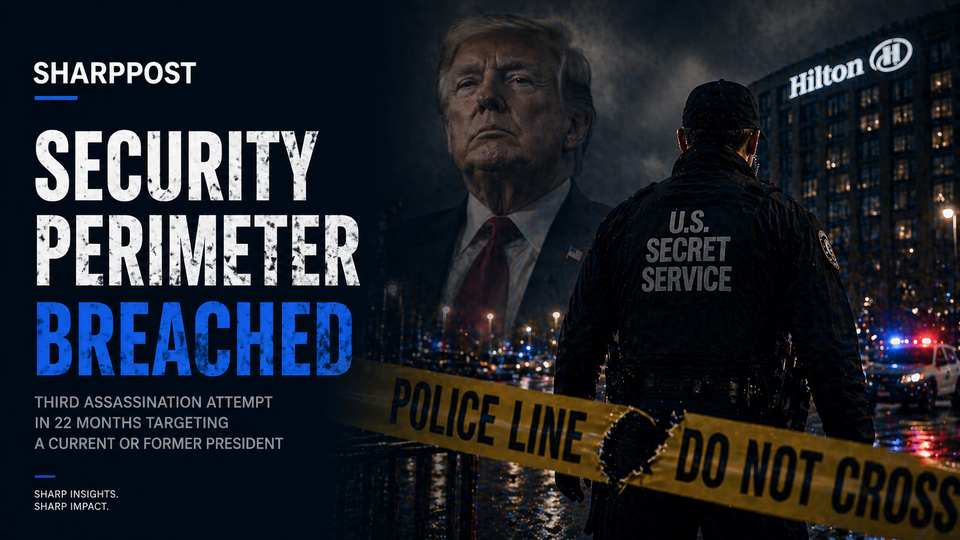
Three failed assassination attempts in 22 months
At 8:34 p.m. on April 25, the security checkpoint outside the White House Correspondents' Dinner ballroom was breached by Cole Tomas Allen, a 31-year-old California tutor. He carried a shotgun and a semi-automatic pistol. Both had cleared FBI background checks. Allen fired one or two rounds. Secret Service officers fired three or four back and brought him down at the magnetometer line. One round caught an officer's body armor. The 2,600 guests evacuated unhurt. Ten minutes earlier, Allen had emailed his family a 1,052-word manifesto. "Let me start off by apologizing to everyone whose trust I abused," it opened — and went on to lay out his "rules of engagement" for targeting Trump-administration officials. He signed it "Friendly Federal Assassin." This is the third attempt on a sitting or former U.S. president in 22 months.
Is the Secret Service stretched too thin?
Butler's roof sat 130 yards from the rally lectern at its closest edge (FBI measurement) and 148 yards from where Crooks actually fired (USSS Acting Director Rowe's congressional testimony). West Palm Beach put Routh in the tree line some 400 yards beyond the sixth fairway of Trump's golf course. The Hilton put Allen at the outer-ring checkpoint. All three failures happened at the outermost ring. On July 22, 2024, then-director Kimberly Cheatle told the House Oversight Committee the agency was protecting 36 individuals; in September 2024 USSS total headcount stood at roughly 8,100, with about 3,800 special agents — still some 20 percent below the 10,000-agent target Congress authorized in 2021. Acting Director Ronald Rowe, testifying before the Senate Homeland Security Committee on July 30, 2024, said it plainly: "We are redlining our people."
The catch is that money does not convert to deployable agents on the timetable Congress imagines. USSS special-agent training takes at least 18 months, from offer to first shift. The $231 million emergency supplemental enacted in PL 118-158 in December 2024 and the $3.3 billion House Appropriations FY2026 mark — which includes a $46 million hiring plus-up — cannot put new agents in rotation before 2027.
The Senate Judiciary Committee's Grassley report (July 2025) showed exactly where the chain broke. USSS leadership had received classified threat reporting on Trump 10 days before Butler. U.S. intelligence collection itself worked. The reporting never reached the local officers actually manning the perimeter. The DHS Independent Review Panel's October 2024 verdict was harsher: the agency had become "bureaucratic, complacent, and static even though risks have multiplied and technology has evolved." DHS Inspector General report OIG-25-37 (August 2025) added the staffing dimension. The counter-sniper team is staffed well below the agency's own internal model — a gap Government Executive estimated at roughly 73 percent. The three outer-ring failures are not isolated incidents. They are the observable consequence of protective tasking expanding while staffing did not.
| Measure | circa 2015 | 2024-2026 |
|---|---|---|
| Protectees (incl. family) | ~30 | 36 |
| Total headcount | ~6,800 | ~8,100 |
| Special agents | ~3,200 | ~3,800 |
| FY appropriation | ~$1.8 bn | $3.3 bn |
| Authorized vs actual | — | ~20% short |
| Training pipeline | ≥18 months | ≥18 months |
Where did the guns come from?
In Butler, Crooks used an AR-15 his father had purchased legally in 2013 and transferred to him legally in 2023. At the Hilton, Allen carried a shotgun bought in August 2025 and a semi-automatic pistol bought in 2023, both cleared through FBI's NICS background-check system. Both weapons came through channels current law allows. Routh's SKS rifle in West Palm Beach was a smuggled weapon — the only attack of the three sourced outside the legal pathway.
The lock is on the legal channel itself. The 2022 Bipartisan Safer Communities Act remains the only major federal firearms statute enacted since the 1994 assault-weapons ban sunset. Federal lawmaking has stalled in the four years since. That leaves administrative rulemaking — the ATF's 2024 "engaged in business" final rule — and Supreme Court adjudication — Bondi v. VanDerStok, decided 7–2 in March 2025 in favor of ATF authority over ghost-gun parts kits — as the only operative levers.
State-level red-flag laws fill some of the gap, but unevenly. By the end of 2025, 22 states plus the District of Columbia had Extreme Risk Protection Order statutes on the books. Cumulative filings from 1999 through 2024 exceeded 67,500. Per-capita filing rates vary by an order of magnitude across states. California, where Allen lived and bought, is among the more mature implementers. The thorny part is that its red-flag mechanism still depends on family, police, or clinicians initiating the process — coverage thins fast for someone with no prior contact with any of them. The NSSF's 2025 report estimates roughly 32.1 million modern sporting rifles — AR-15– and AK-pattern — in U.S. civilian circulation at year-end 2023, up about 4.5 million since 2020. The growth is on the legal side. Legal acquisition, online study of a target's schedule, and an individual radicalization trigger together cost Crooks and Allen no more than a few thousand dollars and a few weeks — every step inside what current law permits.
How does the lone-actor pattern cross party lines?
On the U.S. Capitol Police's books, threat cases against members of Congress went from 3,939 in 2017 to 14,938 in 2025 — nearly a fourfold rise in nine years, and 5,464 of that increase came in 2025 alone. Pew Research's 2022 study found that 72 percent of Republicans and 63 percent of Democrats now describe the other party's voters as "more immoral than other Americans," up sharply from the 47 percent and 35 percent measured in 2016. The University of Chicago's Project on Security and Threats, in its May 2025 wave, recorded that roughly 40 percent of Democrats expressed support for the use of force to remove Trump from office, while roughly 25 percent of Republicans backed the use of the military to suppress protests against the Trump agenda — both more than double their fall-2024 baselines. The animus surveys and the threat-case curve are moving together. The psychological floor of in-system competition is being replaced by the perception that the other party is a threat to the country.
Tellingly, the three suspects' political profiles diverge sharply. Thomas Crooks was 20, a registered Republican who searched for Biden's schedule online. Ryan Routh was 58, a veteran with pro-Ukraine, anti-Trump leanings. Cole Allen is 31, a high-credential tutor who signed his manifesto "Friendly Federal Assassin." Across age, ideology, and education they span the spectrum. Yet they share one behavioral pattern: solitary or near-solitary social ties, written manifestos, legal or quasi-legal weapon acquisition, solo planning, no need for organizational sign-off.
The Combating Terrorism Center at West Point has tracked lone-actor attacks since 2002. The median time between first exposure to extremist content and an attack has shrunk steadily — in some cases to a few weeks. The Center estimates that roughly 93 percent of lethal terrorist attacks in Western countries are now carried out by lone actors. Online platforms route ideologically different marginal individuals into the same behavioral mold. U.S. counterterrorism intelligence is still anchored on organizational networks.
What does this mean for assets and venues?
The political-stability premium long built into U.S. dollar assets is sliding structurally. It will not collapse overnight. But three signals are moving down at the same time. Protective capacity is not keeping pace with tasking. Legal-purchase tools and platform-driven polarization are reinforcing each other. The lone-actor pattern now spans both parties. The 10-year Treasury term premium, the equity risk premium, and currency-volatility pricing will likely reprice gradually, in line with the long-cycle signals tracked in SharpPost's dollar-hegemony six-dimension dashboard. Single-currency exposure on the dollar side now warrants tail-scenario sizing.
All three failed attempts hit the outer ring: the screening line, the rooftop sightline, the perimeter tree line. These are the outer rings of large public events, political rallies, and media gatherings. Three same-shape incidents have now shown this is the weakest layer in the system. Avoiding venues is more operational than avoiding cities. Two near-term conditions matter. One: whether the FY2027 budget closes the USSS staffing gap by the authorized 20 percent and whether more than 70 percent of the inspector general's 30-plus recommendations are implemented on schedule. Two: whether the next 12 months produce another same-shape outer-ring failure. If FY2027 staffing falls short of that 20 percent, if OIG recommendations run below 70 percent, or if the next 12 months bring another same-shape outer-ring breach — any one of the three triggers — structural disorder is no longer a hypothesis.
You read this far. You're not here for noise.
SharpPost delivers one weekly deep dive on geopolitics, finance, and tech — decoded for readers who want signal. Carefully selected, never noisy.