China and Japan Test Reusable Rockets as SpaceX Extends Lead
China recovered a Long March 10B booster and Japan flew RV-X. Ruibao compares their technology, reuse records and costs with SpaceX.

China recovered the first stage of its new Long March 10B after an orbital launch on July 10. A day later, Japan's RV-X test vehicle completed its first short vertical flight. Both countries are pursuing reusable rockets, but the two tests were separated by far more than 24 hours in technical terms.
The Long March 10B lifted off from the Hainan Commercial Space Launch Site and placed a satellite into its planned orbit. About six minutes after stage separation, the booster descended toward a ship at sea and was caught by a net system mounted on the recovery platform, according to the China Aerospace Science and Technology Corporation.
It was China's first controlled recovery of a launch-vehicle stage during an orbital mission. The two-stage rocket stands about 63 metres tall. Its first stage burns kerosene and liquid oxygen, while the upper stage uses liquid methane and liquid oxygen. In its reusable configuration, it is designed to carry about 16 tonnes to low Earth orbit.
CASC said it intends to fly the recovered booster again before the end of 2026. That mission will show how much inspection and repair the vehicle needs after its descent and net capture, information that cannot be taken from the landing footage alone.

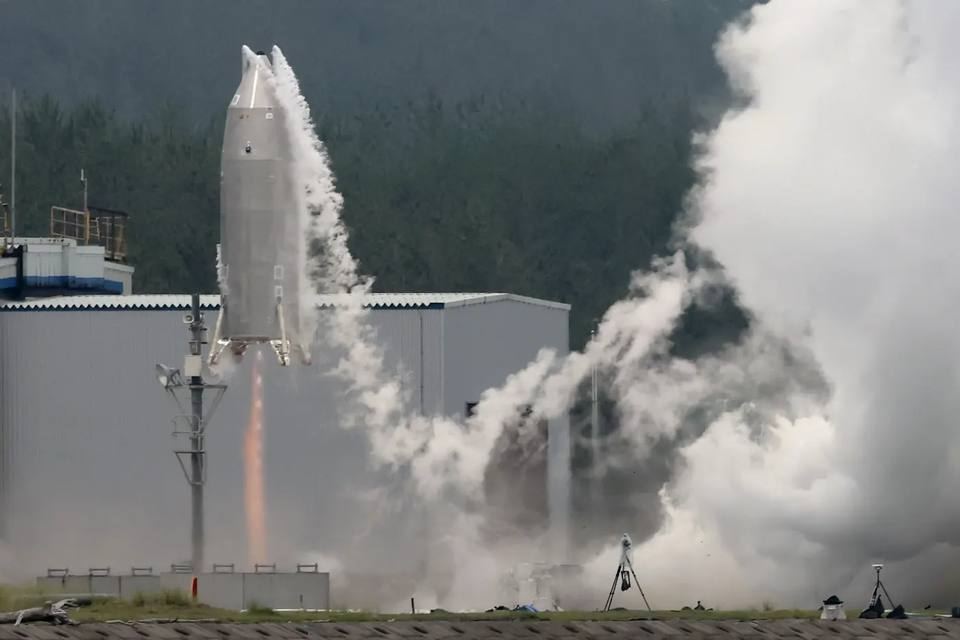
Japan's flight took place on July 11 at JAXA's Noshiro Rocket Testing Center in Akita prefecture. RV-X rose 11 metres, moved 16 metres sideways while remaining upright and then landed, project manager Takashi Ito told reporters. The flight lasted less than a minute.
RV-X is 7.3 metres tall and 1.8 metres wide, with four shock-absorbing landing legs. Its engine had completed 165 firing tests before the flight. JAXA plans to raise the vehicle to about 100 metres in a later test.

The flights do not represent the same stage of development. China's booster separated during an orbital launch and had to survive re-entry, restart its engines, navigate over the sea and reach a moving recovery site. RV-X did not enter space or carry a payload. Its first flight tested throttling, guidance, attitude control and landing gear close to the ground.
China's recovery method also differs from the system used by SpaceX. A Falcon 9 booster steers with grid fins, slows with engine burns and deploys landing legs before touching down on land or on a drone ship. The Long March 10B also requires powered descent and precise guidance, but the final load is taken by the platform's capture net. Removing landing legs could save mass; the net, ship position and sea conditions introduce a different set of constraints.
Japan's RV-X is closer to the low-altitude vehicles SpaceX used early in its reusable-rocket programme. It can provide JAXA with data on repeated engine starts and vertical landing, but it has yet to face the speed, heating and distance involved in recovering an orbital-class first stage. The 11-metre flight cannot be treated as an equivalent of a Falcon 9 landing.
Falcon 9 is already operating at commercial scale. On July 9, booster B1067 flew and landed for the 36th time, setting another SpaceX reuse record. It was the company's 80th Falcon 9 launch of 2026. Most of those missions have carried Starlink satellites, giving SpaceX a large pool of in-house launches on which to recover, inspect and fly boosters again.

SpaceX does not disclose the internal cost of each reused Falcon 9 mission. Its customer price includes mission services and profit, so it cannot be used to calculate what the company spends to fly an older booster. China has not released comparable figures for recovering, inspecting and reflying the Long March 10B. RV-X remains a research programme and has no commercial launch price.
The clearest comparison is therefore operational. Falcon 9 has recorded hundreds of booster landings, and one first stage has now flown 36 times. Neither the Long March 10B booster nor RV-X has flown a second time.
SpaceX remains the only one of the three with a reusable system tested by a sustained commercial launch schedule. China has completed an orbital mission and recovered its first stage, putting it ahead of Japan in flight development. Whether net capture produces a cheaper launcher will depend on a successful reflight and on how quickly the recovered stage can be inspected, repaired and returned to service. Japan is still gathering the low-altitude flight data needed before payload capacity or launch prices can be compared.
Sources: Space.com on the Long March 10B launch and recovery; The Associated Press on the first RV-X flight; SpaceX mission records; and Space.com on Falcon 9 booster B1067's 36th flight. Licensing information for the Falcon 9 photograph is available on Wikimedia Commons.
You read this far. You're not here for noise.
SharpPost delivers one weekly deep dive on geopolitics, finance, and tech — decoded for readers who want signal. Carefully selected, never noisy.