FBI seizes fake consulting sites tied to China allegations
The FBI has seized 13 domains that U.S. officials say posed as consulting firms to reach current and former security-clearance holders. The case shows how intelligence recruitment can start with ordinary-looking job messages.

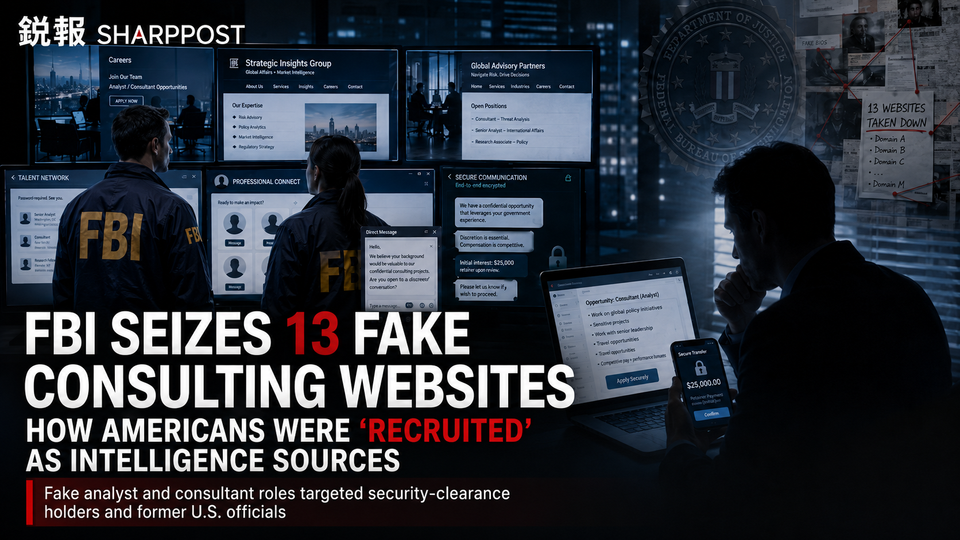
The pages advertised consulting work for analysts and international affairs specialists. The U.S. Justice Department says the companies were fake, and the FBI has seized 13 related domains.
The sites listed company names, staff-style headshots, job descriptions and contact details. The advertised work involved reports on foreign policy, security and the Indo-Pacific. According to the Justice Department, the real targets were current and former U.S. security-clearance holders, as well as people who may have had access to classified or sensitive government information.

U.S. officials allege the operators were linked to Chinese intelligence. The Chinese embassy in Washington denied the allegations. The Associated Press reported that an embassy spokesperson called the accusations "fabricated" and "malicious slander."
How the approach began
The sites had appeared by around November 2023, according to Justice Department materials. Operators allegedly used false or stolen identities and AI-generated photos to make the companies look real, then reached out through social media, job boards and freelance platforms.
The first assignment could look like ordinary consulting work. A candidate might be asked to produce a report based on open sources. Later, the questions could become narrower and closer to internal judgment, including requests for information that was not publicly available.
The 13 domains listed by the Justice Department are: centrikglobalconsulting.com, rightinfoconsult.com, finnaclevesperconsulting.com, cydfconsulting.com, pulsewaveglobal.com, catalystglobalsolutions.com, thehorizzen.com, geoindopacific.com, gpf-ina.org, safesec-group.com, thetruthinfo.com, vandercons.com and gulfpeace.org.
The value of a clearance
A security clearance on a resume tells a recruiter that the person once had access to certain systems, meetings or projects. The recruiter does not need to know the exact classified material to infer what the person may have been near.
A former official may understand procurement channels. A contractor may know the pace of a project. A think-tank analyst may have heard policy arguments before they became public. Each detail may fall short of a secret; taken together, the details can still be useful.
Job platforms enter the picture
LinkedIn, Indeed and Upwork were also named in a warning issued days earlier by the Five Eyes intelligence alliance. The U.S., Britain, Canada, Australia and New Zealand said Chinese military intelligence officers were using professional networking and freelance platforms to contact people who might hold sensitive information.
Some people who were approached later contacted the FBI. AP reported that they found the offers suspicious: payment methods seemed unusual, including cryptocurrency or less common online payment systems, and the same company names appeared repeatedly in job listings on platforms such as LinkedIn.

Not a hacking case
The materials released by the Justice Department do not describe a database breach or a computer intrusion. The contact began with job messages and consulting work. The "non-public" information sought was not necessarily classified; it could include internal judgment, process knowledge, personal networks or policy direction that would not be available from open sources.
After the seizures
Washington and Beijing have traded espionage allegations for years. A domain seizure is not a conviction. In practical terms, it prevents those addresses from being used and warns potential targets that a project that looks like foreign consulting work may not be only business.
High pay for vague work, pressure to move to encrypted apps, requests for "internal" reports, and cryptocurrency or unusual payment methods are all warning signs. The 13 domains are now offline, but U.S. law enforcement officials are treating resumes, job messages and consulting contracts as part of a wider counterintelligence front.
Source note: This article draws on U.S. Justice Department and FBI action details, AP reporting on the domain seizures, Times of India reporting on the domain list, and the recent Five Eyes warning on recruitment through job and freelance platforms. The Chinese embassy in Washington denied the allegations. The domain seizures are a law enforcement action; the article uses terms such as "allege" and "according to" where appropriate.
You read this far. You're not here for noise.
SharpPost delivers one weekly deep dive on geopolitics, finance, and tech — decoded for readers who want signal. Carefully selected, never noisy.