Taiwan Tungsten Company Chief Found Bound and Killed
A tungsten company executive was found bound and killed at his Pingtung home. Police have disclosed no national-security or foreign link.

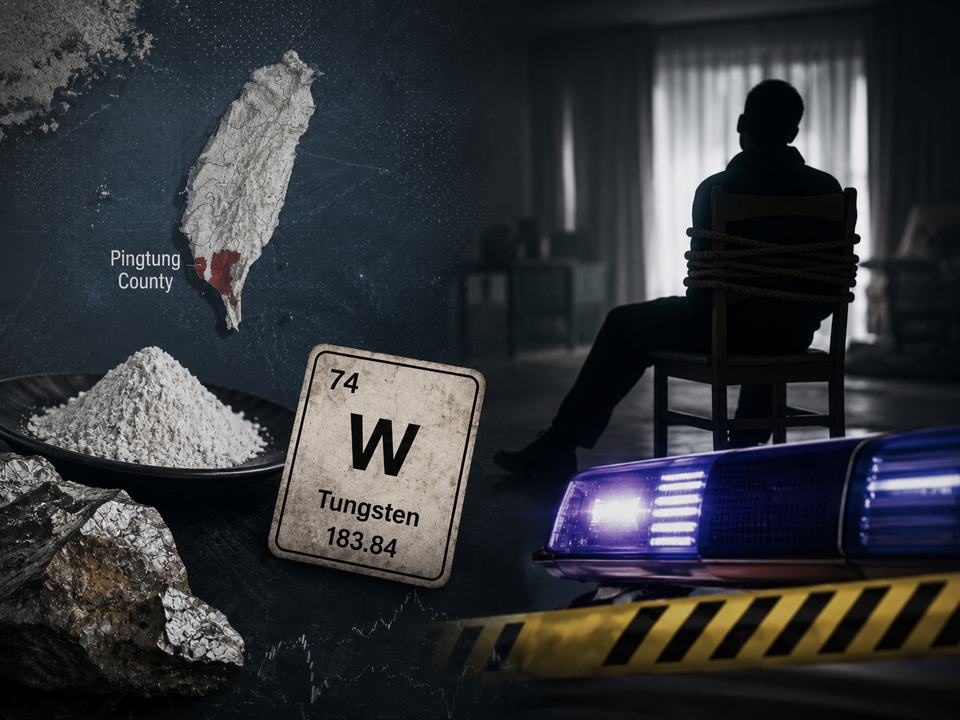
The head of a Taiwanese tungsten processor was found bound and fatally beaten at his home in southern Taiwan on July 24. The company's role in producing a key tungsten intermediate has prompted online speculation, but police have disclosed no evidence linking the killing to national security or a foreign actor.
Fangliao Precinct police said they were called to a house in Taiyuan Village, Fangliao Township, at about 6 p.m. on July 24. Officers found a man inside with no signs of life. Taiwanese media identified him as a 56-year-old surnamed Huang and the head of Jingyuan Tungsten Cobalt Resources Co.
Huang's son went to the house after repeatedly failing to reach his father. He found Huang with his hands tied and injuries to his head and chest that police believe were caused by a blunt object. A preliminary examination attributed the death to severe blood loss. A task force from the county criminal investigation unit and Fangliao Precinct is working under a prosecutor.
Several Taiwanese outlets reported that nothing appeared to have been stolen. Investigators are examining whether the attacker entered through a second-floor window and left across an awning. Police have not confirmed the route or identified a suspect. Robbery interrupted by the victim remains one of several lines of inquiry, not an established motive.
Reports also conflict over surveillance cameras at the property. United Daily News said cameras inside the home were not working and investigators were seeking footage from nearby roads. TaiSounds reported that neither the house nor the nearby roads had cameras. The police statement confirmed neither account and did not say any equipment had been deliberately disabled.

Taiwan's factory registry lists the company's Pingtung plant as active and names Huang Sheng-hsuan as the registered person in charge. Police have not publicly released the victim's full name. According to the company website, the business was founded in 2014, employs about 70 people and recovers tungsten and cobalt from scrap at the Pingnan Industrial Park.
The company says it is Taiwan's only specialist producer of ammonium paratungstate and tungsten oxide powders, with customers in Europe, the United States, Japan, South Korea and Southeast Asia. Taiwanese media, citing company material, put annual ammonium paratungstate capacity at as much as 4,000 tonnes. No independent production figures were available to verify that number.
Ammonium paratungstate, known in the industry as APT, is an intermediate used to make tungsten oxide, tungsten powder and tungsten carbide. Tungsten's hardness and high melting point make it useful in cutting tools, wear-resistant alloys, semiconductors, jet engines and ammunition. The U.S. Geological Survey includes tungsten on its critical-minerals list and assesses its supply chain as high risk.
China's commerce ministry and customs agency placed APT, tungsten oxide, tungsten carbide and some tungsten alloys under export controls on February 4, 2025. Exporters must obtain licences for covered products. Public records do not show a further measure of the same kind in June 2026. Mine supply, inventories and export licensing have all contributed to tighter tungsten markets and higher prices.
After news of the killing spread, some social-media users cited the company's products, tungsten's defence applications and China's export controls in calling for Taiwan's national-security agencies to become involved. The posts offered no evidence identifying an attacker, a financial trail or outside direction. The company's place in a strategic supply chain explains the attention surrounding the case; it does not establish a motive.
Fangliao Precinct said the investigation remained under a prosecutor's direction and declined to release further details. Police have not designated the case a national-security matter. They have also not said whether Huang had received threats or was involved in a debt or business dispute.
Investigators are examining access points, nearby video, communications, financial records and Huang's recent contacts. Forensic work will also be needed to determine whether cameras were absent, had failed or were interfered with. Until police disclose new physical evidence or make an arrest, claims involving strategic-mineral competition or foreign actors remain unsubstantiated.
Sources: Pingtung County Police, Taiwan's factory registry, Jing Yuan's website and China's Commerce Ministry. Local reports conflict over the availability of surveillance footage; police have not resolved that point publicly.
You read this far. You're not here for noise.
SharpPost delivers one weekly deep dive on geopolitics, finance, and tech — decoded for readers who want signal. Carefully selected, never noisy.