Wangwang case: Posts disappear in China as campaign spreads overseas
Posts about the abuse of stray dogs in Jieyang reportedly vanished from Chinese platforms as memorials, petitions and advertising spread overseas.

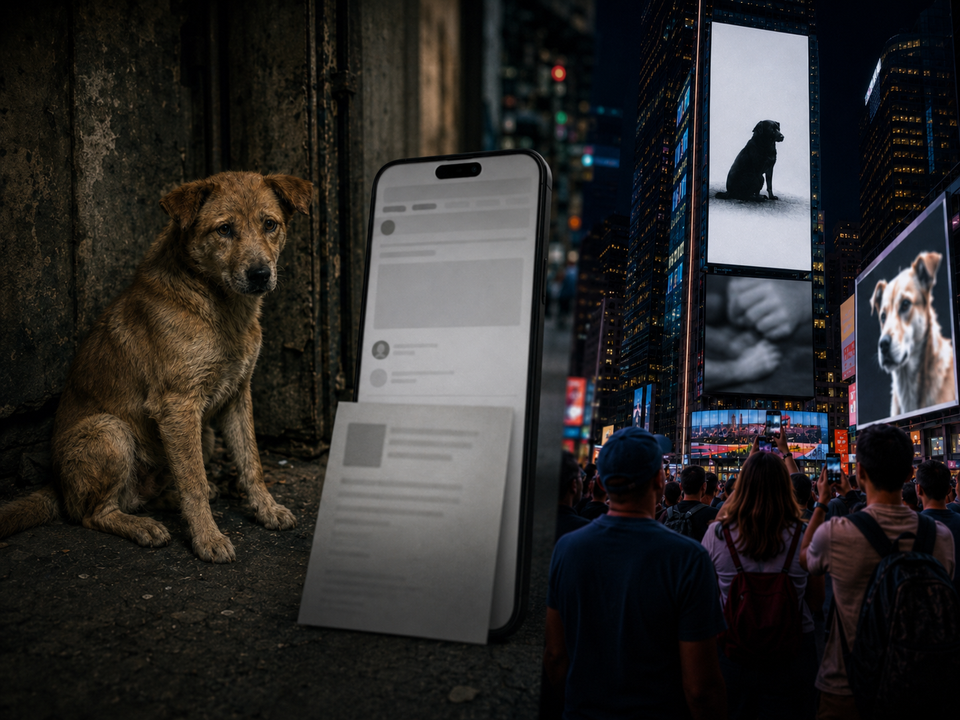
After four children under 14 were shown abusing stray dogs in Jieyang, local officials said they had been sent to a specialised school and told the public not to circulate further material. Posts by Chinese actor Du Jiang, Taiwanese actress Joe Chen and other users were later reported to have disappeared from domestic platforms, while the campaign spread overseas and reached a Times Square billboard.
The government of Xinhen, a town in Jieyang's Jiedong district in Guangdong province, said on June 30 that it had opened an investigation after the videos circulated. Parents were ordered to fulfil their guardianship duties, and all four children were sent to what the statement called a "specialised school", a form of corrective education for minors.

Jiangxi broadcaster City Live had reported that the footage showed a puppy being beaten and an adult dog being doused with oil and set alight after further abuse. Online users later named the adult dog Wangwang. The official statement did not use that name or describe what happened. Ruibao is not republishing the graphic footage.
The town's notice ended by asking internet users "not to spread related information", citing the protection of minors and opposition to online harassment. It did not define whether "related information" meant only violent footage, identifying details and threats, or whether it also covered commentary that contained none of those elements.
Du Jiang began posting on Douyin on July 5, condemning cruelty to animals and calling for stronger legislation. Reports carried by Sina on July 10 said his clips were removed at least three times and disappeared again after he reposted them. A later illustration commemorating the dogs, captioned "May there be peace in the world", was also reported to have become unavailable.
Joe Chen criticised the abuse on Weibo on July 14. Her original post subsequently became inaccessible. Sina discussion pages and user reposts can still be found, but what remains is largely screenshots, summaries and second-hand accounts.
Douyin and Weibo had not explained the handling of either actor's posts by July 26. Public pages contain no moderation records, making it impossible to establish whether each item was removed by the platform, taken down after a complaint or withdrawn by its author. The available evidence also does not show that every disappearance resulted from a single government order.
As original links failed inside China, videos, screenshots and translated accounts appeared on Threads, X, TikTok and Reddit. BBC Chinese reported that campaigners translated material into more than 10 languages. Memorial advertisements and street actions followed in Taipei, New York, Hong Kong, Macau and Japan.
A large digital screen in Times Square displayed a memorial to Wangwang roughly once every 35 minutes. "She was loved. She wanted to live. She should still be here," the message read. Supporters held signs calling for "Justice 4 Wangwang", an end to animal abuse and stronger legislation. The display and gathering were funded by supporters.

A Change.org petition seeking justice for Wangwang and a national anti-cruelty law in China had collected several thousand signatures by July 26. The UK-based Asia for Animals Coalition opened an information page on the case. Italy's International Organization for Animal Protection said it had received reports from several countries and contacted Chinese authorities.
Much of the material used overseas came from Chinese videos, screenshots and participant accounts. BBC Chinese said it could not independently verify the original footage. Asia for Animals also said some details were drawn from reports and contacts inside China.

Chinese regulations require platforms to remove graphic material, personal information about minors and online abuse. They also state that lawful reporting of suspected wrongdoing and public-interest scrutiny are not covered by the rules on cyberbullying. The violent footage, identifying details and threats fall within clear removal grounds. The actors' legislative appeals and memorial artwork did not publicly show the same material, and the platforms have not said which rules those posts breached.
The Times Square display neither identified the children nor showed the original violence. Its message concerned the dogs and legislation. The Xinhen statement, by contrast, placed the protection of minors, opposition to online harassment and the instruction not to share related information in the same notice. Posts reported missing in China included non-graphic comments and memorial images, suggesting a wider limit on discussion.
BBC Chinese quoted one participant in mainland China as saying that dozens of people in her animal-protection group received police calls or visits and were told not to "incite" or "organise". Campaigners in New York, Taipei and elsewhere continued to raise money, translate material, organise petitions and buy advertising. Ruibao could not independently verify the reported police contacts, and local police have not commented publicly.
A widely cited Harvard study of Chinese censorship found that material with the potential to prompt collective action was more likely to be suppressed than criticism alone. Later research has argued that this does not account for every moderation decision. The Wangwang campaign moved from online criticism to cross-regional petitions, fundraising and public events, but neither the Chinese authorities nor the platforms have said that such activity was the reason for removing posts.
China has separate laws covering wildlife, disease control, farming, laboratory animals and urban dog ownership. It has no national law that makes ordinary cruelty to companion animals or strays a distinct offence. An article published on the National People's Congress website previously noted that a standalone act of animal cruelty generally has no corresponding offence in China's Criminal Law. Jieyang authorities therefore relied on corrective education and parental supervision rather than an anti-cruelty charge.
Xinhen has announced what happened to the four children. Douyin, Weibo and the local authorities have yet to explain why non-graphic commentary became unavailable or to respond to accounts that police contacted animal-protection campaigners.
Sources: the June 30 Xinhen government statement and City Live report; Sina pages on the reported removal of Du Jiang's videos and the disappearance of Joe Chen's post; the BBC report on the campaign in China and overseas; statements from Asia for Animals and the International Organization for Animal Protection; the Change.org petition; research on Chinese censorship and collective action and its subsequent reassessment; and China's rules on minors, online abuse and Weibo content. Platforms have not released moderation records, and any assessment of their motives must be kept separate from the confirmed disappearance of posts.
You read this far. You're not here for noise.
SharpPost delivers one weekly deep dive on geopolitics, finance, and tech — decoded for readers who want signal. Carefully selected, never noisy.