Wuhan residents protest hazardous-waste centre planned as close as 27 metres from homes
Residents in Wuhan have protested a planned hazardous-waste risk-control centre near apartment compounds, saying the project sits as close as 27 metres from homes and has not been adequately explained.
免费微软自然语音 · 推荐使用 Microsoft Edge
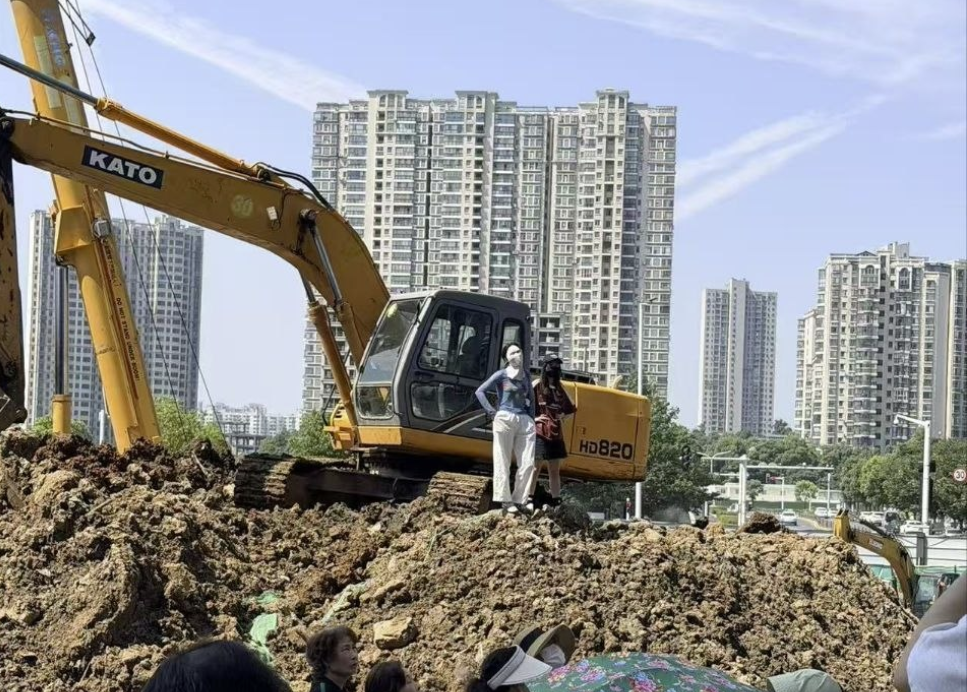
A hazardous-waste environmental risk-control centre planned in Wuhan's central Wuchang district has drawn protests from nearby residents, who say the project is too close to apartment blocks and was not adequately explained before construction moved ahead.
The protests took place around June 12 near the construction site on Gongzheng Road and outside the Hubei Academy of Ecological and Environmental Sciences. Residents from several nearby compounds went to the site to object; police later arrived to maintain order.
Videos circulating on social media show residents filming at the scene and scuffles involving security or other personnel. Claims that several people were taken away spread online. Ruibao has not independently verified the full sequence of the videos.
As of publication, Wuhan and Hubei authorities had not issued a detailed public statement on the protest. Earlier replies on government service platforms said the project had obtained the required approvals and that emissions would meet standards after treatment.


The project is formally named the Central China Hazardous Waste Environmental Risk Prevention and Control Technology Centre. Public documents and excerpts of the environmental assessment provided by residents place it near No. 28 Gongzheng Road in Wuchang. The builder is the Hubei Academy of Ecological and Environmental Sciences.
What the project would do
The centre is not a hazardous-waste landfill or incinerator. Public documents describe it as a laboratory and technical platform.
The planned functions include hazardous-waste identification labs, toxicology labs, sample storage and screening for emerging pollutants. The project covers about 17,200 square metres and is expected to process around 30,000 batches of hazardous-waste samples a year.
A tender screenshot gives the outline of the building: eight floors above ground and one basement level, with about 13,059.50 square metres counted as floor area, another 3,952.53 square metres underground and 83 parking spaces. The same screenshot lists a project contract estimate of 221.07 million yuan and a planned tender date of September 2025; a table above gives a construction-installation estimate of 108.68 million yuan and a 550-day schedule. The figures appear to use different accounting scopes and should be checked against the original tender notice.

The environmental-assessment excerpts list tests involving corrosivity, leaching toxicity, flammable substances and emerging pollutants. Residents also say the building includes a radiation analysis room.
The exhaust-gas section lists pollutants including toluene, methanol, dichloromethane, hydrogen chloride and nitrogen oxides, and says emissions should meet standards after treatment.
Another screenshot shows an "annual air-pollutant emissions" table. Non-methane hydrocarbons, methanol, dichloromethane, hydrogen chloride, sulphuric acid mist and nitric acid mist are measured in tonnes per year. The figures do not by themselves show a breach of standards, but they help explain why residents are asking for a clearer account of the risks.


Only 27 metres away
According to materials shared by residents, the shortest distance between the project and Sunac Center Wuhan One Courtyard Phase II is about 27 metres. Within 500 metres are more than a dozen residential compounds, along with public facilities including the Hubei Provincial Library. Gongzheng Road sits in a densely built part of central Wuchang.
A 500-metre environmental-protection-target map underlines that proximity. It lists the Hubei Provincial Library, Shahu No. 9, Shahu Apartments, Sunac One Courtyard's north and south sections, and Sunac Center Wuhan One Courtyard Phase II. The north and south sections of Sunac One Courtyard are marked at 45 and 42 metres from the project boundary; Sunac Center Wuhan One Courtyard Phase II is marked at 27 metres.

Beyond the distance itself, residents are asking how samples would enter and leave the site, how exhaust gas and wastewater would be handled, and what evacuation plans would apply in the event of a leak, fire or explosion.
Some residents have also compared the Wuhan site with other regional hazardous-waste risk-control centres, questioning why the Central China centre is being placed in a central urban area.
Public records show the project received construction-land planning permission in 2025. Resident materials say it also completed an environmental impact assessment.
Several homeowners trace the dispute back to how and when they learned what was being built. They say early notices did not give enough prominence to the "hazardous waste" nature of the project, and that some owners only understood the details months after construction had begun.
In residents' lists of questions, the social-stability risk assessment is singled out. Publicly available materials do not make clear whether such an assessment was carried out, or how residents' views were considered.
A response that stops at "procedures were compliant" is unlikely to end the dispute.
Source note: This article is based on public planning and environmental-assessment materials, previous responses on government service platforms, documents provided by residents, ecological-environment planning information, and videos and images circulated on social media around June 12. The details of the on-site clashes, the number of people taken away and some individual scenes have not been fully clarified by officials; Ruibao has used cautious wording where verification is incomplete.
You read this far. You're not here for noise.
SharpPost delivers one weekly deep dive on geopolitics, finance, and tech — decoded for readers who want signal. Carefully selected, never noisy.