Indo-Pacific Priority Idling: Three Carriers in CENTCOM, $14B Taiwan Deal Frozen
The January 2026 National Defense Strategy opens with denial defense along the First Island Chain. Yet all three deployable US carriers sit on the Europe-Middle East axis, PDI is cut 32%, and a $14B Taiwan arms package remains unsigned.

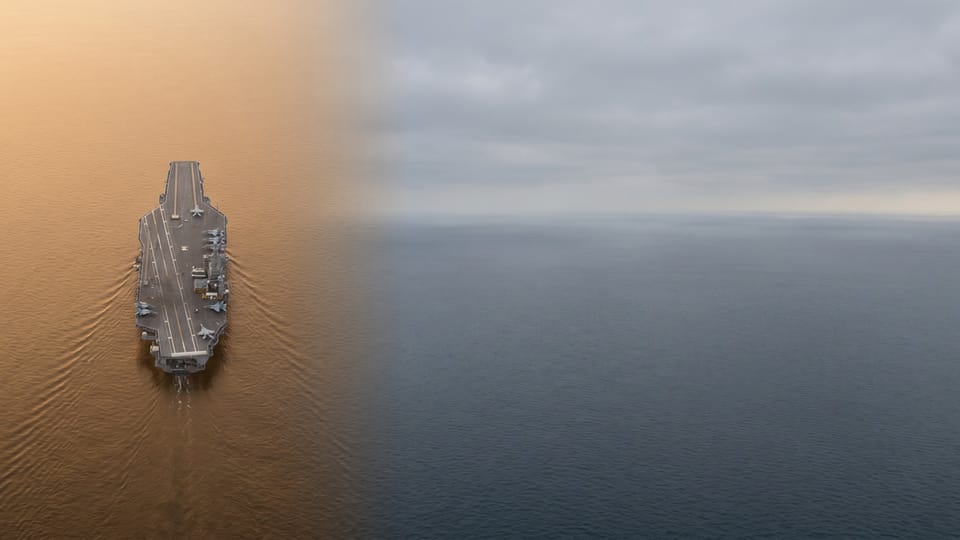
The Pentagon put First Island Chain denial defense in the first paragraph of the new National Defense Strategy, yet all three deployable US carriers now sit along the Europe-Middle East axis and a $14 billion Taiwan arms package remains unsigned. Doctrine and deployment are not on the same page. A Middle East ceasefire, even if it holds, will not move resources west on its own — three constraints pull in the opposite direction at once: industry, politics, and alliance confidence.
Key Judgments
NDS text diverges from actual deployment: Bush, Lincoln and Ford are concentrated on the Europe-Middle East axis; zero deployable carriers sit in INDOPACOM; Vinson is in San Diego maintenance and Reagan is in Puget Sound on a 17-month overhaul through year-end.
Industrial hard constraint: Tomahawk inventory runs roughly 3,000 missiles; Operation Epic Fury has fired at least 850 since 28 February. Even with the February 2026 seven-year expansion deal (1,000 units/year target), the true restock window slides to H2 2027 – H1 2029.
PDI budget rollback: The FY26 request drops to $10.0B from the $14.71B FY24 congressional authorization — a near one-third cut; the March GAO report flags the line item for "significant visibility shortfalls."
Strategy on Paper, Deployment in the Gulf
The 23 January 2026 National Defense Strategy commits in its first paragraph to "build, posture, and sustain a strong denial defense along the First Island Chain." White House and Pentagon language is aligned. The doctrine reads full. Three months later, the actual deployment board tells another story: Lincoln on station in the Arabian Sea, Bush transiting around Africa to the Gulf since 13 April, Ford at readiness in the Eastern Mediterranean. Vinson is in San Diego maintenance; Reagan is mid-overhaul at Puget Sound through late 2026; Washington, though forward-deployed at Yokosuka, is not in an immediate combat-ready state. INDOPACOM has zero carriers available to surge. "Indo-Pacific priority" is the first line of the NDS and the last line legible on the April 2026 deployment board.
Budgets translate strategic intent more honestly than speeches. The FY26 Pacific Deterrence Initiative (PDI) request falls to $10.0 billion from the $14.71 billion FY24 congressional authorization — a cut of nearly one-third. The Government Accountability Office's March report calls the line item's disclosure "significantly lacking in visibility." Numbers do not lie. The gap between text and numbers lands on two coordinates: a 32% PDI rollback and zero deployable Asia-Pacific carriers.
| Carrier | Hull | Status | Theater |
|---|---|---|---|
| USS Lincoln | CVN-72 | Combat deployed | Arabian Sea (CENTCOM) |
| USS Bush | CVN-77 | Reinforcement via Africa | En route Persian Gulf (CENTCOM) |
| USS Ford | CVN-78 | Ready posture | Eastern Mediterranean (EUCOM) |
| USS Vinson | CVN-70 | Maintenance | San Diego |
| USS Reagan | CVN-76 | 17-month overhaul through year-end | Puget Sound |
| USS Washington | CVN-73 | Forward-deployed, not combat-ready | Yokosuka (INDOPACOM) |
One Munitions Pool, Two Theaters
CSIS estimates the US Tomahawk stockpile at roughly 3,000 missiles, with 2025 deliveries of about 100. Operation Epic Fury, the US campaign against Iran that began 28 February, has expended at least 850 Tomahawks — close to a third of inventory. The ledger lies open. The 4 February 2026 seven-year contract between Raytheon and the Pentagon raises the annual output target to 1,000 units, but the typical ramp runs 18 to 24 months, pushing the genuine restock window to H2 2027 – H1 2029.
The PLA's 2027 capability node for a potential Taiwan contingency is written into the Pentagon's own December 2025 China Military Power Report, which describes progress as "steady." The two clocks are out of phase. The munitions restock curve cannot keep pace with the Taiwan Strait countdown — production ramp on one side, capability milestone on the other, both intersecting the same 2027 calendar.
The interceptor ledger is tighter. The Guardian reported that Army Patriot interceptor supplies stand at roughly 25% of Pentagon war-planning required levels; the Army's FY26 budget lifts the PAC-3 MSE procurement target from 3,376 to 13,773 units — nearly four times. THAAD consumed close to 150 interceptors during the June 2025 "12-Day War" with Iran, roughly a quarter of the total US stockpile, as the Wall Street Journal and The War Zone jointly disclosed in July 2025 (SharpPost's "US–Iran 14-Day Ceasefire Game Matrix" provides the full scenario tree). The Washington Post reported on 10 March that US forces have begun transferring THAAD components and PAC-3 batteries from Seongju in South Korea to the Middle East. Expansion contracts can be signed; production curves do not lie. Inside one munitions pool, every THAAD that lands in the Middle East is one less guarding the First Island Chain.
| Munition | Current status | Demand / target | Restock window |
|---|---|---|---|
| Tomahawk cruise missile | ~3,000 stock; ≥850 expended on Iran | 100/yr → 1,000/yr target | H2 2027 – H1 2029 |
| PAC-3 MSE interceptor | Patriot stock at ~25% of required | FY26 buy 3,376 → 13,773 (×4) | Post-2028 |
| THAAD interceptor | ~150 expended in 12-Day War (~25%) | All 6 Seongju launchers moved to Middle East | Undisclosed |
| NASAMS air defense | Part of Taiwan $14B package | Arms package frozen, unsigned | Policy-contingent |
Taiwan Arms Frozen on the Eve of the Beijing Visit
The roughly $14 billion Taiwan arms package — PAC-3 MSE interceptors and NASAMS air defense systems — was frozen ahead of President Trump's 31 March to 2 April Beijing visit and remains unsigned. Sixty-six F-16V fighters are scheduled to begin staggered delivery only in September. In parallel, the Pentagon pushed three carriers to the Gulf, pulled THAAD from Seoul, and moved the Tripoli Amphibious Ready Group out of Sasebo. Two movements run in lockstep. If the NDS is the Pentagon's strategic voice, this deployment pattern is the White House's operational voice — and they are reading from different scripts.
Proponents of the "leverage" theory argue the freeze is a negotiating tool, an extension of the NDS rather than a departure from it. That argument rests on the assumption that the Taiwan defense window is elastic against Beijing concessions. Time does not negotiate. The September F-16V delivery, the suspension of the $14B package, and the 2027 capability node form a fixed calendar — not a mortgageable chip. By that measure, what the leverage and denial camps burn through alike is Taipei's reaction time.
Tokyo and Manila Do Their Own Math
The Tripoli ARG is the US Navy's sole forward-deployed amphibious ready group in Japan; it left Sasebo on 13 March for the Arabian Sea, carrying the 31st Marine Expeditionary Unit's roughly 2,200 Marines. The US-Japan Joint Force Headquarters (JFHQ) upgrade continues on paper. Doctrine pushes east; hulls sail west. The Council on Foreign Relations in an April commentary argued the White House "is abandoning its Indo-Pacific partners," and Chatham House has gone further, recommending Japan, the Philippines and South Korea thicken lateral ties among themselves — advice that edges into instructing allies to self-insure.
Japan's defense budget reached 2% of GDP in March 2026 (SharpPost's "Japan 2026 Bluebook: China Downgrade" traces the same pivot from the diplomatic side); the Philippines added more than 10% year-over-year in the same window. AUKUS Pillar One remains on track; Pillar Two's progress is judged "under pressure" by IISS, owing to an ITAR exemption list deemed too broad. Verbal commitments have lost their reference value. What Tokyo and Manila read is not the statement — it is the direction Tripoli sailed. Allies are not completing integration with Washington; they are completing a second repricing of dependence, and once that curve bends down it does not easily bend back.
| Ally | Defense-budget action | Lateral / hedging signal |
|---|---|---|
| Japan | Reached 2% of GDP in March 2026 (originally planned for 2027) | JFHQ upgrade continues; Tripoli ARG departs |
| Philippines | +10% year-over-year | Chatham House urges Japan–Philippines–Korea lateral ties |
| South Korea | Seongju THAAD munitions transferred out | Nuclear discussion gaining traction |
| Australia | AUKUS Pillar One on track | Pillar Two "under pressure" (IISS) |
What Cannot Be Known, What Can (Closing)
Three indicators can calibrate this article's judgment over the next six months. First, whether Bush returns to Western Pacific rotation within 90 days of the ceasefire's renewal. Second, whether the $14 billion Taiwan arms package is signed within 45 days of Trump's Beijing visit. Third, whether the House FY27 National Defense Authorization version lifts PDI above $14 billion. What cannot be known is the outcome of those three tracks. What can be known is today's coordinates. The first round of ceasefire renewal talks broke down on 12 April; the ceasefire itself is not yet settled. If an actual pivot to Asia is underway, it will not appear in a Trump tweet — it will appear on Subic's warehouse shelves, in RTX's production ramp charts, and in the margin notes of House appropriations drafts. The strategic documents are on paper; the resources are in the Gulf.
You read this far. You're not here for noise.
SharpPost delivers one weekly deep dive on geopolitics, finance, and tech — decoded for readers who want signal. Carefully selected, never noisy.