Inside PURSUE: The U.S. UAP Archive Opens with 162 Files
The U.S. Department of War's PURSUE platform released 162 declassified UAP files on May 8, 2026 — Apollo lunar photos, FBI 62-HQ-83894, WWII foo-fighter cables, contemporary sensor footage.

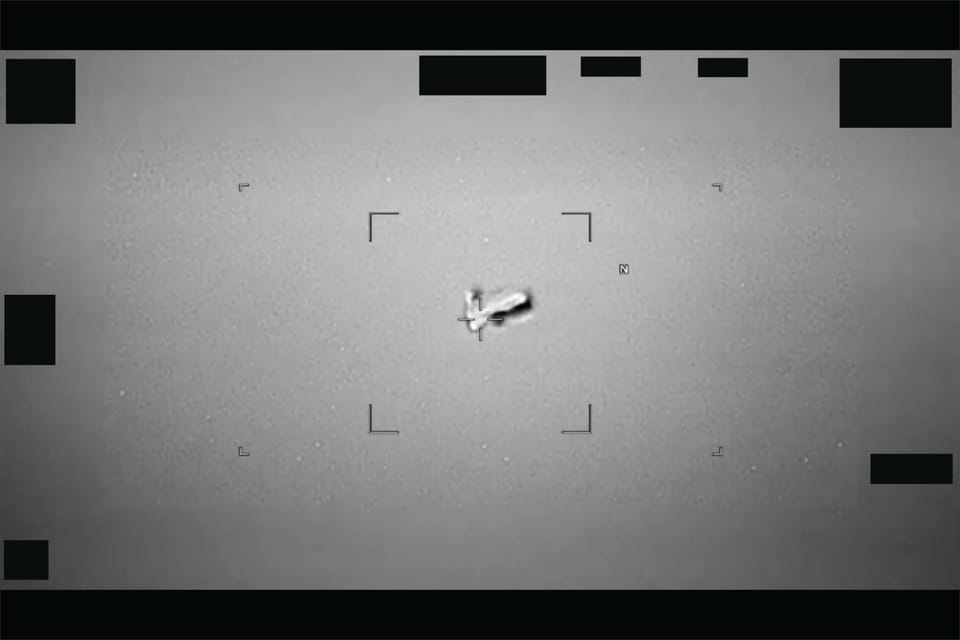
On May 8, 2026, the U.S. Department of War released its first batch of 162 declassified files concerning Unidentified Anomalous Phenomena (UAP) through a newly launched portal called PURSUE. The documents span more than eight decades. They include Allied pilot sightings of so-called "foo fighters" over wartime Germany; the complete FBI case file on flying-disc investigations covering 1947 to 1968; transcripts and audio from the Gemini and Apollo crewed-spaceflight programs; lunar-surface photographs taken during Apollo 12 and Apollo 17; and infrared sensor footage captured by U.S. military platforms in the Middle East between 2020 and 2025. Every record carries the same designation: unresolved. None requires a security clearance to view. All sit, freely accessible, at war.gov/UFO — and for archivists, scientists, and the curious public, this is a primary-source dataset of considerable depth.
An Anatomy of the First Batch
The provenance breakdown is straightforward. Of the 162 documents, the Department of War contributed 82, the Federal Bureau of Investigation 56, NASA 12, and the Department of State 8; four files are unattributed. The collection is best understood as three temporal strata, each carrying a distinct documentary character.
| Source | Files | Era | Document Type |
|---|---|---|---|
| Department of War | 82 | 1944–2023 | SHAEF cables, MISREPs, Range Fouler reports |
| FBI | 56 | 1947–2025 | Investigative case file 62-HQ-83894; modern still imagery |
| NASA | 12 | 1965–1999 | Mission transcripts, lunar imagery, COMETA report |
| State Department | 8 | 1963– | Diplomatic memoranda, NASC correspondence |
| Unattributed | 4 | — | — |
Source: war.gov/UFO record metadata, parsed May 8, 2026.
Stratum I: Wartime and Early Postwar (1944–1948)
The earliest layer reaches back to the closing months of the Second World War. Between November 1944 and the first months of 1945, the U.S. Army Air Forces' 415th Night Fighter Squadron, operating over the European theater, repeatedly reported anomalous nocturnal phenomena above German airspace — flickering lights, cylindrical objects, and what pilots described as "flak rockets" with no visible source. These were the original "foo fighters." The Release 01 archive contains the corresponding SHAEF cables and memoranda in their original form, alongside a numeric file (331_120752_Numeric_Files_1944–1945) covering captured German armament-equipment documents that may bear on the question.
Following the wartime material is internal correspondence from the Air Materiel Command dated 1946 to 1948. The documents establish that flying-disc sightings had, by the immediate postwar period, been formally elevated to a matter requiring institutional response — well before the canonical 1947 Roswell event entered public consciousness.
Stratum II: The Crewed-Spaceflight Era (1965–1972)
The second stratum is the most likely to interest historians of spaceflight. It contains three primary records.
Gemini VII (December 1965). The release includes both the original technical transcript (255_t_763_r1b_transcripts) and a reel-tape audio excerpt (255-t-763-r1b-excerpt) of air-to-ground communications during the Gemini VII mission. In the excerpt, astronaut Frank Borman reports a sighting of what he refers to in radio shorthand as a "bogey." The recording carries NASA Public Affairs commentary, identification of the recording number, and handwritten annotations indicating which mission audio appears on the accompanying tape.
Apollo 12 (November 1969). The file NASA-UAP-D1 is an excerpt of the Apollo 12 Technical Air-to-Ground Voice Transcription, isolating two periods in which crew members report observing unidentified phenomena — a roughly one-hour segment on the fifth mission day, and a two-minute exchange on the sixth.
Apollo 17 (December 1972). The file NASA-UAP-D2 covers three observation periods on the final crewed lunar mission. The transcript is the most detailed of the set. An operator describes "a few very bright particles or fragments or something" drifting past the spacecraft during maneuvers, characterizing them as "very jagged, angular fragments that are tumbling" and noting a "Fourth of July light show" at one point. The accompanying lunar-surface photographs from Apollo 12 and Apollo 17 — which appear in Release 01 as the visually striking centerpieces of the batch — show three anomalous points of light above the lunar horizon. This is the first time the U.S. government has formally published these images.
Whether the points represent optical artifacts, lens flare, orbital debris, particles of insulation shed by the spacecraft, or something less easily catalogued, the government offered no interpretation. That, by design, is the public's problem.
Also released through NASA: the COMETA report. Originally published in 1999 by France's Institut des Hautes Études de Défense Nationale, the study examines UFO phenomena from a national-security perspective and contains correspondence referencing Wernher von Braun. Its appearance in PURSUE indicates that the platform's collection scope reaches beyond U.S. domestic agencies — a meaningful detail for researchers attempting to map the international flow of UAP-related material.
Stratum III: Contemporary Sensor Reporting (2020–2025)
The third stratum consists of standardized military reporting submitted to the All-domain Anomaly Resolution Office. The principal categories:
Mission Reports (MISREPs). The file DOW-UAP-D4 documents an Arabian Gulf incident in 2020. MISREPs are the U.S. military's standard format for recording the circumstances of a tactical operation; the GENTEXT — "general text" — sections often contain narrative descriptions of UAP-related observations.
Range Fouler Reports. Files including DOW-UAP-D42 (Japan, August 2023) and DOW-UAP-D44 (Gulf of Aden, October 2020) cover unauthorized intrusions into controlled airspace during active military operations or training. These are U.S. Navy reporting forms and contain firsthand observer narratives.
Unresolved UAP Reports (PR series). A sequence of files from DOW-UAP-PR40 onward catalogue submissions from U.S. Central Command consisting primarily of infrared-sensor video clips — typically a minute or two in length — captured from sensors aboard U.S. military aircraft.
FBI Imagery. Two image series appear: an A series with date and location withheld, and a B series (B9, B20–B23) captured from U.S. military systems in late 2025 over the western United States. Original imagery was redacted before submission to AARO.
Per the war.gov statement, redactions in this release are confined to witness identities, government-facility locations, and military-sensitive information unrelated to UAP itself. The phenomenological content — the descriptions, the photographs, the audio — has not been altered.
The FBI Case File: 62-HQ-83894
The most substantive single item in the release is the FBI's complete dossier numbered 62-HQ-83894. The case file comprises 18 sections covering June 1947 through July 1968, the entire span of the early-modern UFO era as defined by Bureau records. It contains investigative records, eyewitness statements, and public reports concerning unidentified flying objects and "flying discs" — including high-profile incident accounts, photographic evidence from sites such as the Oak Ridge nuclear facility in Tennessee, technical proposals concerning potential propulsion systems, convention programs, researcher correspondence, and extensive period media coverage.
A partial version of this file had previously circulated on the FBI Vault — the Bureau's online reading room — but with substantially heavier redactions and a number of missing pages. The version now public is materially more complete, with newly declassified pages and only minimal redaction. For historians of postwar U.S. intelligence, the file represents one of the more significant document releases of recent years, independent of any conclusions one draws about the phenomena it describes.
The PURSUE Architecture
PURSUE — the Presidential Unsealing and Reporting System for UAP Encounters — is best understood as an information-architecture experiment. It departs from earlier UAP disclosure mechanisms in three structural respects, each of which carries practical consequences for how researchers will use the platform.
Rolling release. The Department of War has stated that subsequent batches will be posted at intervals of "every few weeks" as records are found, reviewed, and declassified. The underlying corpus, per the official notice, encompasses dozens of agencies and "tens of millions of records, many existing only on paper, spanning many decades." The technical implication is significant: PURSUE is not a one-time data dump but a long-running publication pipeline. Researchers can expect new tranches — and should plan for ongoing parsing and reconciliation against earlier releases.
Open access without clearance. The platform makes every released document available through a public web portal with no security-clearance requirement. The download links are direct (PDFs hosted under /medialink/ufo/release_1/), the metadata is published as a CSV, and the records are addressable via deep-linked hash fragments — features that enable straightforward programmatic access for academic researchers building analysis pipelines.
Open invitation to private-sector analysis. The PURSUE landing page explicitly welcomes "private-sector analysis, information and expertise." This represents a meaningful shift in the institutional posture toward the UAP file. The government is positioning itself as a publisher of primary sources rather than an arbiter of conclusions — a stance familiar from declassification programs such as the CIA's CREST collection, but one not previously applied at scale to UAP material.
| Dimension | AARO (2022—) | PURSUE (2026—) |
|---|---|---|
| Output Form | Annual report to Congress | Rolling public release |
| File Designation | Resolved / unresolved | Unresolved cases only |
| Audience | Congressional briefings (largely classified) | Public (no clearance required) |
| Analytical Subject | Government-internal | Private-sector explicitly invited |
| Active Caseload | 2,000+ (as of early 2026) | 162 published; full corpus undefined |
Sources: war.gov/UFO statement, AARO.mil, FY2024 UAP Annual Report.
What the Archive Enables
For working researchers, the practical value of Release 01 is less about whether any individual document "proves" anything and more about the depth of primary-source material it places in the open. A non-exhaustive list of analyses now technically feasible:
Cross-era comparison of observer language. The archive contains firsthand observer accounts spanning from 1944 SHAEF cables to 2025 FBI imagery memos. Computational comparison of descriptive vocabulary across eras — the persistence of certain shape descriptors, the evolution of military terminology — becomes possible at a corpus scale not previously available outside government walls.
Photogrammetric and spectral analysis of Apollo imagery. The lunar-surface photographs from Apollo 12 and Apollo 17 are now available in their PURSUE-published forms. Sun-angle reconstruction, comparative analysis with adjacent frames in the original NASA mission archives, and lens-flare modeling are all amenable to civilian analysis. The same applies to the FBI 1999 imagery referenced in modern still files.
Provenance reconstruction of the FBI 62-HQ-83894 file. Comparison of the now-released complete file against the previously published FBI Vault version permits reconstruction of which redactions were dropped and which remain — a meaningful exercise for researchers studying postwar intelligence-disclosure patterns.
Sensor-platform metadata cross-referencing. The contemporary military reports use standardized formats (MISREP, Range Fouler) that, even with redactions, contain enough structured metadata for researchers to attempt cross-referencing against publicly known military exercise schedules and sensor-platform deployments in the Arabian Gulf and Western Pacific theaters.
None of this requires accepting a particular interpretation of what the underlying phenomena are. It requires only that the source material be public — which, as of May 8, it is.
An Open Question, Made Open
The 162 documents do not resolve the question of what these phenomena are. The government's own designation — unresolved — explicitly says they cannot. What the release does change is the scientific and historical workflow around the question. Material that was previously available only through Freedom of Information Act requests, congressional hearings, or partial leaks is now indexed, downloadable, and addressable by stable identifiers. Subsequent PURSUE batches, the Department of War notes, will follow at multi-week intervals.
For the small community of researchers who have spent decades attempting to study these phenomena under archival constraints that ranged from inconvenient to absurd, this is a non-trivial change of conditions. Whether the eventual analyses confirm prosaic explanations, illuminate genuine sensor or atmospheric anomalies, or find something else entirely is the work of years, not weeks. But the work, for the first time in the history of the question, can begin from a shared set of public documents.
You read this far. You're not here for noise.
SharpPost delivers one weekly deep dive on geopolitics, finance, and tech — decoded for readers who want signal. Carefully selected, never noisy.