UAE Leaves OPEC May 1: Saudi Stands Alone, Oil Pricing Power Resets
The UAE will leave OPEC and OPEC+ on May 1 after 59 years, ending the dual-pillar quota mechanism with Saudi Arabia. Brent rose 3 percent on April 28 to $111. Saudi alone now bears the cost of cuts; UAE expansion runs unconstrained.

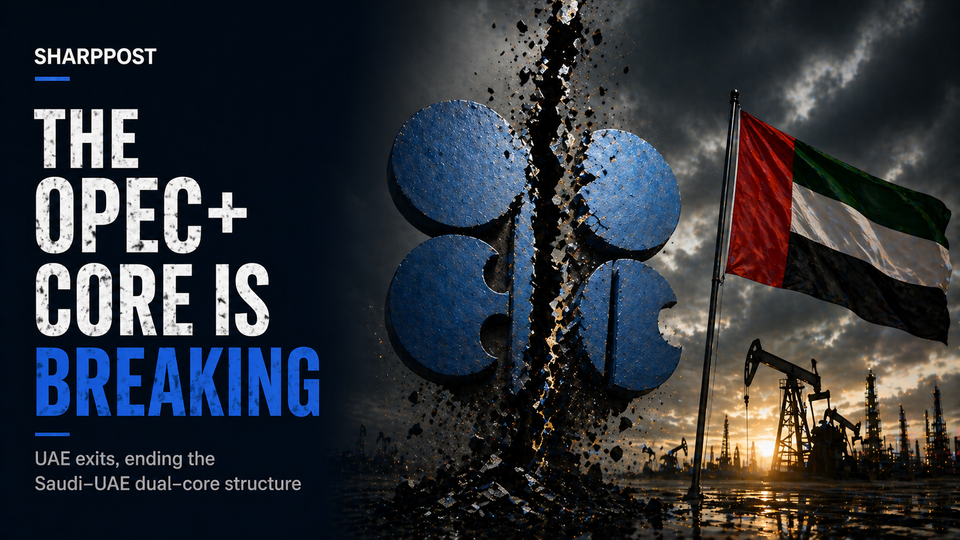
Effective May 1, 2026 — the heaviest exit in OPEC history
On the afternoon of April 28, the UAE government released a statement through state news agency WAM: the UAE will leave OPEC and OPEC+ on May 1, ending 59 years of membership. Energy Minister Suhail Al Mazrouei told CNBC the same evening that this was "purely a policy adjustment." The market read it differently. Brent rose 3 percent that day to settle at $111.26, touching $115 intraday; WTI broke through the $100 threshold. The oil cartel just lost one of its two engines.
What actually happened on April 28?
OPEC, founded in 1960, is the Organization of the Petroleum Exporting Countries — currently 12 members. Saudi Arabia is the largest; the UAE is the third-largest. In 2016, OPEC was extended to OPEC+ to bring in Russia, Kazakhstan, and eight other non-members to coordinate production quotas. The goal has always been one thing: keep oil prices at a level that lets producing nations balance their budgets.
The UAE's exit is unusual on two counts. First, it is total. The UAE leaves OPEC and OPEC+ at the same time, with effect on May 1, no transition period. Second, it is voluntary in an entirely new way. The previous four exits — Indonesia (2009), Qatar (2019), Ecuador (2020), Angola (2024) — all involved producers whose capacity could no longer match their quota, so they walked away. The UAE walks the opposite direction. Its capacity has grown so large that the OPEC quota cannot contain it.
Mazrouei told CNBC the UAE holds "the highest respect for Saudi leadership of OPEC, with no relation to any brother or friend." But he did not tell the full story. Since 2018, the UAE has been publicly committed to raising daily production capacity from 4 mbpd to 5 mbpd; in 2024, it pulled the target forward to 2027. The OPEC quota has constrained that plan. Saudi Arabia conceded in 2023 by raising the UAE's quota from 3.019 to 3.219 mbpd, but that still wasn't enough. The UAE decided it could no longer wait.
What does this actually mean?
To grasp the weight of this exit, it helps to understand how OPEC actually controls oil prices. OPEC does not control prices through political agreements — it controls them through "spare capacity," the production it can switch on or off. When prices fall, the cartel cuts to support them; when prices rise, it releases barrels to stabilize them. OPEC+'s combined spare capacity totals about 5.3 mbpd — Saudi Arabia 3.1, the UAE 1.1, Iraq 0.6, Kuwait 0.4. Saudi Arabia and the UAE together hold 79 percent of it. The two countries have always carried the discipline burden together: Saudi takes the larger share, the UAE follows.
The moment the UAE leaves, Saudi Arabia carries it alone. The catch is the gap in fiscal foundations. The IMF estimates Saudi Arabia needs an oil price near $96 per barrel to balance its budget. The UAE only needs about $50 — almost half. Cutting the same 1 mbpd costs Saudi Arabia far more than it costs the UAE. The shared-discipline mechanism that ran for years simply no longer functions.
Saudi Arabia now has only two options. Bear the cuts alone and defend the price at $75–85, accepting larger fiscal deficits and gradual loss of market share to Russia and the UAE. Or abandon quota discipline and chase market share, pushing prices to $55–65 and squeezing American shale out of the market. Neither path is easy. Which one Saudi Arabia chooses cannot be predicted with confidence.
| Country | Apr 2026 target | Spare capacity | Fiscal breakeven |
|---|---|---|---|
| Saudi Arabia | 10.17 | 3.10 | $96 |
| UAE | 3.43 | 1.10 | $50 |
| Iraq | 4.30 | 0.60 | — |
| Russia | 9.64 | — | — |
| Kuwait | 2.60 | 0.40 | — |
| OPEC+ total | ~42 | 5.30 | — |
Where is the oil price headed?
The short-term reaction is already in. Brent rose 3 percent on April 28, mostly on expectations: the UAE could add 1.8 mbpd to global supply within 18 to 30 months — about 1.8 percent of global demand as pure new supply. Capacity expansion takes time, however, so the immediate physical shock is bounded. The market's more direct response shows up in the futures curve, where Brent's 12-month spread compressed from a slight backwardation toward flat. The curve moved first.
The medium term forks in two. If Saudi Arabia bears the cuts alone, Brent could hold a $75–85 center. If Saudi Arabia abandons price defense and chases market share instead, the 2027 surplus could reach 1.5–2.0 mbpd, pulling Brent down to $55–65. The latter is the 2014–2015 playbook — that round saw Gulf budgets squeezed but also wiped out a generation of high-cost American shale operators.
Which path is more likely? Three things will tell. Whether Iraq and Kuwait follow the UAE in overproducing (Iraq's compliance has long sat at 75–85 percent). Whether Saudi Arabia can absorb the fiscal pressure of unilateral cuts. Whether Russia can still be constrained by Saudi pressure. Any one of the three slipping pulls OPEC's monthly production decisions from cartel-binding into something closer to a coordination forum without enforcement.
The investment-bank view has begun to shift. Goldman Sachs raised its Q4 2026 Brent forecast from $80 to $90 on April 27 — its fourth upgrade this year. JPMorgan warned that medium-term oil will run below earlier expectations, without specifying a magnitude. The IEA's April report did something unusual: it revised 2026 global oil demand from a 730 kb/d expansion to an 80 kb/d contraction — a one-month reversal second only to the COVID period.
What does this mean for investors?
If the price center settles in the $60–70 range, three asset categories feel it most directly.
U.S. energy equities. The past three years of OPEC discipline have buoyed valuations. ExxonMobil and Chevron are both up over 20 percent year-to-date; the energy ETF (XLE) is up 33 percent. These valuations price in a continuing OPEC cartel. If Brent's center moves down, expect a 15–20 percent pullback — pressure but not collapse. Permian shale breakeven is near $45, Bakken near $55; both still profitable, but capex growth slows.
The Asian import side. China imported 11.6 mbpd of crude in 2025, the largest flow in the world. If 2026 averages run $15 below 2025, China saves roughly $62 billion in foreign-exchange annually — back-of-envelope: $15 × 11.3 mbpd × 365 days. Chinese A-share energy stocks (PetroChina, CNOOC, Sinopec) face simultaneous earnings downgrades. The CSI Energy Index trades at a 4.5–5.5 percent dividend yield and 1.1× book — cheaper than U.S. peers in a price-down scenario, provided China keeps its high-payout policy.
Rates and gold. Each $10 fall in Brent shaves 0.2–0.4 percentage points off global headline inflation. The Fed has more cutting room in 2026; the ECB has more still; both are supportive for gold and Treasuries. The Bank of Japan faces the opposite problem — Japan's import-cost relief reduces imported inflation and undercuts the case for hiking.
The renminbi-settlement variable that's underweighted
The UAE is China's seventh-largest crude source, about 7 percent of imports; China is the UAE's single largest buyer. The settlement-currency question is what matters. Renminbi accounted for under 5 percent of global oil-payment volume in 2025. The UAE central bank, however, joined China-led mBridge phase 2 in 2024–25. In April, the UAE energy ministry publicly warned Washington: if dollar liquidity tightens further, the UAE could shift oil sales to renminbi. Leaving OPEC removes the unstated dollar-settlement convention that came with membership — settlement options widen. This is a low-probability variable with very high impact if it lands.
What signals should investors watch?
SharpPost does not issue specific buy or sell recommendations, but the watch-list is clear.
In the next one to three months, watch four things: the first week of oil-price action after the UAE's May 1 exit; whether Saudi Arabia announces unilateral additional cuts; what tone Saudi Arabia takes at the June 7 OPEC+ ministerial meeting; whether ADNOC raises its capex guidance by more than 15 percent.
In the six-to-twelve-month window, three boundary conditions matter: whether Iraq's compliance falls below 70 percent, or Kuwait posts two consecutive months over quota; whether quarterly Brent averages hold above $80 or fall below $65; whether renminbi share of international oil settlement moves from below 5 percent to above 8 percent.
Any one of these triggers turns OPEC system-loosening from hypothesis into observation. Asset allocation then has to switch logic — from "OPEC still sets the price" to "marginal cost sets the price." Two completely different valuation regimes.
You read this far. You're not here for noise.
SharpPost delivers one weekly deep dive on geopolitics, finance, and tech — decoded for readers who want signal. Carefully selected, never noisy.