Beijing’s Majuqiao Workers Search for More Than a Day’s Pay
Fengge’s Majuqiao video shows jobs paying 100–200 yuan a day. Official data and local records offer a closer look at the search for steady work in Beijing.

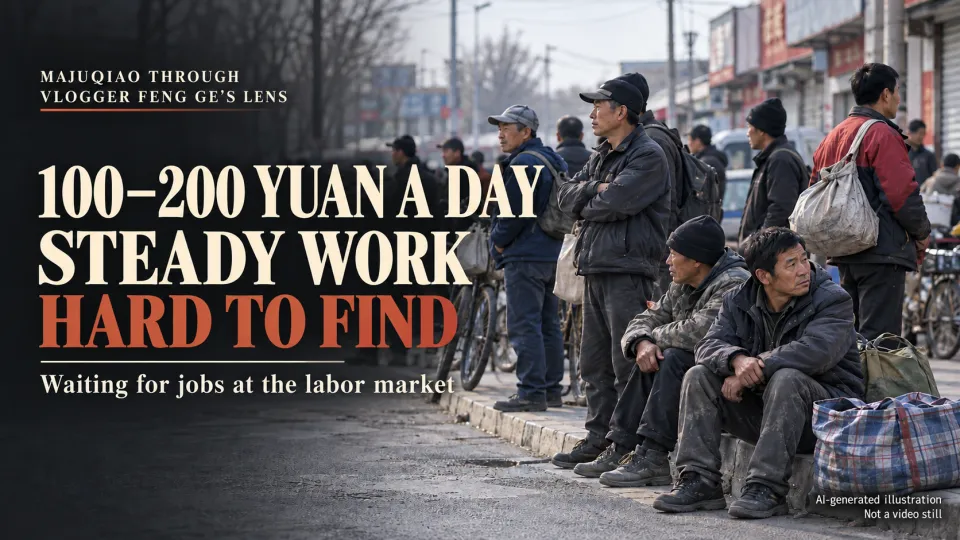
Jobs paying 100–200 yuan a day, shared rooms costing 15 yuan a night and young people unable to find full-time work featured in Chinese vlogger Fengge Wangming Tianya’s October 25 video from Majuqiao, a casual labor hub in Beijing, according to Lianhe Zaobao’s account of the footage. By October 29, the original Bilibili upload was no longer publicly playable. A notice said the uploader had made it visible only to themselves.
A livestream on the day the video was posted also ended abruptly. According to China Digital Times’s account of an excerpt, Fengge got up to answer the door that afternoon; captions included “from the police station” and “met many times.” He returned, said he had something to attend to and ended the stream. The X account @whyyoutouzhele shared the excerpt as a viewer submission. The reason for the visit, any connection to the Majuqiao video and the reason for the upload’s changed visibility remain unconfirmed.
Majuqiao sits beside the Beijing Economic-Technological Development Area, where factories and construction sites draw workers looking for temporary jobs. Once an assignment ends and the wages are paid, the search begins again. At an illustrative rate of 150 yuan a day, 20 days of work would bring in 3,000 yuan a month. Ten days would bring in 1,500 yuan. Both amounts are before living expenses, which continue on days without work.
China’s surveyed urban unemployment rate fell to 5.2% in September. Under the International Labour Organization standard used by the National Bureau of Statistics, people aged 16 or older count as employed if they work for pay or profit for at least one hour during the survey’s reference week. That includes people earning money from casual jobs, without measuring how many days they work or how much they earn in a month.
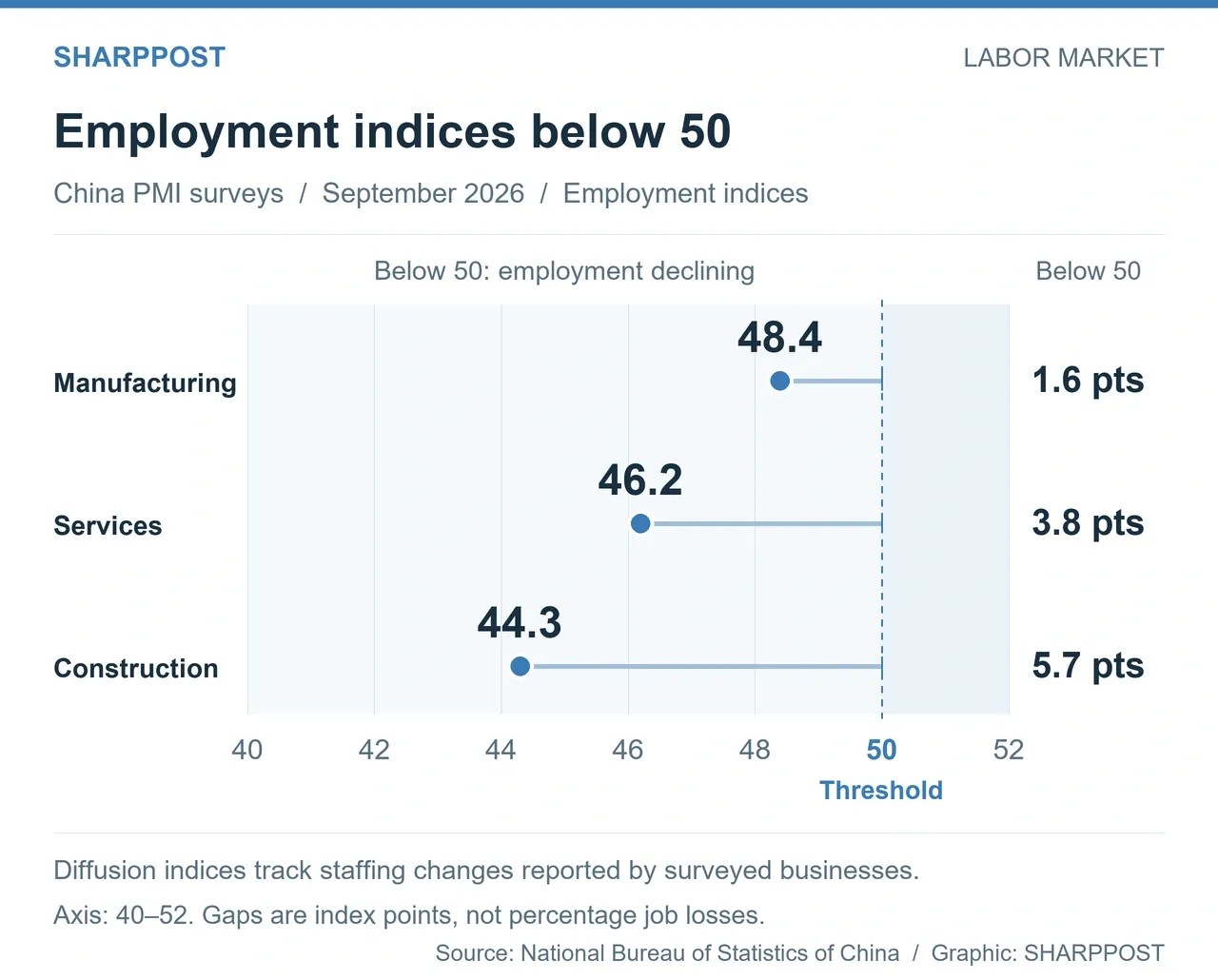
The NBS’s September purchasing managers’ survey showed the manufacturing production index rising to 51.7 while its employment index fell to 48.4. With 50 separating expansion from contraction, manufacturers reported increasing output but declining employment. The pickup in production had not brought an expansion in their workforce.
The construction employment index was 44.3, below both manufacturing and services. Property development investment fell 20.6% year on year in the first nine months of 2026. For workers hired by the project, a construction stoppage can reduce the number of paid days and their monthly earnings even if the daily rate stays the same.
Workers over 50 accounted for 32% of China’s rural migrant workforce in 2025, and 65.4% had no more than a junior secondary education, according to the NBS’s annual migrant worker survey. For those living on daily wages who need training to change jobs, time away from work means lost earnings while food and accommodation still have to be paid for.
Beijing’s 2024 guidelines for casual labor markets, issued by six municipal departments, require commercial recruitment agencies operating the markets to serve workers free of charge, verify job advertisements and provide channels for employment disputes and legal assistance. The guidelines call for helping people who struggle to find work earn money through temporary jobs and gradually move into stable employment.
In Majuqiao, an August 27 subsidy application notice from Tongzhou district’s human resources bureau recorded 61,518 successful job matches that year. Another 97 people had completed skills training, obtained the relevant qualifications and started work. The market sought 2.6679 million yuan in subsidies for operations, job matching and skills development.
The placement total counts matches, so a worker taking several assignments can be counted more than once. The notice gave no figures for subsequent working hours, monthly earnings or continued employment, including for the 97 people placed after training. The services had helped workers find jobs; how long those jobs lasted was not reported.
You read this far. You're not here for noise.
SharpPost delivers one weekly deep dive on geopolitics, finance, and tech — decoded for readers who want signal. Carefully selected, never noisy.