Chinese anti-scam blogger killed in million-yuan abduction plot
Court reports detail a million-yuan plot against Chinese anti-scam blogger Huijian and 14 convictions, upheld despite compensation and a letter of forgiveness.

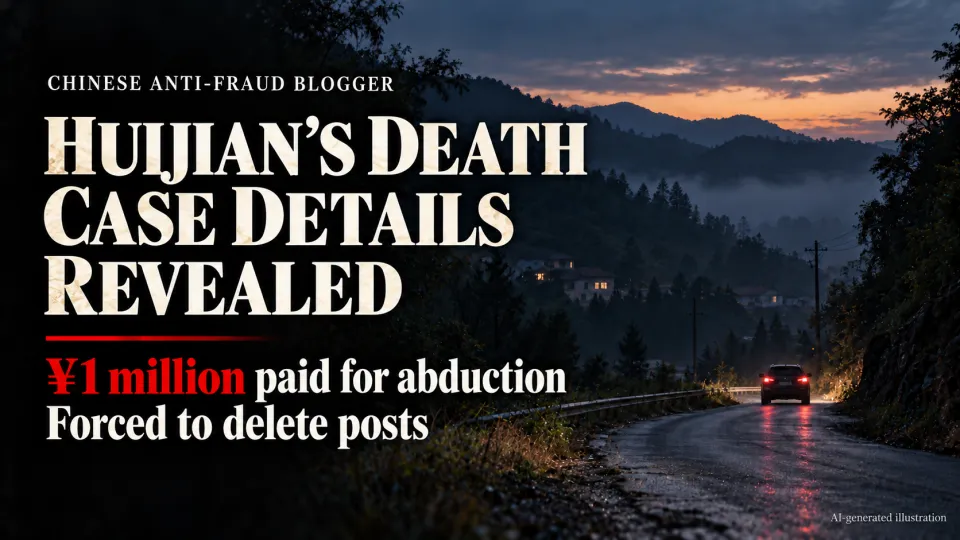
A Chinese blogger who reported on scam compounds in Myanmar and Cambodia was abducted and fatally beaten in a plot that cost 1 million yuan, Jiemian News reported on October 27. Wu Kai, known online as Huijian, was killed in November 2024. Fourteen people have been convicted in the case.
According to an appeals ruling obtained by Jiemian, someone using the screen name “Shaoxiao,” meaning “Major,” offered 300,000 yuan on Telegram to have Wu abducted. The instructions were to find out who had directed his anti-scam posts and to delete them. Zhao Bing took the job, recruited others and raised the price to 1 million yuan.
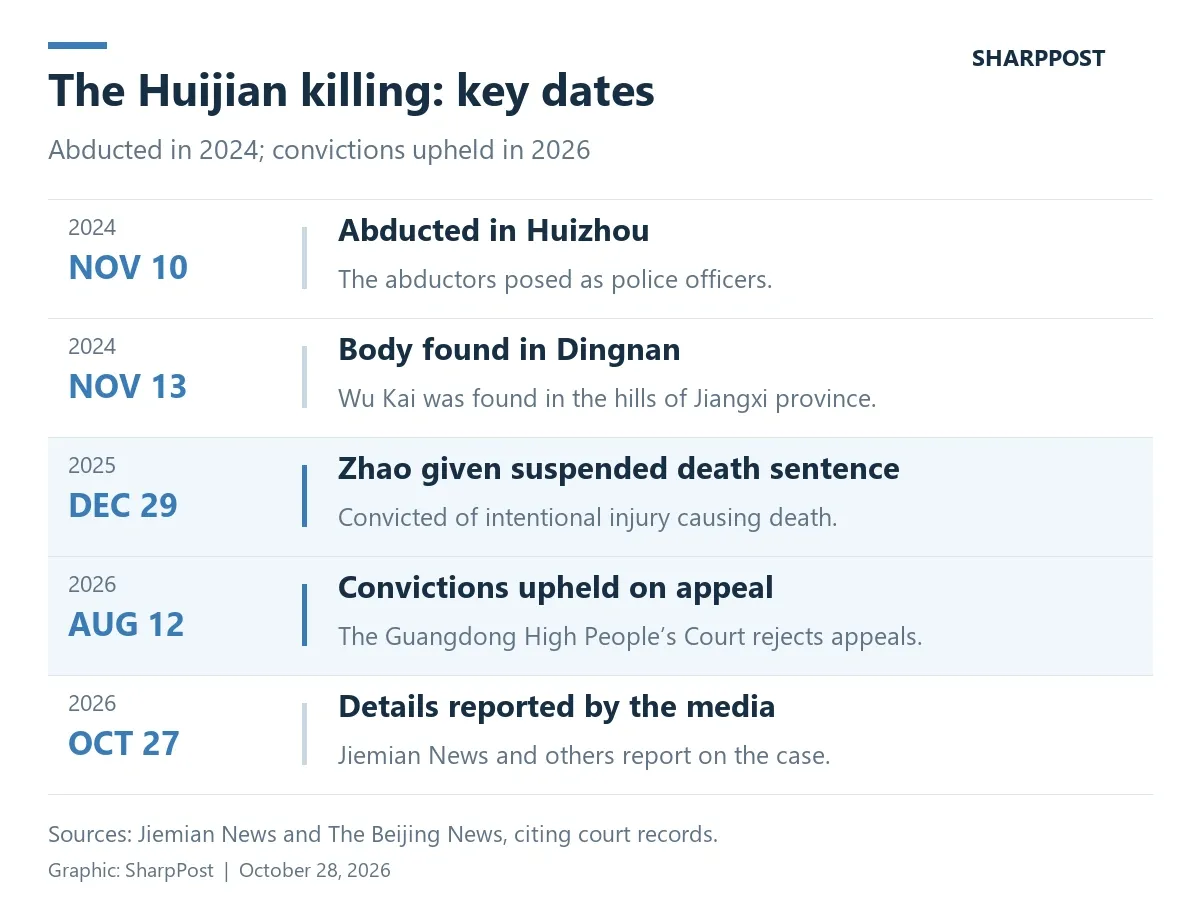
Men posing as police seized Wu in Huizhou, Guangdong province, on November 10, 2024. That day, Zhao’s accomplice Chen Jianhua received the agreed payment in cash from someone sent by Shaoxiao. The group moved Wu across provincial borders, beat and questioned him, deleted his posts and handed his phone to someone designated by Shaoxiao. The following day, Zhao kicked Wu unconscious in the hills of Dingnan, Jiangxi province, and abandoned him after dark. Villagers found his body on November 13.
A friend, identified under the pseudonym Zhang Yangfei, told Phoenix New Media that rumors of Wu’s arrest for extortion, along with the disappearance of his posts, had led him to believe Wu was in prison. He learned that Wu had been killed only when reporters contacted him.
The Huizhou Intermediate People’s Court found that Zhao’s assault on Wu during his detention caused his death, according to the ruling reported by Jiemian. On December 29, 2025, it sentenced Zhao to death, with execution suspended for two years, for intentional injury, and stripped him of political rights for life. The other 13 defendants received prison terms for intentional injury, unlawful detention or harboring offenders.
The Beijing News, citing the ruling, reported that Zhao paid 500,000 yuan in compensation to Wu’s family through his mother. In December 2025, Wu Zhengjie, acting as a representative, signed a letter expressing forgiveness for all 14 defendants.
Wu Zhengjie told the newspaper on October 27 that two men had come to his home looking for his father before he signed the letter. He said he called the police after hearing about the visit and subsequently learned that the men were associated with the perpetrators’ families. He said he signed the letter to avoid further trouble.
The Guangdong High People’s Court upheld the verdicts on August 12, 2026. It said the abduction and assault of an anti-scam campaigner caused serious harm to society and that the compensation and letter of forgiveness did not warrant reduced sentences.
Article 238 of China’s Criminal Law directs courts to apply the provisions on intentional injury or intentional homicide when violence during unlawful detention causes disability or death. Under Article 234, intentional injury resulting in death can carry the death penalty.
Among those Wu had accused was Liu Ren, chairman of the Anhui Chamber of Commerce in Cambodia. Wu alleged that Liu ran scam compounds and committed other crimes. Liu denied the allegations in a statement issued in the chamber’s name, Jiemian reported.
On June 17, 2026, Xinhua reported, citing China’s Ministry of Public Security, that Liu had been brought back from Cambodia. Police described him as a key member of Chen Zhi’s criminal group, involved in online gambling and scam compounds, and suspected of unlawful detention and intentional injury. The announcement did not link Liu to Wu’s killing or to Shaoxiao, the person who commissioned the abduction.
A relative of Wu told The Beijing News on October 27 that, to their knowledge, Shaoxiao remained abroad and had not been arrested.
You read this far. You're not here for noise.
SharpPost delivers one weekly deep dive on geopolitics, finance, and tech — decoded for readers who want signal. Carefully selected, never noisy.