FCC Sets Deadline to Move Electronics Testing Out of Mainland China
FCC rules require testing to leave mainland China by December 2028. An October 8 draft estimates $79.3 million in added annual costs as manufacturers switch labs.

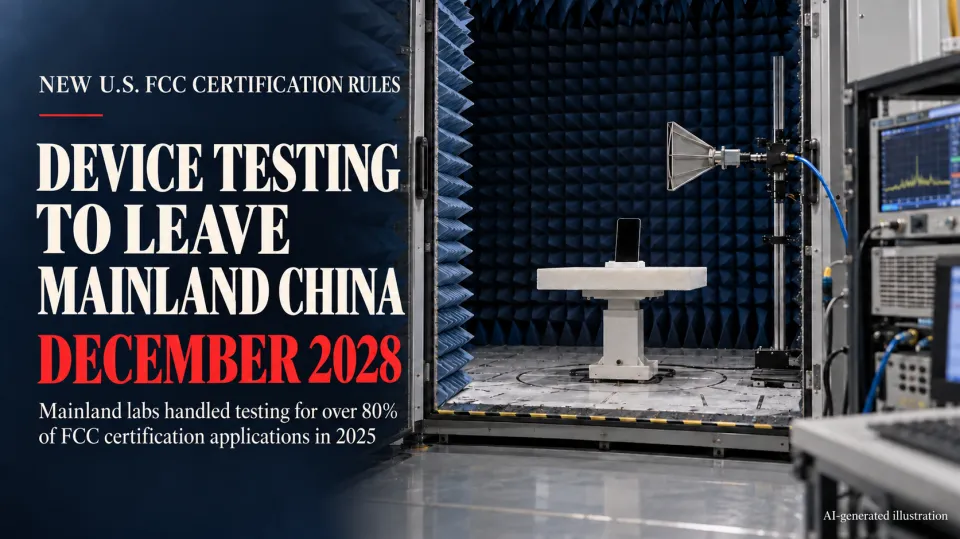
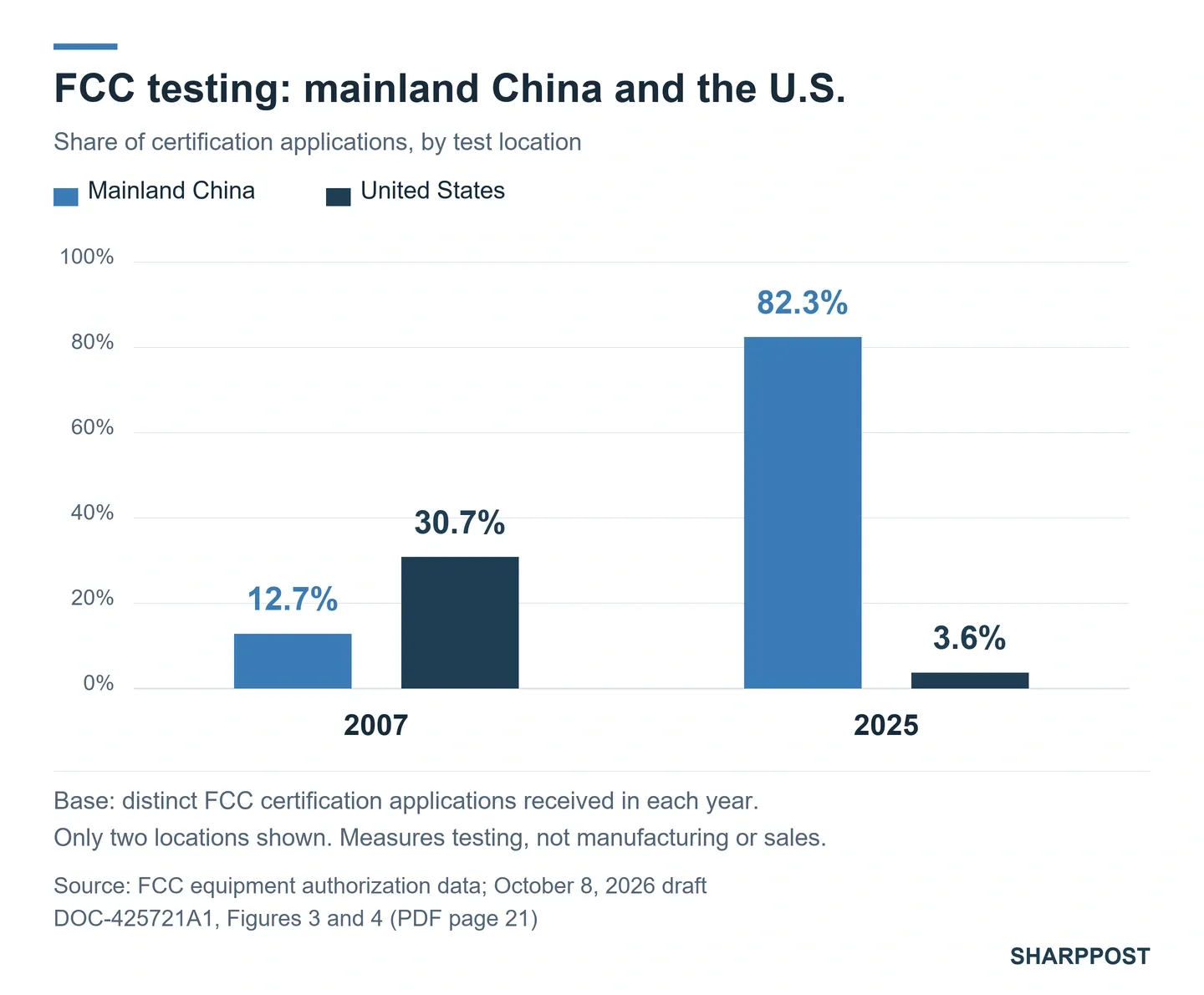
Electronics manufacturers that use mainland Chinese labs for FCC certification will have to move those tests elsewhere under rules the Federal Communications Commission adopted on October 29. The deadline is December 1, 2028. Tests conducted in mainland China supported 82.3% of FCC certification applications in 2025, compared with 3.6% for U.S. labs, according to data in the commission’s October 8 draft.
The FCC’s announcement says the testing, certification and accreditation work covered by the rules must take place in the United States or an economy that recognizes U.S. labs in return. Manufacturers will need to choose replacement facilities based on price, available capacity, turnaround time and technical expertise—factors the draft identifies as shaping where the work goes.
Hong Kong, Taiwan and Singapore appear on the draft’s list of eligible economies. The U.S. National Institute of Standards and Technology also lists mutual recognition arrangements with all three. Manufacturers could use labs there that hold the necessary recognition, allowing testing to stay in Asia.
The October 8 draft puts additional testing costs at $79.3 million a year. It assumes that 65% of affected work would move to lower-cost economies with reciprocal arrangements and 35% to the United States. The FCC’s October 29 announcement confirms the restrictions and deadline but does not include the cost estimate.
The model assumes fees would rise by 20% at those lower-cost alternatives and reach five times their previous level for work moved to the United States. It deducts estimated U.S. lab profits when calculating the $79.3 million figure, so that estimate is not the total increase in manufacturers’ bills. Actual fees would depend on each lab’s quote.
Under the October 8 draft, a testing group could not keep its FCC testing and analysis in mainland China simply by issuing reports through a Hong Kong company. Test setup and operation, measurements, analysis, and the preparation or approval of certification reports would all have to take place in an eligible location.
Phones, wireless earbuds and other devices made in mainland China could still be tested at eligible labs elsewhere. The draft exempts research and development tests that are not used in FCC certification applications. It also exempts the manufacture, maintenance and calibration of measuring equipment, allowing companies to keep those activities in place.
The Alliance for Automotive Innovation warned that changing labs could require duplicate investment and changes to operations, raising costs. It and the Consumer Technology Association also warned of delays, according to comments summarized in the draft. EMTEK and the Telecommunications Industry Association asked the FCC for data on available testing capacity. Industry submissions raised concerns about qualifying replacement labs, expanding facilities and fitting the move around product development schedules.
Manufacturers that rely most heavily on labs in affected locations may face higher adjustment costs, the draft says. Testing fees can take a larger share of revenue at some small manufacturers; larger companies may pay more overall because they submit more products. The FCC said the evidence before it did not establish that the rules would impose disproportionate costs on a particular industry or on small businesses.
The draft counts $20.2 million a year in measurable benefits, chiefly payments expected to move from overseas labs to U.S. labs, calculated at existing fee levels. The FCC also argues that the rules would improve national security, test reliability and supply-chain resilience—benefits it does not put a dollar value on. Its October 29 announcement says reciprocal agreements support oversight, accountability and enforcement.
In a June 9 announcement, the FCC said Dongguan-based SLG-CPC had reused test data in reports covering 33 distinct FCC equipment identifiers, sometimes for entirely different products. The commission said the lab admitted submitting false reports and blamed inadequate review procedures. It initiated proceedings that month to withdraw the lab’s recognition.
TIC Council, which represents the testing and certification industry, and the Consumer Technology Association argued in comments recorded in the draft that reciprocal agreements alone were not a sound basis for judging a lab’s competence, impartiality or security risk. They called for reviews and audits targeting irregularities. In its October announcement, the FCC cited risks to oversight and supply chains from concentrating testing in economies without reciprocal arrangements.
The October 8 draft would keep existing equipment certifications valid unless separately set aside or revoked. For future testing, the Consumer Technology Association and the automotive alliance sought at least three years to prepare; the Association of Home Appliance Manufacturers sought about four. The December 1, 2028 deadline confirmed in the FCC’s announcement allows roughly two years and one month from the vote.
You read this far. You're not here for noise.
SharpPost delivers one weekly deep dive on geopolitics, finance, and tech — decoded for readers who want signal. Carefully selected, never noisy.