Four Entry Points: Taiwan's April Window Into Cross-Strait Infiltration
Four incidents in late April 2026 surfaced separate vectors of mainland Chinese influence operations in Taiwan: a film screened in barracks, 834 mainland Pride Games applicants, a retired Lt.

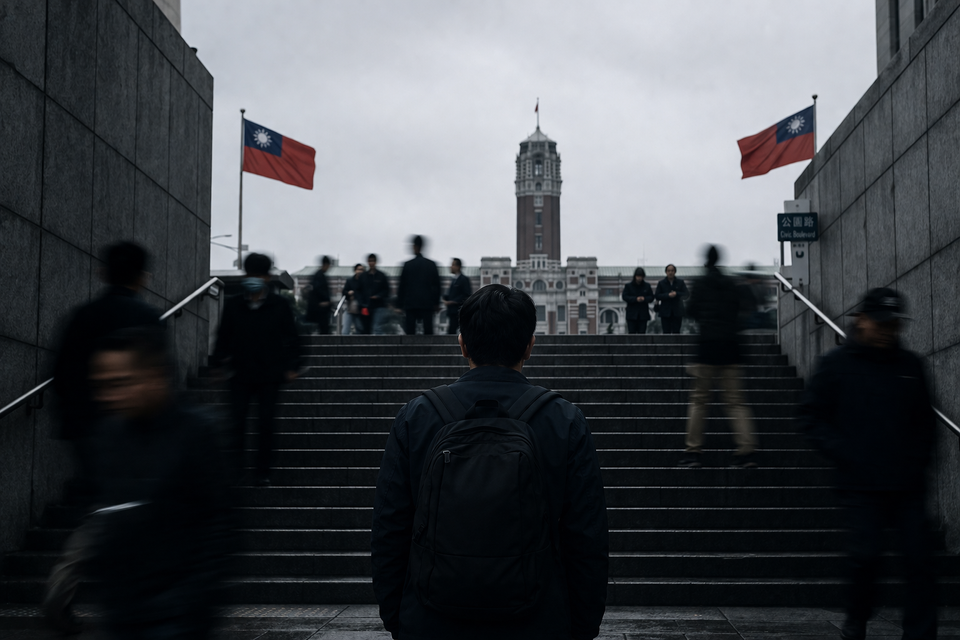
Barracks, Pride Games, retired officer, AI-forged credentials — done with the cover?
In the last week of April, Taiwan saw four separate incidents tied to mainland Chinese influence operations land in public view. A battalion commander in Army Brigade 153 had screened the 2020 mainland film "The Eight Hundred" to his troops at the Jin-Liu-Jie barracks in Yilan; the matter surfaced in legislative questioning on April 27, and the Ministry of National Defence formally classified the film as "explicit united-front messaging." On April 30, the Asian Pride Games opened in Kaohsiung with 834 mainland applicants — up from past totals in the double digits — including individuals identified by Taiwan officials as having People's Liberation Army ties and AI-generated falsified credentials. On April 23, retired Lieutenant Commander Lü Lishi boarded a People's Navy destroyer in Qingdao, signing a guestbook with "two sides one family" and saying "a strong motherland means a safer Taiwan." The four incidents involve very different actors. The security threat behind them, however, runs along the same direction.
First entry point: April 27 — "The Eight Hundred" inside the barracks
A battalion commander in Army Brigade 153 had, in January 2026, screened the 2020 mainland war film "The Eight Hundred" to his entire battalion at the Jin-Liu-Jie base in Yilan. Legislator Wang Ting-yu raised the matter at the Legislative Yuan's Foreign Affairs and National Defence Committee on April 27. Deputy Defence Minister Hsu Szu-chien gave two findings on April 29: the film, made in mainland China, requires Ministry of Culture approval before public screening, which the commander did not obtain; the screening also bypassed the standard "Patriot Day political-education programme." The Ministry of National Defence formally classified the film as containing "explicit united-front messaging."
The commander's defence rested on the film's depiction of the Republic of China flag and national anthem, which he argued made it "suitable for moral instruction." A worth-noting fact: the original 13-minute flag-protection sequence in "The Eight Hundred" was cut from the mainland release, and the white-sun emblem on the flag was technically dimmed in the version distributed there — what the commander described as the "intact flag and anthem" is precisely what the mainland's own censorship apparatus did not preserve. Army Chief of Staff Chen Chien-yi described the commander's act as "a misjudgement at the cognitive level." The disciplinary outcome was two formal reprimands. Culture Minister Lee Yuan stated separately on April 28 that the mainland's intent was to "blur the friend-foe boundary for the armed forces." A separate incident at the same brigade in early April — a company commander under prosecution for verbal abuse of a Taiwan-Japanese mixed-heritage conscript, removed from his command post and referred to judicial investigation — surfaced in the same news cycle. Two cases inside four months pointed at the same level of the chain: mid-rank serving officers losing the ability to read national symbols against political messaging.
Second entry point: April 30 — 834 mainland applicants at the Pride Games
The 2026 Asian Pride Games ran in Kaohsiung from April 30 to May 4, jointly hosted by the Taiwan LGBT Sports Movement Association and the Kaohsiung City Sports Development Bureau. Executive director Yang Chih-chun confirmed 834 mainland applicants — past editions had been in the double digits, putting the increase at roughly forty-fold. Independent Kaohsiung city councilor Chang Po-yang disclosed during review that the applicant pool included individuals with PLA backgrounds and others using AI-generated falsified credentials.
The screening outcome: Mainland Affairs Council deputy minister Liang Wen-jie confirmed that as of late April no application had reached the MAC review stage — cases were being rejected at the earlier credentials-review and document-supplementation stages, with Kaohsiung city ultimately rejecting the entire pool. That outcome was an event-specific decision after the legislator's disclosure, not a standing policy.
The demand-side signal showed up on Xiaohongshu. Posts there read: "you don't have to be LGBT to register" and "the entry fee is just over 1,000 yuan, while a business visa easily runs over 10,000." The Pride Games registration was being marketed as a low-cost route to a Taiwan entry permit. Mainland Affairs Council deputy minister Liang Wen-jie said Beijing would not in any case approve their participation, and that the screening criterion is "whether the applicant has a united-front background." Japanese reporter Akio Yaita's comment was one line: "Open societies are easy to exploit."
Third entry point: April 23 — Lü Lishi and the war-anniversary forum
Lü Lishi graduated from Taiwan's Naval Academy navigation track in 1991, retired at the rank of Lieutenant Commander, and once captained the missile patrol vessel Hsin Chiang. He is a major, not a flag officer. He now works as a military commentator. On April 23, the 77th anniversary of the People's Navy, Lü and a small group of Taiwan compatriots toured the 052D-class destroyer Urumqi and the 054A-class frigate Weifang in Qingdao. Mainland media described him as "the first retired Taiwan military officer to board an active People's Liberation Army front-line warship." His written line was "two sides one family"; his spoken lines included "feeling the motherland is strong means Taiwan is safer" and "the People's Liberation Army Navy is ready."
This was the third time. In November 2024, Lü appeared on China Central Television at the Zhuhai Airshow saying he wanted "Taiwan's audience to know how strong our China is." On September 3, 2025, he attended the "September 3" military parade in Beijing. After the Qingdao visit, Taiwan Affairs Office spokesperson Chen Bin-hua's April 29 response framed the People's Navy mission as including "defending the people," and called Lü's remark "the most reassuring rear support for all Chinese descendants."
The Taiwan-side problem is legal coverage. The current Cross-Strait People's Relations Act, Articles 9-3 and 91, applies only to retired officers at major-general rank and above receiving monthly pension benefits. Lieutenant Commander through Colonel ranks sit in a legal blind spot. Defence Minister Wellington Koo said on April 27 he found the conduct "deeply unacceptable," but the current statute provides no specific administrative penalty. The Executive Yuan has passed an amendment expanding pension forfeiture to "Major and above," and sent it to the Legislative Yuan.
One layer further back: the Seventh "Cross-Strait Symposium on the History of the Anti-Japanese War and the Inheritance of the Anti-War Spirit" was held in Beijing on December 23, 2025. The series has been jointly organized by cross-strait groups since 2017, now in its seventh edition. The Taiwan Affairs Office's announcement listed attendees as including academics, retired generals and student representatives. The Veterans Affairs Council's response questioned the framing: "the anti-war heroes are all in Taiwan."
Fourth entry point: AI-generated forged credentials
The AI-generated falsified-credentials cases inside the Pride Games applicant pool are the first publicly visible footprint of identity-document forgery moving from one-off smuggling to a tool that scales. AI image-generation models have driven the marginal cost of forged credentials toward zero. The pool of people who can be recruited or used has expanded from professional organizations to individual actors.
The National Security Bureau's existing infiltration-channel framework was built between 2010 and 2015 — five channels (criminal organizations, underground banking, front companies, religious groups, civic associations) calibrated to pre-AI conditions. AI-generated credentials are not on that list. Entry-permit screening still relies on manual sampling and visual document verification. The technology gap is structural.
| Event | Actor type | Institutional blind spot |
|---|---|---|
| Apr 27 — Brigade 153 commander screens "The Eight Hundred" | Mid-rank serving officer | Patriot Day curriculum review (annual) |
| Apr 30 — 834 mainland Pride Games applicants | Civic body + cross-border applicants | Civic-association exchange permit review (split jurisdictions) |
| Apr 23 — Lü Lishi boards PLAN destroyer | Retired Lt. Commander | Cross-Strait Act covers only Major General and above |
| AI-generated forged credentials (Pride Games applicant pool) | Cross-border individuals or organizations | NSB five-channel framework calibrated to 2010s |
What the four points add up to
Place the four against the prosecution curve. Taiwan indicted 16 espionage cases in 2021; the count rose to 64 in 2024 — a fourfold increase in three years. Of the 2024 cases, 43 percent were active-duty service members and 23 percent were retired — combined, military personnel, active or retired, made up 66 percent. The first three quarters of 2025 produced 24 indictments. The National Security Bureau identifies four recruitment vectors — using retirees to reach active-duty personnel, online cultivation, financial inducement, and debt-leverage — with "retiree-to-active" listed first.
The Mainland Affairs Council's April 2025 polling showed 73 percent of the public believed Beijing's infiltration efforts had intensified. Seventy point nine percent supported requiring legislators or elected officials to apply for permission before mainland visits. Sixty-seven point eight percent supported revoking residence permits for mainland spouses publicly advocating armed unification. Fifty-six point nine percent supported screening mainland applicants on whether they had a united-front background.
The American assessment runs along a parallel track. The American Enterprise Institute's January 2026 review described United Front operations in Taiwan as "systematic, planned and targeted," with recruitment shifting from mid-rank officers to junior enlisted personnel. The U.S. intelligence community's March 2026 assessment held that Beijing did not plan a 2027 invasion but continued to invest in political infiltration and united-front activity.
The four incidents share three underlying features. Cost reduction — AI-generated credentials, civic-body exemptions from the harder permit reviews, retired officers willing to speak publicly. Population expansion — coverage moves down from major generals to majors, battalion commanders, retired enlisted. Voice outsourcing — Taiwan citizens delivering Beijing's lines about a "strong motherland." The three layers of Taiwan's existing defences — the Cross-Strait Act, entry-permit screening, the Patriot Day curriculum — are calibrated to "Major General and above plus organized smuggling plus Cold-War-era ideological contest." Against the current scenario, structural blind spots have already shown up.
What Taiwan has to do next is build a more complete review system, with a clear boundary drawn between national security and civil liberty. Friction in the short term is likely. The matter is no longer one that can wait. The lesson Taiwan cannot afford to repeat is the one in which an open democracy is exploited and the freedoms it protects are turned against it.
You read this far. You're not here for noise.
SharpPost delivers one weekly deep dive on geopolitics, finance, and tech — decoded for readers who want signal. Carefully selected, never noisy.