China’s New Exit Rules Raise Passport Concerns
China’s new rules take effect September 15, setting procedures for exit bans, passport cases, migration agents and foreign entry restrictions.
免费微软自然语音 · 推荐使用 Microsoft Edge
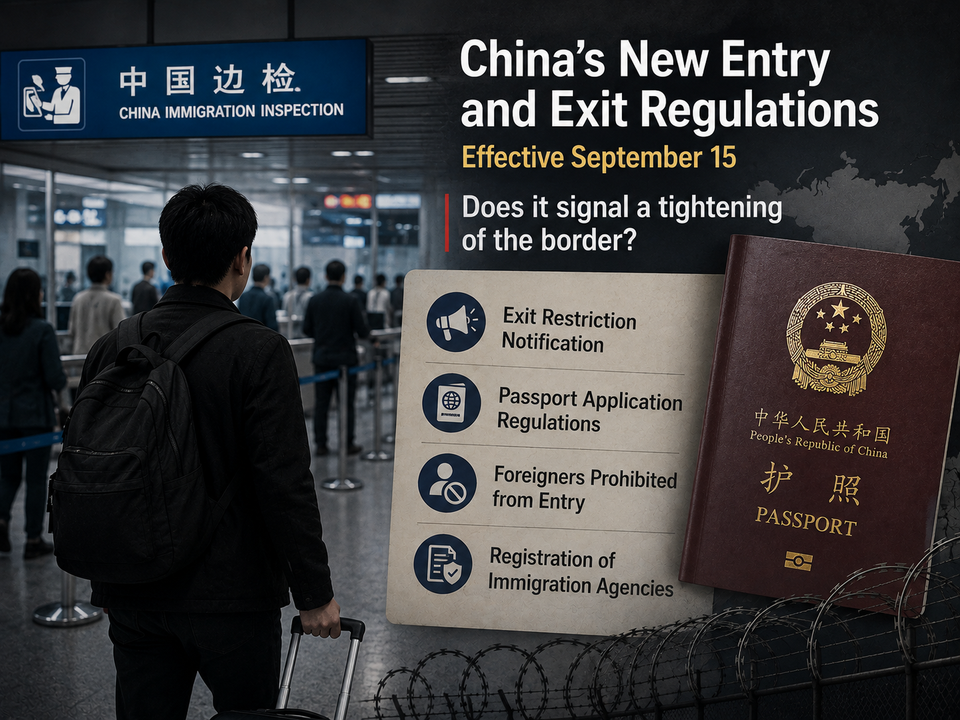
China has issued new exit and entry rules that take effect on September 15. They set procedures for exit bans, entry bans on foreign nationals and agents handling overseas study or migration, but do not replace the country’s existing Exit and Entry Administration Law.
The 19-clause measure was published on July 31 as State Council Order No. 841. China’s cabinet approved it on June 29 and Premier Li Qiang signed it on July 22. It is an administrative regulation that adds procedures to the law already in force.
Criminal cases, unresolved civil litigation, immigration offences and national security concerns were already grounds for stopping a Chinese citizen from leaving under the law adopted in 2012. The 19 new clauses do not require every citizen to obtain prior approval before travelling abroad, and they do not abolish the ordinary passport system.

Written notice for exit bans, with exceptions
Article 6 requires an agency imposing an exit ban to notify the National Immigration Administration and give the person a written account of the facts, reasons, legal basis and available remedies. Once the order reaches a port of departure, border officers are to relay that notice.
An agency may withhold written notice temporarily if disclosure could affect national security or a criminal investigation. The regulation gives no maximum period for that delay and sets out no separate review procedure. Officials have yet to explain how the exception will be applied or when an affected person can seek a remedy.
Article 12 of the existing law already lists the main grounds for an exit ban. Article 65 requires the ordering agency to notify border authorities and lift the restriction once those grounds no longer apply. The September rules add notice to the person concerned while allowing delayed disclosure in national security and criminal cases. They do not make every exit ban secret.
Some restrictions can last three years
A Chinese citizen held in administrative detention for obtaining travel documents by fraud or crossing the border illegally may face a further exit ban of six months to three years after completing the penalty. The same range can apply after a citizen returns from unlawful activity abroad that is found to have harmed national security or national interests.
Cabinet-level authorities may also stop people from leaving if they have breached export-control or technology-trade rules in a way that could endanger industrial or technological security. No standard duration is given for this category.
When foreign affairs, culture or tourism authorities issue an overseas security alert, immigration officials must flag the risk during document processing and at border checks. Officers may discourage travel to places under the highest alert or facing repeated serious threats. The Chinese text says “discourage”; it does not make travel to such places an automatic ground for an exit ban.
Applicants for travel documents, visas or residence papers must give a truthful account of their purpose. Visa and immigration authorities may question them and request documents, other records and electronic data. The regulation does not define the scope of that data or explain how a request should comply with personal-information protections.
Will passports become harder to obtain?
The publication prompted questions about whether China was preparing to tighten its borders, ration passports or make emigration more difficult. Nothing in the 19 clauses creates a universal exit-approval system or announces a halt or quota for ordinary passports. Passport applications remain governed by the Passport Law and current immigration-service rules. Statutory grounds for refusal include imprisonment, pending criminal cases, court-ordered travel restrictions and national security.
A passport and permission to cross the border are separate matters. A person with a valid passport can still be stopped at a port if an exit ban has been issued. A citizen without a passport may continue to apply if the statutory conditions are met. The new measure changes notice procedures and adds time-limited restrictions after certain offences; it does not add a blanket screening test for every passport applicant.
Emigration also depends on the destination country’s visa, work-permit and permanent-residence rules, none of which are changed by this regulation. The immediate effect in China is on agents: they must file with regulators, foreign entities may not provide exit-entry agency services inside the country, and some improper requests must be reported. That could narrow the choice of providers or raise compliance costs, but the text does not bar ordinary citizens from lawfully applying for a foreign visa or residence status.
National, industrial and technological security are not tightly defined, and the rules leave open both the scope of electronic-data requests and the length of delayed notice. Expansive implementation could make travel harder for people in sensitive sectors, classified posts or active investigations. The published text alone does not support the claim that China is closing its borders.
Overseas study and migration agents must file
Agents handling overseas study, migration and other exit-entry services will come under a common filing system. New firms must file within 15 days of establishment. Those already operating before September 15 have 90 days after the regulation takes effect. Foreign companies and organisations may not offer such services inside China.
Agents are prohibited from false advertising, document fraud, leaking personal information or assisting cross-border crime. If public employees, active-duty service members or other covered people ask for improper help obtaining foreign citizenship, permanent residence, residence documents or other exit-entry papers, the agent must refuse and report the request.
The reporting duty applies to requests made in breach of applicable rules. It does not declare that all public employees or military personnel are barred from foreign travel or residence. Their restrictions continue to depend on employment, secrecy and internal personnel rules.
An agent making at least 20,000 yuan in unlawful proceeds can be fined one to five times that amount. Where proceeds are lower or absent, the fine ranges from 20,000 to 50,000 yuan. Serious cases can bring suspension or loss of a licence or business registration. An individual operating without registration can have the proceeds confiscated and, in serious cases, face an additional fine of up to 5,000 yuan.
False statements can bring a five-year entry ban
A foreign national who submits false material or makes a false statement in a visa application or at an entry inspection can be barred for one to five years. The same range may apply after a criminal or administrative penalty for document fraud or illegal entry or exit, unless another law provides otherwise.
Foreign individuals and organisations on China’s countermeasures list, unreliable entity list or another statutory list may also face visa and entry restrictions. A person or organisation in China that supplies an invitation or supporting document must vouch for its accuracy. False material can result in a fine and confiscation of unlawful proceeds.
The National Immigration Administration and the State Administration for Market Regulation must still publish detailed filing procedures for agents. No implementing rules have yet clarified delayed notice of exit bans, electronic-data requests or the reporting process.
Sources: This report is based primarily on the full text of State Council Order No. 841 published by the Chinese government, together with the Exit and Entry Administration Law and the Passport Law published by the National Immigration Administration. Ruibao’s assessment of passports and emigration is an analysis of the texts now available. Actual enforcement will depend on implementing rules and decisions in individual cases.
You read this far. You're not here for noise.
SharpPost delivers one weekly deep dive on geopolitics, finance, and tech — decoded for readers who want signal. Carefully selected, never noisy.