EU states bolster defences against drones and sabotage
France, Poland and Germany strengthen domestic protection. SharpPost examines deployments, attribution of incidents and proposed EU coordination.
免费微软自然语音 · 推荐使用 Microsoft Edge
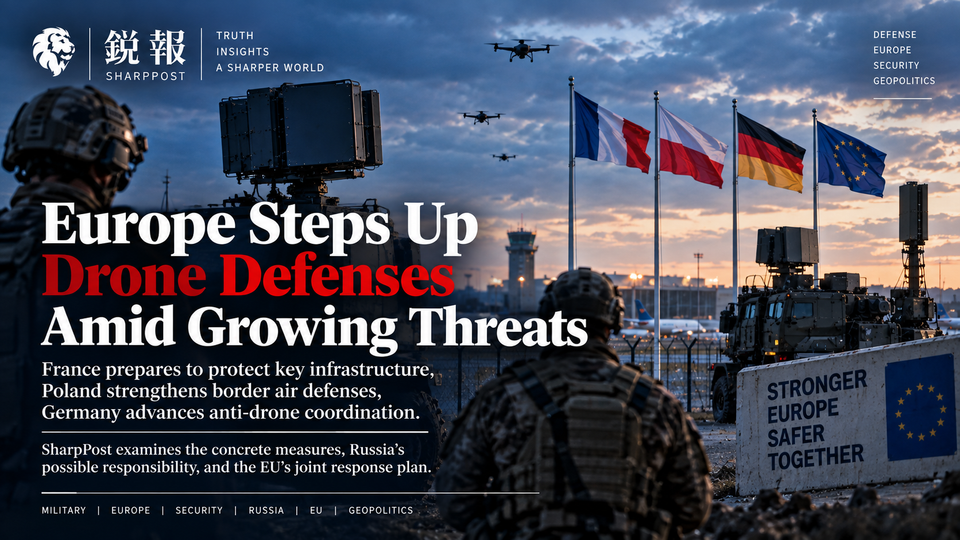
France is preparing a plan to protect critical facilities, Poland has deployed air defences at six border crossings, and Germany is strengthening counter-drone coordination. A recent attempted airport attack and drone incursions have prompted EU countries to tighten protection of infrastructure at home.
After meeting parliamentary party leaders on September 18, French President Emmanuel Macron said Russian “hybrid threats” against Europe and France had intensified. According to the transcript released by the Élysée Palace, he had asked the government to prepare a plan to protect critical infrastructure and sensitive defence industry sites from drone and cyberattacks. The interior ministry had also convened defence-zone prefects to raise vigilance.
Germany blames Russia; Lithuania investigates a drone’s target
The incident at Germany’s Leipzig/Halle Airport is a prominent recent case that a European government has publicly attributed to Russia. An explosives-laden drone was found near a Ukrainian aircraft on August 4, and the device was defused, the Associated Press reported. On September 1, the German government said police findings, operational patterns and intelligence collectively pointed to Russian responsibility.
In its public explanation, Berlin distinguished that political attribution from the criminal investigation and judicial proceedings, which remain ongoing. Russia’s ambassador to Germany denied Russian involvement, calling the incident a provocation.
The assessment in Lithuania was different. On September 15, Italian fighter jets on a NATO mission shot down a drone that had entered Lithuanian airspace. President Gitanas Nausėda said the following day that it was a Gerbera drone of a type used by Russia and had most likely been heading towards Ukraine before electronic warfare caused it to veer off course. The military was still analysing its electronics to establish its target, according to Reuters.
Deliberate sabotage and a drone straying from the battlefield require different investigations and assessments of responsibility. Air-defence forces, however, may have to respond before an incoming object’s purpose is known. That is a practical pressure on countries bordering the war.
Poland deploys air defences at six border crossings
Polish Prime Minister Donald Tusk warned parliament on September 17 that intelligence assessments indicated Russia was planning “hybrid strikes” with drones and missiles against countries supporting Ukraine, including Poland.
According to the Polish prime minister’s office, air defences had been deployed at six border crossings, with additional command and radar facilities. Engineering units were ready to support evacuation, search and reconnaissance tasks, while an airfield repair unit was held in reserve in case infrastructure near the border was attacked.
Jeśli ktokolwiek odważy się nas zaatakować, spotka się ze stanowczą odpowiedzią. Naszą i naszych sojuszników.
— Donald Tusk (@donaldtusk) September 17, 2026
Germany’s counter-drone preparations predate the latest alerts. Government information published in March says the federal police have had a dedicated counter-drone unit since December 2025. Federal and state authorities have also established a joint centre to compile information on drone activity and assess risks.
At an August 10 government briefing, the interior ministry explained that the centre coordinates and analyses information; it is not an operational interception unit. Counter-drone work involves the military, federal police and state agencies. The centre helps them share an understanding of incidents. Equipment is only part of the task: getting alerts to the right authorities, and determining who can act, also matter.
How should Europe respond together?
In her State of the Union address on September 16, European Commission President Ursula von der Leyen proposed an emergency security coordination mechanism for incidents below the threshold of armed aggression that nevertheless clearly threaten national security. A request from one member state would bring the others together to discuss a response. She described it as Europe’s own “Article 4”, intended to complement NATO rather than replace it.
The proposal is not yet an operational mechanism. NATO’s Article 4 provides for consultation when a member’s security is threatened, while Article 5 concerns collective defence. Significant cyberattacks and other hybrid attacks may also be considered to amount to an armed attack.
The measures do not amount to the EU as a whole moving onto a wartime footing. Poland is strengthening border air defences, France is preparing protection for factories and other important facilities, and Germany is concentrating on coordination. A common purpose is to keep transport, production and defence activity running despite localized disruption. At EU level, the next question is how quickly the other member states can agree on a response when one comes under attack.
You read this far. You're not here for noise.
SharpPost delivers one weekly deep dive on geopolitics, finance, and tech — decoded for readers who want signal. Carefully selected, never noisy.