F-35 parts missing after diversion to Hong Kong
US officials seek F-35 parts reportedly diverted to Hong Kong. The reason, current holder and any exposure of sensitive technology remain unconfirmed.
免费微软自然语音 · 推荐使用 Microsoft Edge
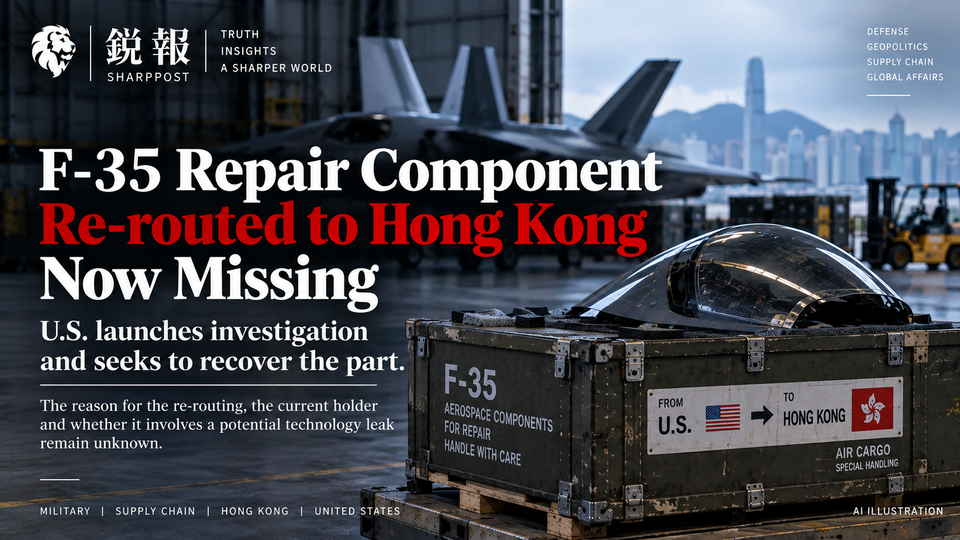
A shipment of F-35 fighter jet components intended for repair in the United States reportedly went missing after being diverted from its route out of Australia to Hong Kong. The Pentagon’s F-35 Joint Program Office has acknowledged a shipping problem and says it is trying to recover the parts.
Politico disclosed the incident on September 18. FreightWaves, citing that report, said an intermediary was transporting the shipment on behalf of Lockheed Martin. The program office described the components as unserviceable and said it was working with US authorities and industry partners to recover them and investigate.
Why the shipment changed course, and who now holds it, remain unclear. It is too early to call the diversion a shipping mistake. There is also no public evidence that the Chinese government or military has obtained the parts.
A Lockheed Martin spokesperson declined to discuss the specific shipment for security reasons, saying the company complies with applicable shipping requirements, according to Taiwan’s Central News Agency.
Why the canopy matters
An account of Politico’s reporting cited two people familiar with the matter as saying the missing components included an F-35 canopy. US State Department and Pentagon officials reportedly briefed staff on relevant congressional committees in June. The account did not establish a full timeline of when the problem was detected and recovery efforts began.
Product information from PPG, a supplier of F-35 aircraft transparencies, says its canopies and windows must meet stealth and combat aircraft specifications as well as requirements for optical clarity and durability. The Defense Logistics Agency’s customer handbook also explains that demilitarization applies to items in both serviceable and unserviceable condition.
Those documents give reason not to assume that a part awaiting repair has lost its technical sensitivity. A security assessment would need to consider not just whether the shipment can be recovered, but whether anyone accessed or dismantled it while its whereabouts were unknown. How much could be learned from the hardware depends on the particular component and its condition; the available information does not establish that.
Who holds the last handover record?
Another line of inquiry concerns the division of responsibilities: ownership, management and transportation of the equipment sit with different organizations.
SharpPost reviewed a 2023 Government Accountability Office audit of the F-35 global spares pool, which is owned by the US Defense Department and managed by prime contractors. The audit found that the program office had not entered the relevant spare parts held at non-prime contractor facilities into an accountable property system capable of recording real-time changes. Prime contractors maintained that information.
As of September 19, all four recommendations remained open. GAO’s September follow-up notes said the department was gathering updates. Whether corrective action has resolved the recordkeeping problems still requires clarification. It has not been established that the missing shipment falls within the scope of the inventory examined in that audit.
The earlier audit does not explain this diversion. It does, however, suggest a question worth pursuing: can those responsible for the equipment’s security promptly obtain the carrier’s handover records? If location and receipt information is spread across organizations, investigators need to reconcile it. Establishing responsibility requires knowing who received the shipment, when, and on whose instructions it was forwarded—not simply that it was reportedly sent to Hong Kong.
The original shipping documents, rerouting instructions and proof of receipt could help distinguish a shipping error from an unauthorized diversion. They could also show whether the trail was lost in transit or after delivery. The reporting available so far does not provide enough of those records to decide.
US officials have acknowledged a shipping problem. Exposure of sensitive technology remains a risk, not an established finding. Even if the components are recovered, questions about who held them and whether anyone accessed them during the gap in tracking would remain.
You read this far. You're not here for noise.
SharpPost delivers one weekly deep dive on geopolitics, finance, and tech — decoded for readers who want signal. Carefully selected, never noisy.