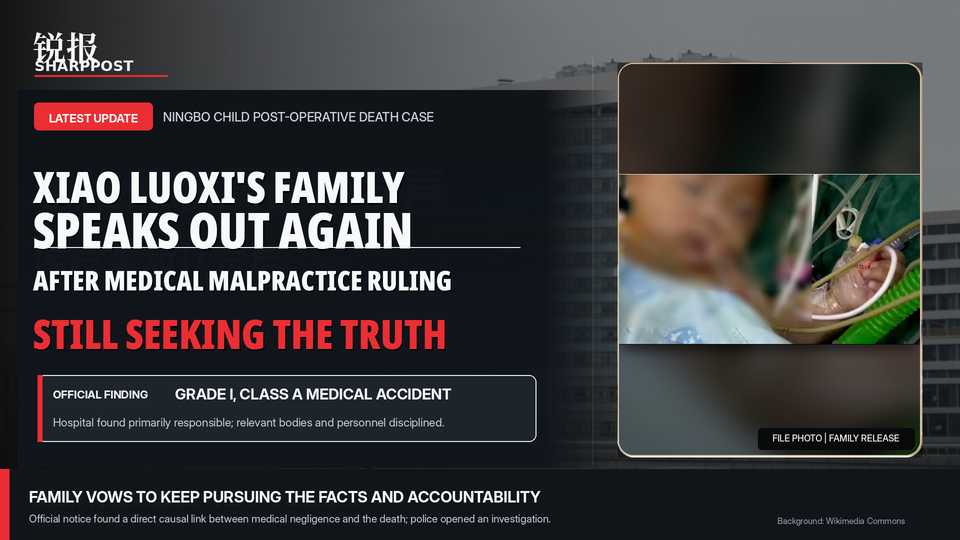
Xiao Luoxi case: family seeks answers
After a June 15 video from Xiao Luoxi's family revived attention online, questions remain over criminal liability and a supplementary medical appraisal in the Ningbo baby death case.
免费微软自然语音 · 推荐使用 Microsoft Edge
On the afternoon of June 15, the parents and grandmother of a baby known online as Xiao Luoxi appeared in a short video on Chinese social media. The subtitles said they were going to a police station to "verify the situation" and that if they did not report back safely by evening, "we could not get out".
The post accompanying the video said Xiao Luoxi's mother, father and grandmother had been called to the local police station to "drink tea", a Chinese colloquialism often used for being questioned by police. Ruibao cannot independently verify what happened after the video was posted. As of June 19, Ningbo authorities had not issued a public explanation about the reported police summons.

The video pushed the case back into public view. In recent days, discussion has again spread across China's internet, with users reposting the family's account, reconstructing the timeline and leaving messages of support. Unlike the wave of attention that followed the official report in February, the latest discussion has centred on whether the family can continue to speak publicly, and why there has been no published result from the criminal investigation or supplementary medical review.
By the time the video appeared, more than four months had passed since Ningbo officials released their investigation findings. The hospital had been punished and several staff members disciplined. The family is still asking what happened in the final hours before the child died, whether anyone will face criminal liability, and whether further medical findings will be made public.
Xiao Luoxi, whose full name was made public by her family as Xu Luoxi, died at 10:03pm on November 14, 2025, at Ningbo University Affiliated Women's and Children's Hospital after heart surgery. In official documents, she is referred to as Xu Mouxi, using the common anonymised form for a named person.
The official report said she had been admitted on November 11 with mixed atrial septal defect, unroofed coronary sinus syndrome and pulmonary hypertension. Surgery was performed on November 14. After the operation, her condition changed, including heart failure and respiratory failure, and she was pronounced clinically dead that night.
After her death, the family began posting questions about the medical records, surgical notes, autopsy findings and operating-room footage. Public discussion moved from the fact of a failed operation to whether the pre-operative assessment, surgical decision-making, post-operative monitoring and preservation of records could withstand scrutiny.
What has been made public
As of June 19, the most complete official account available remains Ningbo's February 5 report. It said a medical-accident technical appraisal had classified the case as a Grade I Class A medical accident, the category used for death or severe disability, and that the hospital side bore the main responsibility. The report said both the medical and patient sides had signed to confirm the appraisal result.
The same report said the Haishu branch of the Ningbo Public Security Bureau had opened a criminal investigation. The lead surgeon, identified as Chen, was removed from his post as head of the second surgical department's cardiothoracic unit and had his medical licence revoked. An anaesthetist, Yan, was removed as head of the anaesthesiology department, and a PICU doctor, Dong, was suspended from practice for six months. The three were also given warnings and fines.
At hospital level, Ningbo University Affiliated Women's and Children's Hospital was ordered to rectify problems and was given a warning and a fine. The hospital's party secretary received a warning; the president was given a major demerit and removed from office; a vice-president was also removed. The Ningbo municipal government ordered the city's health commission to review its handling and carry out rectification.
After the February 5 report, the family said it believed the police would investigate according to law and that it would wait for a judicial outcome. Reports also said Xiao Luoxi's mother wrote in a comment that a question over the source of a "1.0 x 0.9" defect had been sent by the Ningbo health commission to the original autopsy institution for supplementary appraisal. Ruibao has not found any public release of that supplementary appraisal or of the criminal investigation's conclusion.
The mistakes identified by the appraisal
Ningbo's report listed a series of medical failures. According to the appraisal panel, the pre-operative basis for diagnosing unroofed coronary sinus syndrome was insufficient; there was no multidisciplinary discussion before surgery; the assessment was inadequate; the timing of surgery was not well chosen; and the surgical approach was not sufficiently cautious.
The report also cited mistakes during the operation. It said surgical errors led to a second repair of the atrial septal defect and prolonged the procedure. It also said the handling of unexpected events during the operation and the communication with the family were not timely or standardised. After surgery, doctors underestimated the seriousness of the condition and its changes, monitoring was inadequate, and treatment was not timely enough.
The key sentence in the appraisal was blunt: the hospital's failures had a direct causal relationship with the child's post-operative heart failure, respiratory failure and death.
The report also noted the child's underlying condition. Experts said she had a mixed atrial septal defect, pulmonary hypertension and a right pulmonary vein variant, and that the defect was close to the openings of the right pulmonary vein and inferior vena cava, increasing the difficulty and risk of surgery. Those factors, the report said, were also related to the death.
That did not dilute the responsibility finding. A Grade I Class A medical accident is the highest category in China's medical-accident classification. In this case, the official conclusion placed the main responsibility on the medical side rather than treating the death simply as the result of surgical risk.
Records, footage and mistrust
The case remained prominent on social media partly because many people struggled to reconcile the idea of a planned operation with the death of a five-month-old baby that same night. Another reason was the question of whether key records could fully show what happened.
On medical records, the official report said the hospital sealed the records with the family's presence and signature, and provided them to the family. Later expert review and third-party electronic-record appraisal found that the records were "not accurate or complete enough"; pre-operative discussion records and death records were not standardised, and some descriptions of vital signs were wrong.
On operating-room surveillance, the report said the room had two cameras. One wide-angle camera was used for real-time monitoring, but its storage drive had been removed in October 2022 to protect patient privacy, leaving only live viewing. The other camera monitored the anaesthesia cart and had recording and playback functions, but its view covered only that area. The equipment had been inspected by police with notarisation, the report said.
Those explanations addressed questions of formal procedure, but they did not fully settle the public's doubts. In a case that drew intense attention, there was no complete recording of the most important hours, and the medical records themselves were found to be inaccurate or incomplete. For the family, that made it hard for an appraisal alone to restore trust.
The family continues to seek answers
The February 5 report set out administrative punishments: the hospital was sanctioned, senior managers were removed, and the lead surgeon's licence was revoked. It also said the police had opened a criminal investigation.
But there has been no public conclusion on whether anyone will face criminal liability. For the family, that remains the next threshold. Administrative accountability says the hospital and doctors were at fault; a criminal investigation must decide whether those faults amount to a crime.
Another unresolved thread is the supplementary appraisal mentioned by the family. Public reports said Xiao Luoxi's mother had referred to the source of a "1.0 x 0.9" defect and said the matter had been sent for further review. The issue is not about compensation. It goes to whether the pre-operative diagnosis, surgical records and autopsy opinion can be made to match.
The hospital side holds the medical records, surgical notes, surveillance equipment and professional explanations. The family is left to work backwards from a death, sealed documents and later appraisals. The official report has already found that the records were not accurate or complete enough and that the hospital bore the main responsibility. Whether every key moment can be explained will decide whether the case moves beyond punishment toward an account the family can recognise.
For the family, "Grade I Class A medical accident" is only the wording of an appraisal. They are still asking who, if anyone, should bear criminal responsibility, and whether the final hours before their child died can be fully explained.
As of June 19, Ningbo authorities had not publicly released the final result of the criminal investigation or the supplementary appraisal. If prosecutors, a court or medical authorities later publish new findings, the case will enter another stage.
Source note: This article is based on CCTV News's February 5, 2026 report on Ningbo's investigation result, Sina News's republication of an Observer Network report on the family's response, and the June 15 social-media video screenshot provided to Ruibao. As of June 19, Ruibao had not found an authoritative public release of the criminal investigation result or supplementary appraisal. References: CCTV, Sina News.
You read this far. You're not here for noise.
SharpPost delivers one weekly deep dive on geopolitics, finance, and tech — decoded for readers who want signal. Carefully selected, never noisy.