Chinese Children in Vladivostok: When Patriotic Narrative Collides With Historical Memory
A children's parade in Vladivostok — a city ceded by Qing China in 1860 — exposes the selectivity at the heart of China's patriotic-education narrative.
免费微软自然语音 · 推荐使用 Microsoft Edge
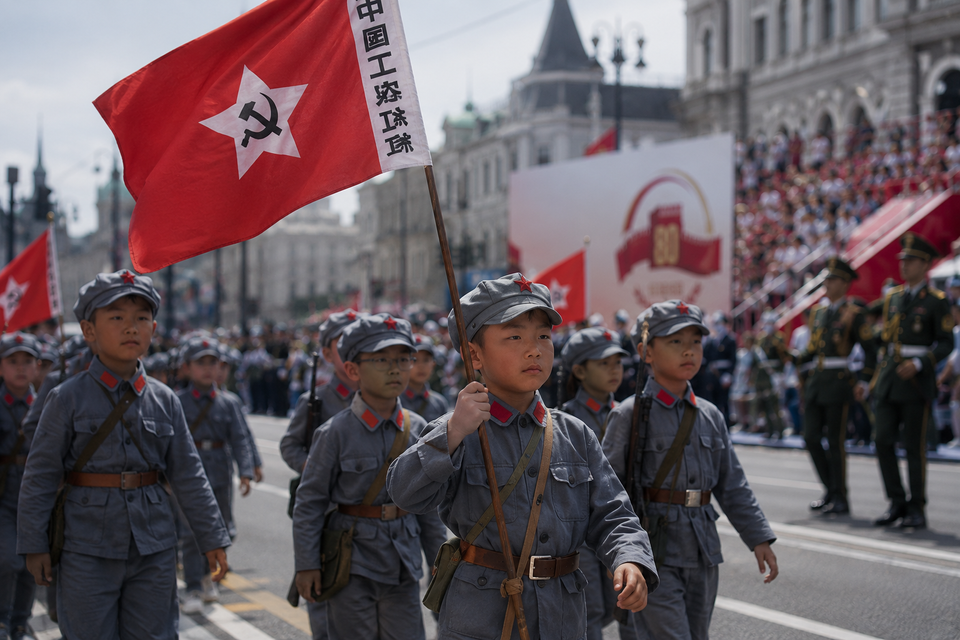
In the Russian city of Vladivostok, roughly 1,500 children from Russia, China and Laos took part in a parade rehearsing for Victory Day. One contingent of Chinese students crossed the square in replica uniforms from China's war of resistance against Japan. For many Chinese internet users, what stung most was not the scene itself, but the city's older Chinese name: Haishenwai.
On May 3, Vladivostok hosted an international children's parade. Russian and Chinese media reports both indicate that around 1,500 children took part, including students from China and Laos. The event quickly drew controversy on the Chinese-language internet. Critics asked why young Chinese pupils were assembled in Vladivostok for a public ceremony so heavy with military symbolism — a question that, in their telling, exposed both the selectivity of historical education and the malleability of nationalist narrative under the pressures of present-day politics.
The dispute escalated on May 6, when Safe Campus, a WeChat outlet under the People's Daily group, published a piece titled "On the Streets of Vladivostok, Just Whom Are These Chinese Children Cheering For?" It called the act "a shameless performance," writing that "diplomacy demands pragmatism, but no degree of pragmatism justifies trading away national dignity and historical memory at the same time." Within China's official media system, criticism this direct and this sharp is uncommon.
The site itself is the dispute
Vladivostok is sensitive first because of the place it occupies in modern Chinese memory of territorial loss. On November 14, 1860, the Qing court signed the Treaty of Peking with Russia, ceding roughly 400,000 square kilometres east of the Ussuri River to the tsar. Vladivostok subsequently became one of Russia's most important Far Eastern naval ports. The name itself is commonly translated as "Ruler of the East" or "Conqueror of the East."
This history is no secret, but it is rarely activated in contemporary Chinese public discourse with anything like the intensity reserved for memories of war with Japan. That asymmetry is precisely why, when first-graders in replica resistance-era uniforms appeared on a Vladivostok square, much of the criticism aimed not at the children but at those who had organised them: how can the same vocabulary of patriotism deliver such different force and such different direction depending on its target?
Recent tragedies and own goals of patriotic fervour
Hostility directed at Japan has surfaced repeatedly in Chinese public life in recent years. On June 24, 2024, a Japanese mother and child were attacked at a school bus stop in Suzhou. Hu Youping, a Chinese school-bus attendant who tried to stop the assailant, died of her injuries. The Suzhou Intermediate People's Court issued a first-instance death sentence to the defendant, Zhou Jiasheng, on January 23, 2025. China's foreign ministry subsequently informed Japan on April 16 that Zhou had been executed; the time and place of execution were not publicly disclosed.
Three months later, on September 18 — the anniversary of the 1931 Mukden Incident — a 10-year-old boy was stabbed near the Japanese School in Shenzhen on his way to class and died the following day. The Shenzhen Intermediate People's Court issued a first-instance death sentence to the defendant, Zhong Changchun, on January 24, 2025. China's foreign ministry informed the Japanese embassy in Beijing on April 21 that Zhong had been executed; here, too, no execution details were released. The verdict held that Zhong had bought a knife and committed the killing "to draw attention online" — a judicial framing that did not, in fact, settle the wider debate about the social atmosphere surrounding the case.
Looked at alongside the smashing and looting of Japanese-branded property during China's 2012 anti-Japan protests, and the multiple recent episodes in which people wearing kimono have been confronted in public, one observation comes through clearly: once nationalist sentiment is mobilised, the consequences tend to slip beyond control. They first turn outward, then turn back on the country's own citizens, its commercial order and its shared public space.
The plasticity of patriotic narrative
The Patriotic Education Law, passed on October 24, 2023, and in force from January 1, 2024, institutionalised and routinised patriotic education, weaving schools, families and social practice more tightly into a single framework. The text of the law alone cannot directly explain the Vladivostok episode, but it sets the wider stage: in today's China, patriotism is not only a register of values but also a mode of organisation and a language of public mobilisation.
And that is precisely where the difficulty lies. Once patriotism is heavily instrumentalised, its target, its intensity and its mode of expression can each be retuned to fit present-day need. Towards Japan, historical memory can be triggered at high frequency; towards Russia, comparable historical injuries are usually placed in the lower registers. The Vladivostok episode unsettled the public mood because it made that asymmetry impossible to ignore.
None of this implies that China should abandon patriotic education, nor that Sino-Russian cooperation should not develop. The substantive question is this: when an educational narrative must constantly adjust its tone, redact its emphases and re-sort its allies and adversaries to track diplomatic and political reality, is it cultivating stable civic understanding — or training political emotion that can be redirected at any time?
The voiceless pay first
In all of these arguments, the people who pay first are seldom those who craft the narrative. They tend to fall into two relatively silent groups. The first comprises those physically harmed when emotion overflows: foreign residents, Chinese citizens who try to intervene, and ordinary residents whose sense of safety quietly erodes under the weight of public sentiment. The second comprises children drawn into symbolic politics. To a six- or seven-year-old, Vladivostok is not a geopolitical question, nor a site of historical injury; the child has simply been put in uniform, taken to a square and asked to perform a meaning assigned by adults.
Which is why this episode points beyond a single children's parade. It points, instead, to the deeper question that opens up whenever "patriotism" is repeatedly assigned new practical purposes: who bears the cost when the line gets crossed?
You read this far. You're not here for noise.
SharpPost delivers one weekly deep dive on geopolitics, finance, and tech — decoded for readers who want signal. Carefully selected, never noisy.