Why Trump and Xi extended the trade truce by just two months
The US-China trade truce now runs to 10 January 2027. Disputes over purchases and rare earths explain why businesses still lack long-term certainty.
免费微软自然语音 · 推荐使用 Microsoft Edge
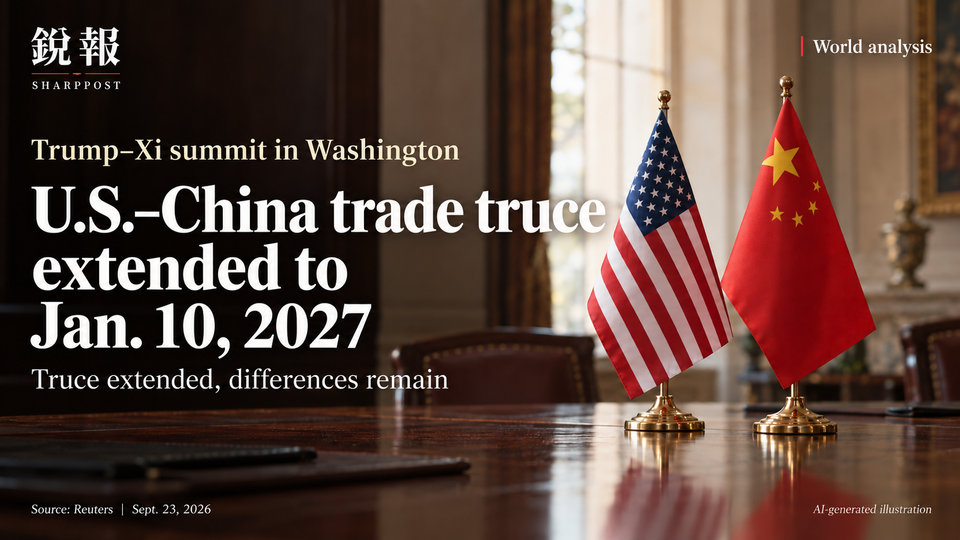
The United States and China have agreed to extend their trade truce from November 10 to January 10, 2027, US Treasury Secretary Scott Bessent said on September 23. The announcement came before Donald Trump and Xi Jinping sat down at the White House, giving their economic teams another two months to negotiate.
At the meeting the following day, Xi referred to a new joint economic and trade arrangement. China’s account of the talks did not set out its full terms. It quoted Trump calling for further dialogue and a better agreement. The extension has a date; the scope of additional market opening still depends on the details.

The appearance of U.S. Department of War (DoW) visual information does not imply or constitute DoW endorsement.
What the extension offers businesses
Bessent was referring to the truce reached after last year’s Busan summit. The White House’s November 2025 account described a suspension of higher reciprocal tariff rates while retaining a 10% reciprocal tariff, alongside pauses in certain other restrictions. That agreement left tariffs in place. Extending it does not restore free trade.
For an importer with a shipment due around the original expiry date, an extension can reduce uncertainty over pricing and delivery. A manufacturer considering a new factory needs a longer horizon. It must decide who would absorb a future tariff increase and whether to retain alternative suppliers. Short-term orders and long-term investment can therefore respond differently to the same diplomatic announcement.
Bessent said China was on track to meet its commitment to buy at least 25 million metric tons of US soybeans this year, but behind on other agricultural purchases. Reuters also reported that US officials had previously described rare-earth deliveries as insufficient. Those are US assessments of separate commitments; the public material reviewed for this article provides no jointly reconciled figures.
The White House’s May 17 fact sheet put the agricultural pledge, in addition to soybeans, at at least $17 billion a year for 2026–28, with 2026 prorated. That is a commitment, not a record of payments. Using the full $17 billion as this year’s benchmark would overlook the qualification.
Agricultural contracts, shipments and arrivals can fall in different reporting periods: an order still has to become a delivery. Mineral supplies bring additional questions of product specifications and export licenses. Aggregate purchases can approach a target while a particular manufacturer still lacks the material it needs. For that company, the date the material arrives determines whether production can proceed on schedule.
A narrower route to lower trade barriers
In May, the White House said the leaders had authorized a US–China Board of Trade for nonsensitive goods and a separate Board of Investment for government-to-government discussions. These offered a way to pursue some commercial deals while continuing to address security disputes.
After talks in New York on September 20, US Trade Representative Jamieson Greer said the two sides had agreed to put the trade board into operation. They were still discussing which goods might qualify for lower tariffs. The Associated Press reported that possible categories included consumer goods, farm products, energy and medical devices. These were candidates, not an effective tariff schedule.
An agreement covering those categories could benefit companies by lowering specific barriers. Tariffs affect the cost of entering a market; licenses and other requirements can determine whether a product may be sold and when it can be delivered. The two governments can address these transactions without waiting to resolve every dispute over advanced technology.
The investment forum addresses projects that may bring equipment, technology and financing under different sets of rules. Easier trade in an individual product does not automatically settle the approvals needed to build a factory. Separate talks allow some transactions to advance, while companies assess exporting and local production as distinct options.
AI notification proposal awaits operating details
Bessent’s September 20 proposal was for a bilateral notification mechanism covering AI incidents that could affect national security. AP described a US proposal. China’s account of the summit said both leaders favored continued AI dialogue, without announcing a launch date or detailed rules for the mechanism.
There is already some common ground. A White House statement on September 2 said G20 participants, including China, had reached consensus on principles for emerging technologies. The ministerial declaration favors applying existing sectoral regulation where appropriate and directing new rules at problems those frameworks cannot address. It also recognizes safety risks and leaves countries room to design their own policies, rather than prescribing one regulatory system.
An incident channel raises more specific questions. The two governments would need to establish notification thresholds, designate points of contact and decide what technical information to share and how to protect sensitive material. China’s summit readout, published on September 25, did not supply those details or explain how the mechanism would operate.
Greer also said before the summit that export controls on advanced AI chips and semiconductor manufacturing equipment were outside the agenda of the AI mechanism talks. Risk notifications can therefore be discussed without first opening technology trade. Even an operational channel would leave chipmakers’ export permissions to a separate process.
Taiwan remains exposed to arms-sale uncertainty
Xi called on the United States to oppose Taiwanese independence. That goes beyond Washington’s longstanding formulation that it does not support independence. The Chinese account of Trump’s remarks did not address Taiwan, leaving unanswered whether he accepted Xi’s request.
AP reported in May that Trump, after visiting China, confirmed he was holding up a roughly $14 billion package that had already been delayed for months. He described it as a negotiating chip. A separate package worth about $11 billion had been approved in December 2025. The administration had made different decisions on separate packages; the hold did not cover all weapons supplies.
Linking weapons to talks with Beijing gives Taiwan reason to worry that other negotiations could affect its security. Even with unchanged policy language, the pace of approvals and deliveries affects when Taiwan receives equipment. The published summit material supplies no specific agreement trading commercial concessions for a change in Taiwan policy.
Pressure from the Middle East
The Iran war gives Washington an additional incentive to avoid another economic confrontation. Reuters’ summit report connected the war and higher energy prices with pressure on Trump ahead of November’s midterm elections. Keeping the China truce in place can spare US importers and manufacturers another policy shock, giving Washington a practical interest in stable trade. Iran alone, however, does not explain the choice of a two-month extension.
Xi’s public position was to support a return to the Islamabad memorandum and negotiations toward a comprehensive agreement, including the nuclear issue. Xinhua’s account contained no pledge to secure Iranian concessions for Washington. Support for renewed diplomacy leaves open the question of how much pressure Beijing would apply.
China’s readout also said the leaders would support each other’s hosting of this year’s APEC and G20 summits, without announcing another bilateral meeting. Bessent’s new deadline takes the negotiating window past the US midterm elections and into January. Companies planning next year’s orders in the meantime still need further details on product coverage, duties and licenses.
You read this far. You're not here for noise.
SharpPost delivers one weekly deep dive on geopolitics, finance, and tech — decoded for readers who want signal. Carefully selected, never noisy.