US says China will buy 10 million tons of coal a year; Beijing gives no figure
The US says China will buy at least 10 million tons of American coal annually in 2027–28. Beijing gives no volume; tariff cuts await implementation.
免费微软自然语音 · 推荐使用 Microsoft Edge
China’s commerce ministry published detailed product lists for reciprocal tariff reductions with the United States on September 28. Each side’s list covers roughly $30 billion in goods. The reductions will take effect simultaneously after both countries complete their domestic legal procedures; the announcement does not set a start date.

The appearance of U.S. Department of War (DoW) visual information does not imply or constitute DoW endorsement.
The two $30 billion figures are based on 2024 bilateral trade values. They describe the trade covered, not new orders or the value of tax relief. A framework released by the White House on September 27 confirms that both sides have approved the lists, while tariff changes remain subject to their respective legal processes.
According to the commerce ministry’s announcement, more than 90% of products on the lists will have all additional tariffs imposed by the two countries on each other removed and receive most-favoured-nation treatment. That removes the extra duties, but does not mean underlying tariff rates fall to zero. The percentage applies only to products on these lists.
The US list includes toys but excludes those with radio-frequency, Wi-Fi, Ethernet or Bluetooth capabilities. The Chinese list covers soybeans for sowing, not all US soybeans. Neither document gives item-by-item tariff rates. Importers can check whether a product falls within the listed descriptions, but cannot calculate the resulting duty from the lists alone.
Coal purchases and the trade truce
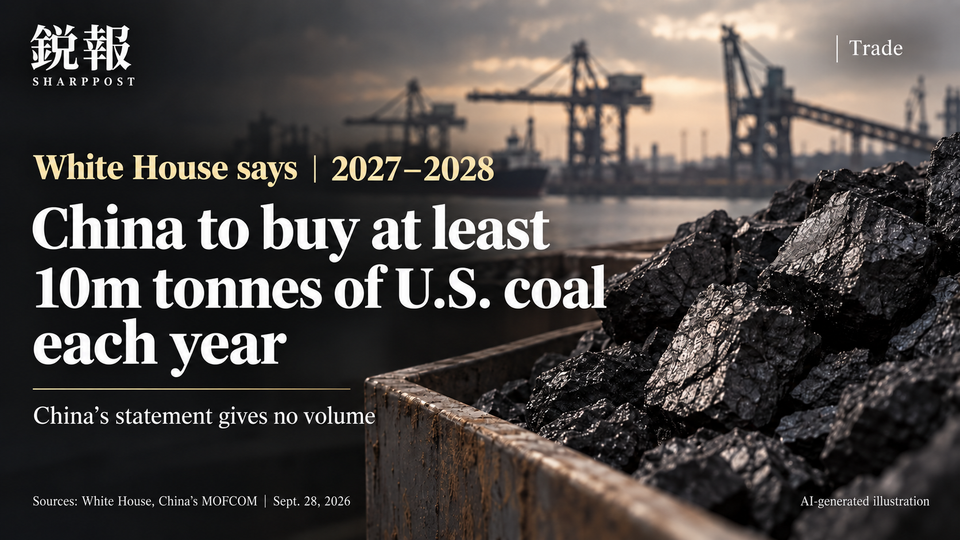
The White House said on September 25 that China would import at least 10 million metric tons of US coal in each of 2027 and 2028. Beijing’s September 28 account gives no volume, saying only that including coal in the tariff framework would facilitate imports from the United States in those years.
Anthracite and coking coal appear on China’s list, but the tariff arrangements do not identify purchase contracts, buyers or delivery schedules. Beijing’s omission of a minimum volume does not establish that it rejects the US account. Nor does listing a product establish that an order has been placed.
The commerce ministry also announced that the suspension of certain tariff and non-tariff measures under the joint Kuala Lumpur arrangements will be extended from November 10, 2026, to January 10, 2027. The two sides will discuss further extensions. The current agreement extends the suspension without permanently removing the measures.
AI talks to resume by the end of November
The White House calls the new mechanism the “Super Intelligence (SI) Dialogue”, while China’s foreign ministry account on September 26 retains the term “artificial intelligence dialogue”. The White House’s renaming concerns the emerging technologies in question.
The commerce ministry says the talks are led by Chinese Vice-Premier He Lifeng and US Treasury Secretary Scott Bessent, within the bilateral economic and trade consultation mechanism. A first dialogue under that mechanism has already taken place, with the next scheduled before the end of November 2026. Both sides also agreed to establish a channel for communicating about related incidents. Neither account specifies reporting thresholds, deadlines or procedures, leaving its likely response speed unclear.
Before the summit, Reuters identified an extension of the trade truce as a central focus, while analysts interviewed by the Associated Press expected only modest progress. The outcomes announced so far broadly meet those expectations, representing limited but concrete progress without yet amounting to a major breakthrough.
You read this far. You're not here for noise.
SharpPost delivers one weekly deep dive on geopolitics, finance, and tech — decoded for readers who want signal. Carefully selected, never noisy.