Yemen fighting escalates as Saudi Arabia seeks allied help
Britain will provide a refueling aircraft as Saudi Arabia seeks allied help against Houthi attacks, with Yemen’s peace efforts stalled and fighting spreading.
免费微软自然语音 · 推荐使用 Microsoft Edge
Britain’s Ministry of Defence announced on September 22 that it had agreed to provide one RAF Voyager tanker at Saudi Arabia’s request to support its air operations in the Yemen conflict. London describes the mission as backing Saudi defensive operations in support of Yemen’s internationally recognised government. Britain had already supplied air-defence equipment and personnel to help counter missile and drone attacks.

The announcement followed a September 16 Associated Press report citing two unnamed regional officials who said Saudi interceptor stocks were running low and Riyadh was seeking allied air-defence support. AP gave no inventory figures, and Saudi officials did not immediately respond to its request for comment.
The Voyager can extend compatible aircraft’s range and endurance, supplying fuel for patrols or other air missions. Interceptors, used to shoot down incoming threats, require separate replenishment. Refuelling cannot itself resolve the reported ammunition shortage. Britain has not specified the receiving aircraft, detailed mission scope or first operating date.
Conflict monitor ACLED recorded at least 276 deaths in violence between the Houthis and forces on the side of Yemen’s internationally recognised government from September 3 to 7. Saudi Arabia carried out at least 15 strikes over those five days, mostly in Taiz, the most intensive period since it resumed military intervention in July, according to ACLED.
AP reported on September 21 that they had seized Mokha port and key Red Sea islands that month, declared a blockade on Saudi shipping through the Bab el-Mandeb Strait and Red Sea, and attacked Saudi-linked ships and oil facilities. The territorial gains improve the Houthis’ ability to monitor shipping, but do not establish that they have closed the entire route. Britain’s defence ministry cited energy supplies, prices and business costs in explaining its support.
Houthi leader Abdul-Malik al-Houthi reiterated demands that Saudi Arabia end what he described as aggression and lift its blockade, according to AP’s account of his September 21 televised speech. Britain continued to voice support for a diplomatic solution when announcing the military assistance.
The UN-mediated truce that began on April 2, 2022, expired on October 2 after two extensions. It sharply reduced fighting and deaths over those six months without ending all violence. In December 2023, the UN announced commitments to a nationwide ceasefire and political process and began developing a roadmap. A comprehensive peace agreement had not been reached.
The roadmap’s provisions included paying public-sector salaries, resuming oil exports, reopening roads and lifting restrictions on ports and airports. Putting these commitments into effect requires further agreement on income and access; a ceasefire alone is not enough. ACLED warned in 2024 that Red Sea attacks and military responses threatened earlier progress. On September 10 this year, UN envoy Hans Grundberg told the Security Council that the risk of renewed large-scale conflict had become a reality.
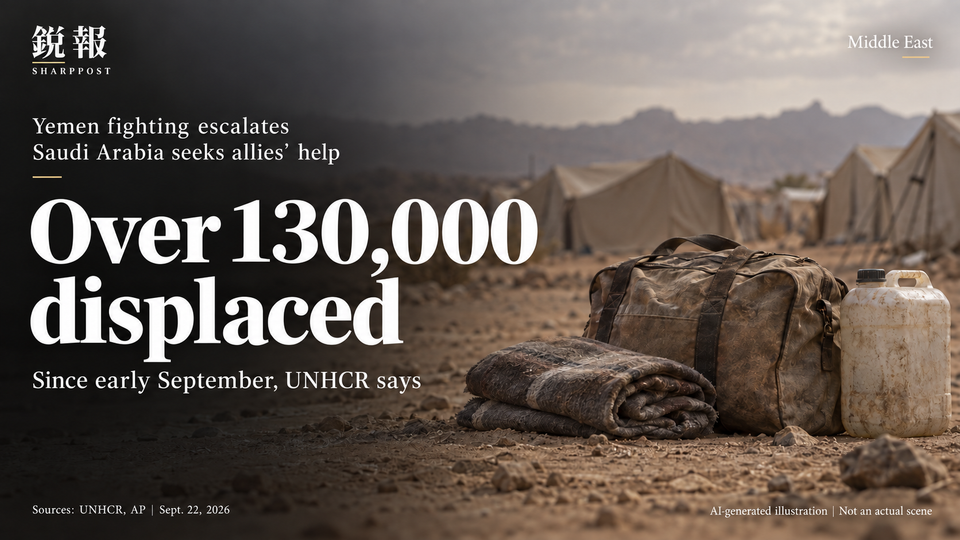
Britain estimated on September 25 that the recent fighting had displaced more than 130,000 Yemenis and announced £10 million in emergency aid. The allocation comes from the £104 million annual Yemen aid package announced in June and will fund food, child nutrition and emergency healthcare for women and children, among other needs.
You read this far. You're not here for noise.
SharpPost delivers one weekly deep dive on geopolitics, finance, and tech — decoded for readers who want signal. Carefully selected, never noisy.