Man Dies After Setting Himself on Fire Outside UN Headquarters in New York
New York police said a man died after setting himself on fire outside the UN headquarters. US media and Tibetan advocacy figures identified him as Lobga Rangzen, a Tibetan man who had criticized China’s new ethnic unity law.
免费微软自然语音 · 推荐使用 Microsoft Edge
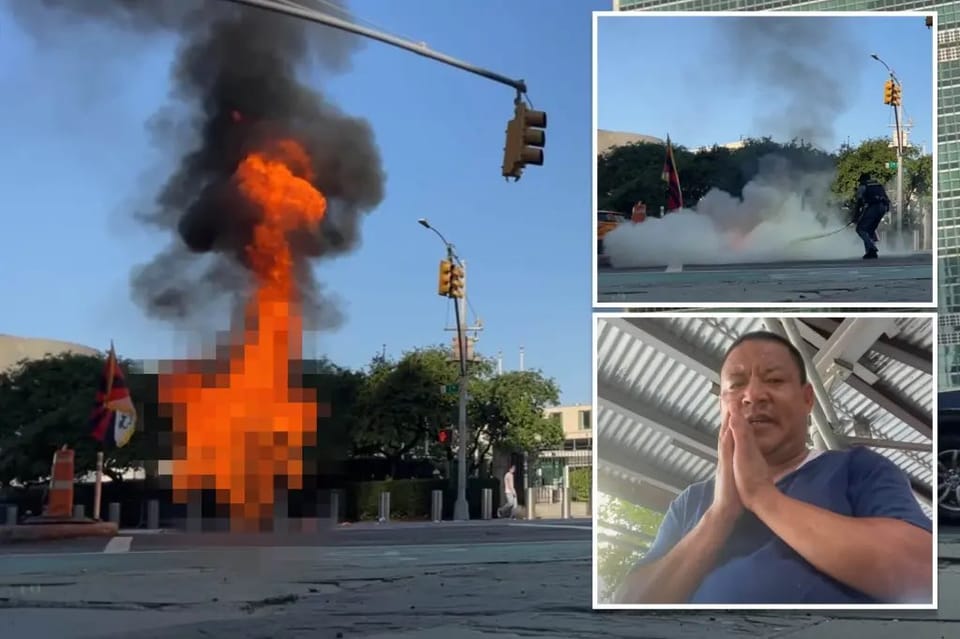
New York police said a man died after setting himself on fire outside the United Nations headquarters in Manhattan on July 2. Police have not released his name. US media and Tibetan advocacy figures have identified him as Lobga Rangzen, a Tibetan man who had criticized China’s new Law on Promoting Ethnic Unity and Progress.
The New York Police Department said officers and emergency workers responded to a 911 call outside the UN complex at about 6:30 p.m. local time. The man was taken to hospital and later pronounced dead. Police said a Tibetan flag was visible at the scene and the case remained under investigation.


Authorities did not describe what happened before the man set himself on fire, and said his identity would not be released before family notification. The Associated Press, citing police, reported that the man was 52. The New York Post, citing sources and a friend, identified him as Lobga Rangzen, 42, and said he had lived in the United States for about 20 years. The age accounts differ.
A Tibetan advocacy figure has said the dead man was Lobga Rangzen and described him as a committed supporter of Tibet. The same accounts said he had strongly criticized China’s Law on Promoting Ethnic Unity and Progress, which took effect on July 1. That connection has not been confirmed by police, and Ruibao has not independently reviewed a full record of his recent statements.
A UN spokesperson said the incident occurred after scheduled meetings had ended for the day and did not disrupt UN business. The office of Secretary-General António Guterres was reported to have expressed shock and sadness and offered condolences to the man’s family. New York police had not released a final investigative finding as of publication.
China’s Law on Promoting Ethnic Unity and Progress writes the Communist Party’s “Chinese national community” language into a range of public duties. It also says overseas organizations and individuals may face legal responsibility for acts China defines as damaging ethnic unity or promoting ethnic separatism. Ruibao has previously published a separate report on the law’s overseas provisions and the concerns they have raised.
Chinese authorities say the law is intended to safeguard national unity and ethnic solidarity. Rights groups and minority-rights advocates outside China say the wording could add pressure on speech, organizing and academic work beyond China’s borders. Beijing treats Tibet as an issue of sovereignty and ethnic affairs; exiled Tibetan groups and supporters accuse China of restricting religious, linguistic and cultural life in the region.
The International Campaign for Tibet has documented more than 150 self-immolations by Tibetans between 2009 and 2022. Such cases are difficult to verify independently inside China, and overseas reporting often relies on exile communities, local contacts and human rights organizations.
As of publication, China’s mission to the UN and China’s foreign ministry had not issued a public response to this case. New York police said the investigation into the man’s identity and the circumstances of his death was continuing.
Source note: This report draws on Associated Press and New York Post reporting, Tibetan advocacy accounts, and the public text of China’s Law on Promoting Ethnic Unity and Progress. Because this article concerns a suicide, it does not reproduce livestream footage or detailed method descriptions. In the United States, people experiencing suicidal thoughts can call or text 988 for crisis support.
You read this far. You're not here for noise.
SharpPost delivers one weekly deep dive on geopolitics, finance, and tech — decoded for readers who want signal. Carefully selected, never noisy.