23 Seconds Pried Open: How a FOIA Filing Cracked Four Years of Silence on MU5735
A Chinese citizen filed a FOIA request with the U.S. NTSB. On April 29, the agency released the FDR data: both engine fuel switches set to cutoff at 29,000 ft, autopilot disengaged, yoke pushed down. The CVR audio of "excellent" quality remains with China's CAAC.
免费微软自然语音 · 推荐使用 Microsoft Edge
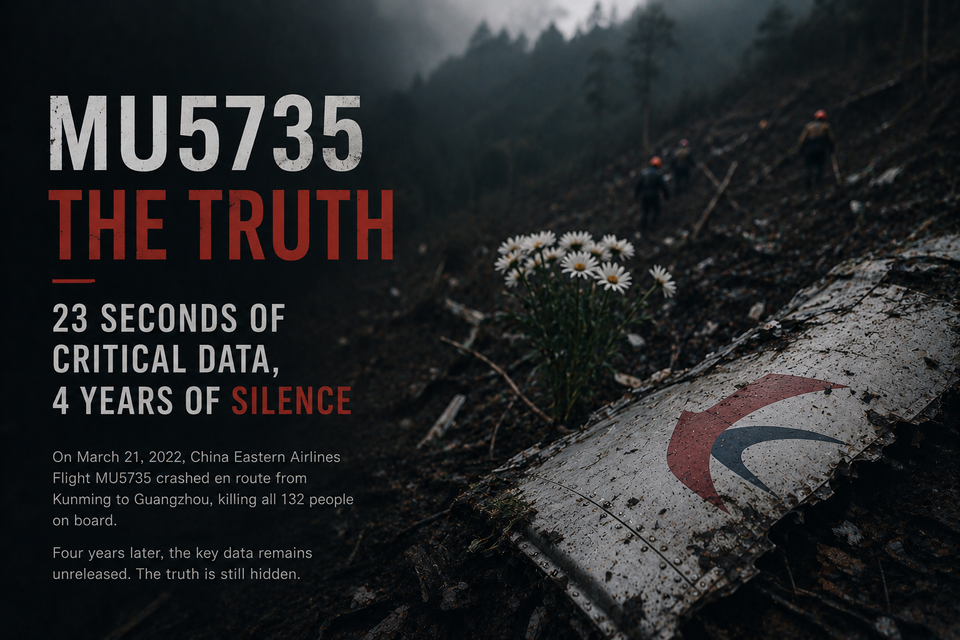
On May 1, the NTSB's FOIA Reading Room posted a file labeled DCA22WA102 — the official documentation for the China Eastern MU5735 crash. Two days earlier, on April 29, a Chinese citizen had received a reply to a Freedom of Information Act request: a package containing the flight data recorder (FDR) combined download report, NTSB-CAAC email correspondence, and the July 2022 data download report. Four years after the crash, this is the first time anything official on MU5735 has been put in public view.
According to the FDR data, while the aircraft was cruising at 29,000 feet, the fuel control switches for both engines moved to CUTOFF within roughly one second, and autopilot disengaged immediately afterward. About three seconds later, one of the cockpit yokes was pushed down — what the NTSB report describes as a "violent" forward push. The FDR stopped recording when the aircraft descended to roughly 26,000 feet — the recorder has no battery backup and stops once the engines lose power. The data does not identify the operator of the yoke.
FOIA released 23 seconds of flight parameters. The cockpit voice recording remains with the Civil Aviation Administration of China.
Four years of silence
The crash occurred on March 21, 2022. The aircraft was a Boeing 737-89P (a 737-800 series variant), registration B-1791, operating Kunming to Guangzhou. In Tengxian County, Wuzhou, Guangxi, it pitched into a near-vertical dive and struck the ground; all 132 on board — 123 passengers and 9 crew — died. Under ICAO Annex 13, China's CAAC released a preliminary investigation report within 30 days (April 20, 2022), with the conclusion that "the cause of the accident remains under investigation."
After that, the anniversary notices settled into a pattern. The one-year "investigation progress notice" on March 21, 2023 reached no definite conclusion. The two-year notice on March 20, 2024 read almost word-for-word like the first. The third anniversary in 2025 and the fourth in 2026 came and went with no notice at all.
In May 2025, a Chinese citizen filed a government information disclosure request with CAAC concerning the "3·21 accident investigation progress." CAAC declined, citing "public disclosure may endanger national security and social stability."
Sources: CAAC successive bulletins, NTSB FOIA archive, Wikipedia, Wall Street Journal, CNN, Wikimedia Commons
ICAO Annex 13 — the international convention on aircraft accident investigation — requires the state of occurrence to release a preliminary report within 12 months and a final report within three years, with progress updates if the timeline cannot be met. MU5735 is now one year past that three-year deadline. The "national security" rationale CAAC invoked has no corresponding provision in international aviation practice.
Annex 13 also gives the state of design and manufacture — the United States here, since the aircraft is a Boeing — a seat in the investigation and access to the data. The NTSB took that seat as an observer, not as lead investigator. But once a Chinese citizen filed a FOIA request, NTSB had to respond under U.S. law.
One Chinese citizen's FOIA request
The applicant remains anonymous. Two dates are known: the request was filed in January 2026; the response arrived on April 29.
Within hours of receiving the files, the applicant uploaded the full package to a GitHub repository (wrongly-cuddly-obsession/NTSB_FOIA_MU5735) and to Wikimedia Commons, then spread it across Chinese social platforms — Zhihu, Weibo, Xiaohongshu. Posts inside China were taken down quickly, the GitHub repo went offline for a stretch, but the Wikipedia archives are still up.
The applicant has no official position and no investigative authority. They relied on U.S. FOIA law — a citizen's statutory right to compel disclosure of government information. The request opened a door to official records previously unreachable in the Chinese-language world.
China has its own government information disclosure system (the Regulations on Open Government Information). And yet in May 2025, CAAC turned down a request on the same subject, citing "national security" and "social stability." Same data. Opposite outcomes.
The real key isn't the FDR — it's the CVR
The FDR has no battery backup; once the engines lose power, it stops. That is where this FOIA disclosure has to stop, too. The FDR cut off at about 26,000 feet, and the next minute or so of the dive went unrecorded. Even so, five of the six FLASH chips inside the FDR were successfully read, putting the reconstructed dataset at about 83% completeness (the U2 chip's silicon was shattered beyond recovery).
The other black box is the cockpit voice recorder (CVR) — a Honeywell HFR5-V, serial number CVR-04014, with a battery backup that keeps it running for at least 10 minutes after main power is cut. The final minute of the dive into the ground — the minute the FDR missed — sits inside that window. The CVR caught it.
The NTSB report documents three download attempts on the CVR. The first, conducted by CAAC in Beijing on March 28, 2022, returned all four channels as unreadable — stutters, echoes, and persistent digital noise. The second, performed by NTSB with its in-house tools, rated the crew channels as "fair" and the CAM channel as "poor."
NTSB engineers then diagnosed the physical causes — bent connector pins and damaged chip address lines. The third download returned all four channels at "excellent" quality: two hours each on the captain, first officer, and observer channels, plus three hours of CAM audio, fully recovered. The complete audio was handed to the Civil Aviation Administration of China, and NTSB kept no copies.
| Specification | FDR (Flight Data Recorder) | CVR (Cockpit Voice Recorder) |
|---|---|---|
| Model / manufacturer | Honeywell HFR5-D | Honeywell HFR5-V |
| Serial number | FDR-02952 | CVR-04014 |
| Battery backup | None — loses power when engines fail | Yes — at least 10 min after main power loss |
| Recording for this accident | Stopped at ~26,000 ft; final ~1 min not captured | Complete; covers entire descent to ground impact |
| Data integrity | ~83% (U2 chip silicon shattered; 5 of 6 readable) | All four channels rated "excellent" |
| Content | Flight parameters, switch positions, control inputs, autopilot state | Captain, first officer, observer audio + cockpit area mic |
| Does NTSB retain a copy? | Yes — FDR data published via FOIA | No — fully transferred to CAAC, no copy retained |
| Current disclosure status | Public on NTSB website May 1, 2026 | Held by CAAC; no transcript or summary released |
Source: NTSB, Cockpit Voice and Flight Data Recorder Combined Download Report (DCA22WA102, July 1, 2022, by Charles Cates)
The two recorders carry very different evidentiary weight. The FDR gives mechanical facts — switch positions, control inputs, autopilot state. The CVR gives the people: crew conversations, switch sounds, breathing, and any sign of a struggle or someone else in the cockpit. Who controlled those 23 seconds, who pushed the yoke, and why — only the CVR can answer that.
The FDR data was released through NTSB's FOIA process. The CVR audio is no longer with NTSB, beyond FOIA's reach. CAAC has held the original for more than four years and released no transcript or summary — this silence is not the result of insufficient evidence.
Inside the lab — the U.S.–China division of work
The signature page of the NTSB report makes one detail public: the data-recovery working group consisted of 4 NTSB members and 6 CAAC members, with all ten names, agencies, and titles listed. Three of the six on the CAAC side are laboratory engineers — meaning the CAAC lab took part in the physical disassembly of the CSMU (the protected memory module inside each black box). This list has rarely appeared in Chinese-language reporting.
| Agency | Name | Title |
|---|---|---|
| NTSB | Charles Cates | Report author; Mechanical Engineer / Recorder Specialist |
| NTSB | Joseph Gregor, Ph.D. | Subject Matter Expert; Electrical Engineer / Recorder Specialist |
| NTSB | R. Greg Smith | Recorder Division (Blue) Branch Chief |
| NTSB | W. Deven Chen | Electrical Engineer / Recorder Specialist |
| CAAC | Xiangdong Wan | Group Lead; Chief Pilot |
| CAAC | Hang Lin | Lead Investigator |
| CAAC | Yu Zhang | Investigator |
| CAAC | Liling Yu | Laboratory Engineer |
| CAAC | Xin Miao | Laboratory Engineer |
| CAAC | Chun Wang | Laboratory Engineer |
Source: NTSB DCA22WA102, Cockpit Voice and Flight Data Recorder Combined Download Report, signature page
The FDR's data gap
The FDR works like a stenographer's pad that flips its own pages — 512 entries per second, each page filled in 1.3 seconds, then on to the next, in a continuous cycle. The recorder on this aircraft contained six storage chips. After the impact, five were intact and readable. The sixth (chip U2) had its silicon shattered into a web of cracks; even professional chip readers couldn't recover it. The reconstructed dataset works out to "1.3 seconds lost every 7.8 seconds" — final completeness about 83%.
How NTSB's lab recovered the data
The recovery moved from light-touch to heavy intervention. Honeywell's factory playback software was tried first — failed. NTSB's own engineering tools, reading the contents of each FLASH chip directly — partial success. The last step put the most damaged chips onto a microelectronics workstation, where they were physically removed from the circuit board one by one and read separately. The industry name for this process is "chip-off." Step by step, the FDR data went from 0 to 83% recovered.
How the CVR went from "unusable" to "excellent"
NTSB engineers landed on a key diagnosis — the stutters, echoes, and digital noise in the first CVR download were not problems with the audio itself. The chip's internal "address lines" were broken. By way of analogy: the magnetic tape was still there, but the index that told the playback machine which order to read it in had been torn up. NTSB rebuilt the connector — pulled off the housing, insulated with Kapton tape, reshaped the bent pins one by one — and pulled the data again. All four channels (captain, first officer, observer, cockpit area mic) came back at "excellent" quality. The path from "completely unintelligible" to "excellent" was a team of engineers at a microscope workstation, straightening bent pins one at a time.
After the audio files were handed over, NTSB retained no copy. FOIA can only reach the FDR data; disclosure authority for the CVR audio rests entirely with CAAC.
The structural transparency gap
| Dimension | CAAC (China) | NTSB (U.S.) |
|---|---|---|
| Statutory disclosure | Open Government Information Regulations — includes national security / social stability exemptions | FOIA — narrow exemptions; national security must be specifically classified |
| MU5735 progress | 4 years, no final report; anniversary notices stopped after 2024 | FOIA response within 48 hours of request in April 2026 |
| Disclosure channel | Official bulletins; CAAC chooses timing | FOIA Reading Room — automatic public posting plus request-driven release |
| ICAO Annex 13 role | State of occurrence — three-year final report deadline (now one year overdue) | State of design / manufacture — assists investigation; no primary report obligation |
Sources: PRC Open Government Information Regulations, U.S. FOIA (5 U.S.C. § 552), ICAO Annex 13, CAAC successive bulletins, NTSB public archive
All governments retain some accident-investigation information. The difference lies in the default: NTSB's default is public, with FOIA enforcing that default; CAAC's default is review-then-release, with broadly applicable exemptions.
The central facts on MU5735 — the simultaneous switching of both engine fuel controls to CUTOFF, the violent forward push on the yoke — were already reported in May 2022 by the Wall Street Journal, citing U.S. officials. China denied the account through both the Foreign Ministry and CAAC at the time. Four years later, the FDR's raw data is openly online, with no need for any intermediary or diplomatic channel. Denial and data sit on the same screen.
CAAC's four-year silence isn't without reasons. If "intentional act" gets written into an official report, the legal chain extends immediately to family compensation, insurance terms, and China Eastern's apportioned responsibility. The pilot is deceased, but those consequences still sit on the table. The report would have to face courts, insurance companies, and the lawyers of 132 families. Caution is real caution.
The social-stability calculation also holds up. The moment "crew deliberately crashed the aircraft" enters an official document, follow-up questions land on pilot psychological screening, China Eastern's management, and the regulator's emergency capacity. Whether to absorb those questions, and when, is a political judgment — not a technical one. "Investigate first, publish later" has its own logic inside the Chinese bureaucracy.
None of which gets around one thing — the core data is already downloadable from the NTSB website. The Chinese-language world doesn't see this information because the disclosure key isn't in Chinese hands.
What to watch next
NTSB has a hearing scheduled in May, the next step in the legal process. If it's held in public, more technical detail enters the record — particularly material from the CVR. The FOIA release this round was largely FDR flight parameters.
CAAC's own cadence has already answered the question for the past four years. Will a final report ever appear? Look at March 21, 2027 — the fifth anniversary. Whether it appears or not is itself the most direct statement CAAC will make about its information-governance posture.
One thread to watch domestically: the Chinese citizen denied disclosure in May 2025. Will administrative reconsideration or administrative litigation come next? The few public cases of this kind have always defined the practical boundaries of China's Open Government Information Regulations in major-accident contexts.
23 seconds are already on the public internet. The remaining minutes — the cockpit struggle, the shouts, the silences — are still in someone's drawer.
Editor's Note: This piece was revised on 11 May 2026 for clarity and tone. Factual content is unchanged. Earlier versions are preserved at the Internet Archive Wayback Machine.
Sources: U.S. National Transportation Safety Board (NTSB) FOIA response of April 29, 2026 (DCA22WA102); CAAC bulletin of April 20, 2022 and progress notice of March 20, 2024; Wall Street Journal, May 17, 2022; CNN, May 18, 2022; ICAO Annex 13 (Aircraft Accident and Incident Investigation); PRC Regulations on Open Government Information; GitHub repository wrongly-cuddly-obsession/NTSB_FOIA_MU5735 (deleted); Wikimedia Commons category "China Eastern Airlines Flight 5735 NTSB documents."
You read this far. You're not here for noise.
SharpPost delivers one weekly deep dive on geopolitics, finance, and tech — decoded for readers who want signal. Carefully selected, never noisy.