Former HSBC executive testifies in Huawei's US criminal trial
Alan Thomas testifies in Huawei's US trial. SharpPost examines the 2013 Hong Kong meeting, what HSBC knew and Meng Wanzhou's signed statement of facts.
免费微软自然语音 · 推荐使用 Microsoft Edge
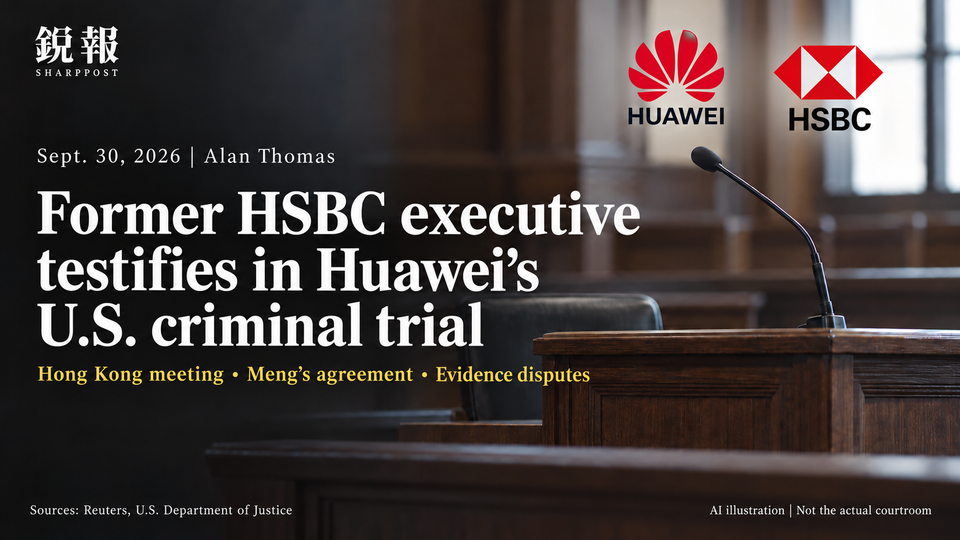
Former HSBC executive Alan Thomas testified on 30 September in the US government’s criminal case against Huawei in federal court in Brooklyn, New York. In August 2013, Huawei chief financial officer Meng Wanzhou met him in Hong Kong to explain the company’s relationship with Skycom, which operated in Iran.
According to the captions accompanying Reuters’ courtroom sketches, a photograph of Meng and a Reuters article were displayed as prosecutor Alexander Solomon questioned Thomas, HSBC’s former deputy head of global banking for Asia-Pacific. Huawei lawyer David Bitkower also cross-examined him. The public captions do not give the substance of his testimony.

Between December 2012 and January 2013, Reuters and other media reported on Skycom’s Iranian business and its links to Huawei. According to the statement of facts Meng signed in 2021, financial institutions providing international banking services to Huawei then sought explanations. Huawei requested a meeting with a senior executive at one of the banks.
That meeting took place in Hong Kong on 22 August 2013. Meng gave a PowerPoint presentation in Chinese, with an interpreter translating into English. She described Skycom as Huawei’s business partner in Iran, said they had a normal commercial relationship and said Huawei had sold its Skycom shares. The US documents call the bank “Financial Institution 1”. HSBC and Thomas were identified in the UK High Court’s 2021 judgment on Meng’s application for banking records.
The statement of facts Meng later acknowledged as accurate says Huawei subsidiary Hua Ying transferred its Skycom shares to Canicula in 2007, but Canicula was also controlled by Huawei. From 2010 to 2014, Huawei made Skycom’s major business decisions in Iran, and Skycom’s local manager was a Huawei employee.
The statement contrasts those ownership and control arrangements with Meng’s account at the meeting. It says she knew Huawei still controlled Skycom and describes that information as material to the bank. Prosecutors allege the bank was not given accurate information needed to assess the customer and the risks of the transactions.
The statement also records about $100 million in US-dollar transactions Skycom conducted through Financial Institution 1 between 2010 and 2014, cleared through the United States. It says at least some supported business in Iran that violated US law. These included about 80 payments totalling at least $7.5 million from Skycom’s Asian accounts to a British staffing company for engineers working on Iranian projects.
Meng signed a deferred prosecution agreement in September 2021 without pleading guilty. She confirmed the attached statement of facts was true and accurate to the best of her information and belief. She acknowledged making false statements to the bank about Skycom while knowing it remained under Huawei’s control. Paragraph 7 also barred her, and lawyers or other representatives authorised to speak for her, from making statements contradicting the statement of facts.
Prosecutors agreed to seek dismissal of the charges against Meng if she fulfilled her obligations during the deferral period. Her individual charges were dismissed in 2022, while the case against Huawei continued.
Huawei objected to the use of statements from Meng’s personal agreement in the company’s trial, arguing that her statements could not deprive it of its own right to remain silent. Reuters reported on 17 June that Judge Ann Donnelly rejected that argument and allowed prosecutors to use the statement. The judge cited Meng’s position as CFO, the fact that the statement concerned her conduct in that role, and Huawei’s adoption of her statements.
Paragraph 6 of the 2021 agreement addressed how the statement could be used if prosecutors resumed proceedings against Meng personally. This year’s separate ruling allows it to be used in prosecuting Huawei. That evidentiary decision was not a finding of the company’s guilt.

HSBC had compliance obligations of its own at the time of the 2013 meeting. In a December 2012 announcement, it confirmed settlements with US authorities over anti-money-laundering and sanctions compliance. It committed to cooperating with regulators and law enforcement, strengthening internal controls and accepting an independent monitor for five years.
What the bank knew is also central to Huawei’s defence. Reuters’ account of opening statements on 9 September reported its lawyers’ argument that the bank knew Huawei operated in Iran and still sought its business. The defence also said there was no evidence Huawei knew the dollar clearing would breach US sanctions, and that it could have used other currencies or processed transactions outside the United States. Huawei has pleaded not guilty.
Meng advanced more specific arguments during the earlier Canadian extradition proceedings. The UK High Court’s 2021 judgment recounted her position that knowledge of Huawei’s relationship with Skycom was not confined to junior HSBC staff. She also challenged the alleged link between the bank’s decision to continue serving Huawei and its processing of dollar receipts for the British staffing company. These were Meng’s submissions, not factual findings by the UK court.
The records she sought in Britain included Thomas’s internal correspondence about the Hong Kong meeting, HSBC risk committee material and Skycom transaction-monitoring records. The High Court dismissed the application in 2021, finding, among other reasons, that the legislation invoked did not apply to those foreign proceedings and the requested documents exceeded the statutory scope of bankers’ records. Assessing the bank’s knowledge requires distinguishing what account managers, regional executives and the risk committee knew, and how internal reports after the meeting described Huawei’s relationship with Skycom.
Huawei’s US case also includes trade-secret, money-laundering and obstruction-of-justice charges, extending beyond the 2013 meeting. As of 30 September, the trial was continuing and the jury had not returned a verdict.
You read this far. You're not here for noise.
SharpPost delivers one weekly deep dive on geopolitics, finance, and tech — decoded for readers who want signal. Carefully selected, never noisy.