US ends Iraq coalition mission; Syria operations continue
SharpPost examines official statements on Iraq's security transition, continuing Syria operations, Kurdish air-defence concerns and militia disarmament.
免费微软自然语音 · 推荐使用 Microsoft Edge
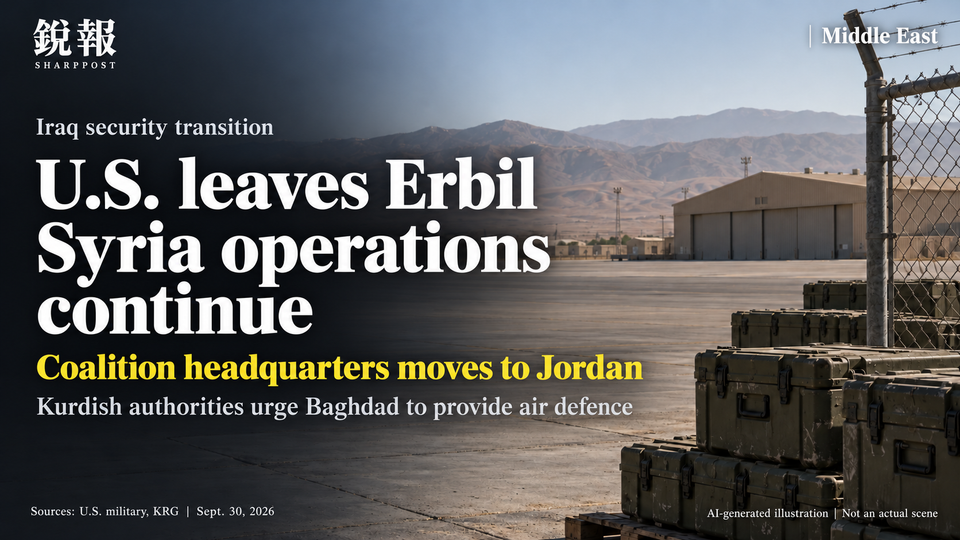
US Central Command announced on 30 September that American personnel and equipment had withdrawn from Erbil Air Base in northern Iraq, ending Operation Inherent Resolve’s mission in the country. The base had been an important coalition operations hub. US and coalition forces began leaving areas under Iraq’s federal government in October 2025, with the remaining withdrawal completed at Erbil.
CENTCOM’s announcement said the combined joint task force remained active, with its headquarters now in Jordan. It continues counter-Islamic State operations in Syria with coalition partners and the Syrian government, while the US-Iraqi defence relationship shifts to bilateral cooperation.

Washington and Baghdad announced a phased transition in September 2024. A US inspector-general report at the time set out plans for the coalition’s military mission in Iraq to end in September 2025 and shift to bilateral security cooperation. Support from Iraqi bases for counterterrorism operations in Syria was to continue until at least September 2026.
Britain’s defence ministry outlined its arrangements on 30 September. British personnel serving in the coalition mission had left Iraq, and future bilateral cooperation would cover counterterrorism, military education, capacity building and the defence industry. Britain also said Operation Shader, its contribution to the campaign against Islamic State, would continue.
In explaining the withdrawal, CENTCOM commander Brad Cooper pointed to Iraqi forces’ ability to counter Islamic State. He said the group no longer posed a systemic threat to Iraq’s national security, and that Iraqi security forces and Kurdish forces, including the Peshmerga, could independently address threats at home. US and coalition forces in the surrounding region remained ready to counter Islamic State, he said.
The Kurdistan Regional Government’s Ministry of Peshmerga Affairs raised a concern about air defence in its 28 September statement. It said the region had faced numerous drone and ballistic-missile attacks during the US-Israeli conflict with Iran, some causing civilian casualties. The ministry warned at the time that no replacement air-defence system would be in place when US forces withdrew.
The regional military response described in CENTCOM’s announcement was explicitly directed at Islamic State; the announcement did not identify a replacement air-defence system or deployment timetable. Further details are needed to establish how protection against the missile and drone threats raised by Kurdish officials would be provided after the withdrawal.
The Peshmerga ministry said Baghdad should assume responsibility for future air defence because the Kurdistan Region’s airspace is part of Iraq’s national airspace. It also emphasised that it formed part of Iraq’s defence system and would continue coordinating with the Iraqi military.
The Associated Press reported on 30 September that Prime Minister Ali al-Zaidi had told The New York Times that the original 30 September deadline for militias to disarm had been extended to June 2027. The same report quoted a statement from the Islamic Resistance in Iraq saying talks with the government over weapons had produced no agreement. The group said it was not bound by timetables announced by the government or political groups, but remained willing to join dialogue aimed at preserving Iraqi sovereignty.
You read this far. You're not here for noise.
SharpPost delivers one weekly deep dive on geopolitics, finance, and tech — decoded for readers who want signal. Carefully selected, never noisy.