Germany's "Driving School": anatomy of a transnational drugging-rape network
German prosecutors dismantled an 8-member core, 4,500-strong Telegram drugging-rape network run by Chinese nationals. Lead defendant: 14 years.
免费微软自然语音 · 推荐使用 Microsoft Edge
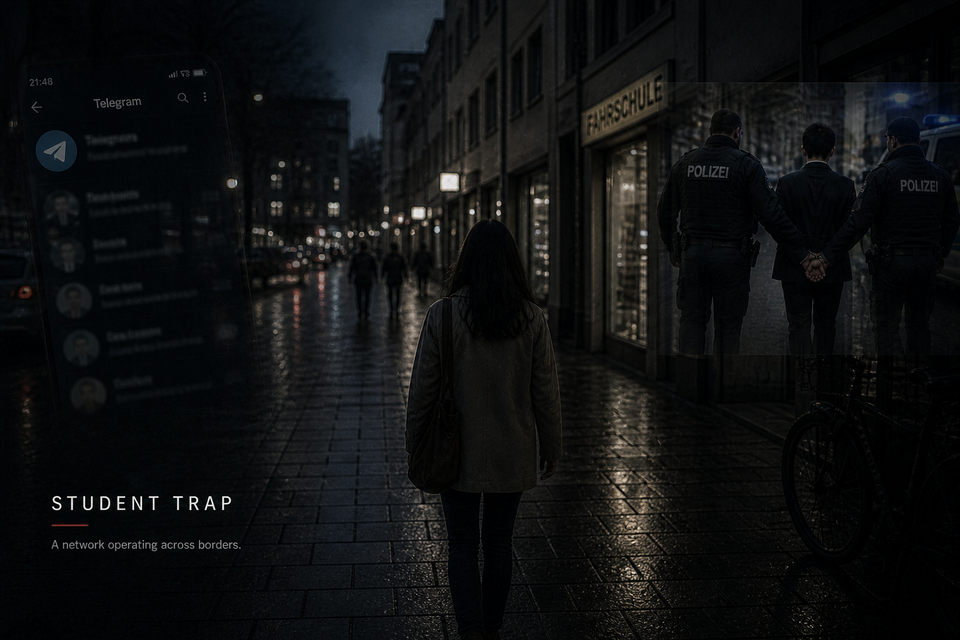
In February 2026, the Frankfurt Regional Court sentenced a 44-year-old Chinese national, Dapeng Z., to 14 years in prison and ordered subsequent preventive detention — meaning that even after his term expires, he can be held indefinitely if the court deems him a continuing threat. He had lived in Germany for more than two decades and worked, until his arrest, as an IT manager at the British sports-car maker Lotus. The conviction concerned 22 counts. It also concerned much more than one man.
Since 2020, Dapeng Z. had run a private Telegram group called Deutsche Fahrschule — "German Driving School." Its inner core had eight members. The outer rings reached roughly 4,500 people, of whom more than 2,000 were active in discussing how to drug women and in trading footage of the resulting assaults.
His method, according to the court's findings, was a closed loop. Posing as a woman on Chinese-language platforms WeChat and Xiaohongshu, he listed flats for rent, targeting newly-arrived Chinese female students who needed housing. When prospective tenants came to view, he pressed an anaesthetic-soaked cloth over their mouths, raped them, and filmed the assaults — uploading the videos to the Telegram group. Between January and November 2024, at least four women remembered enough to file complaints. He was arrested on 14 November 2024 at his workplace in southern Hesse. Investigators found more than ten million sexually violent image and video files on his computer.
Three convictions, one network
The Frankfurt case is not isolated. On 14 April 2026, a Munich court sentenced 28-year-old Zhongyi J. to 11 years and three months for two counts of attempted murder, six counts of aggravated rape, and violations of personal-image rights. Between 2023 and December 2024, he drugged and assaulted his female neighbour in his apartment at least seven times, using anaesthetic doses prosecutors estimated at five to ten times the medical norm — heavy enough that her breathing repeatedly stopped. Tong Z., a Berlin engineering student also part of the inner group, received five years and nine months in August 2025: he had drugged a woman during a date and filmed the assault, and had installed hidden cameras in the bathrooms of eight other women.
| Defendant | Court | Sentence | Method & key facts |
|---|---|---|---|
| Dapeng Z.44, Lotus IT manager | Frankfurt Feb 2026 |
14 yrs + preventive detention 22 counts |
Posed as woman on WeChat / Xiaohongshu listing flats; used anaesthetic-soaked cloth at viewings; 10M+ files seized |
| Zhongyi J.28 | Munich 14 Apr 2026 |
11 yrs 3 mos 2 attempted murder + 6 aggravated rape |
Drugged neighbour ≥7 times in own apartment; doses 5–10× medical norm; victim's breathing repeatedly stopped |
| Tong Z.Berlin engineering student | Berlin Aug 2025 |
5 yrs 9 mos Rape + voyeurism |
Date-rape filmed; hidden bathroom cameras targeting 8 other women |
| Zhiting S.32, medical professional | Berlin Trial: Mar 2026 – |
Verdict expected mid-May 2026 | Alleged "technical adviser" on dosing; prosecutors also pursuing 2016–21 China offences under extraterritorial jurisdiction |
| Xukeyuan X. · Sizhe W. | Berlin / Munich / Los Angeles | Pending; case details not public | Detained members of the core group of eight; charges and proceedings undisclosed |
The three men shared not only methods but vocabulary. Inside the chat, members called themselves "drivers." Their female targets were "cars": acquaintances and partners were "private cars," more attractive victims "luxury cars," and unconscious women — those drugged into immobility — "dead pigs." Sedatives were "fuel" or "oil." The lexicon served two purposes. The surface function was to evade keyword detection on platforms. The deeper function was to strip the women of personhood altogether: in the group's grammar, they had ceased to be people.
| Term in chat | Original (Chinese) | Referent |
|---|---|---|
| Driver | 司机 sī jī | Group member / perpetrator |
| Car | 汽车 qì chē | Female target, generic |
| Private car | 私家车 sī jiā chē | Acquaintance, colleague, or partner of perpetrator |
| Luxury car | 豪华车 háo huá chē | Victim deemed more attractive |
| Dead pig | 死猪 sǐ zhū | Woman drugged into unconsciousness |
| Fuel / Oil | 油 / 燃料 | Sedatives |
| Driving School | 老司机驾校 | The chat group itself |
The supply chain
The drug pipeline crossed two continents. Zhiting S., 32, a Berlin medical professional and core member of the group, is alleged by prosecutors to have served as the network's "technical adviser" — counselling other members on which sedatives to use, how to mix them, and how much to dose. The drugs themselves were sourced through illicit channels on WeChat and shipped between members by post; some packages were disguised as cosmetics or skincare to slip past customs. His trial opened at the Berlin Regional Court in March 2026; prosecutors are also pursuing offences they say he committed in mainland China between 2016 and 2021, brought into the German indictment under Germany's extraterritorial-jurisdiction provisions for serious sexual crimes. A verdict is expected in mid-May.
The chemistry of the supply chain illustrates how thin the line between commerce and predation has become. Gamma-butyrolactone (GBL), classified as a controlled precursor in the EU, is nonetheless legally available because of its industrial uses, including as a nail-polish remover. One member of the network sold disguised "nail-polish remover" through an online storefront; what buyers received was GBL, which the body converts into the date-rape drug GHB. Surgical-grade anaesthetics required tighter access — and that is where Zhiting S.'s medical credentials reportedly mattered. The supply chain ran from Chinese illicit suppliers, through disguised cross-border parcels, to a chemistry-literate adviser inside the chat. Each link bore the marks of division of labour. Spontaneous individual crime does not produce this kind of architecture.
The London parallel
On 19 March 2025, an Inner London Crown Court jury convicted 27-year-old Zhenhao Zou, a Chinese PhD student at University College London, on 28 counts including 11 of rape and 3 of voyeurism. He received a life sentence in June, with a minimum term of 24 years. Between 2019 and 2023, Zou drugged and raped at least 10 women in London and in mainland China, using a method that mirrored the Frankfurt model: contact young Chinese women through dating and social platforms, invite them to his flat under pretexts of study or socialising, and film the assaults. After the verdict, at least 24 additional women came forward to police.
| Frankfurt — Dapeng Z. | London — Zhenhao Zou | |
|---|---|---|
| Period of offences | Jan – Nov 2024 | 2019 – 2023 |
| Targeting platform | WeChat / Xiaohongshu apartment ads | Dating apps and social platforms |
| First-contact pretext | Apartment viewing | Drinks or study session at his flat |
| Drug method | Anaesthetic-soaked cloth over mouth | Drugged drinks |
| Recording | Each assault filmed; uploaded to chat | Each assault filmed; some kept privately |
| Victims (court-recognised) | ≥4 in Frankfurt indictment | 10; another 24+ came forward post-verdict |
| Sentence | 14 yrs + preventive detention | Life, min. 24 yrs |
| Network involvement | Inner core of "Driving School" (8) | Overlapping chats; network reaches 20+ countries |
No court has yet ruled the British and German cases organisationally connected. What is documented is that the men moved within overlapping chat groups and that the broader network spans more than 20 countries. The shared infrastructure is real. Whether it amounts to a single criminal organisation, in a legal sense, is a question prosecutors have so far declined to answer.
What the case actually exposes
The architecture of the crime is what should command attention. Telegram's end-to-end encryption, weak identity verification, and limited content moderation provided a near-perfect refuge: the 4,500-strong outer group ran from 2020 to late 2024 — four years, undisturbed. Even after STRG_F, the investigative unit of German public broadcaster NDR, spent more than a year exposing Telegram channels with upwards of 70,000 members trading sexual-violence material, the platform's response was to remove the flagged groups; new ones reappeared almost immediately. Telegram says it has "zero tolerance" for abuse. Its architecture, however, is engineered to make tolerance the default.
Cross-border enforcement worked no better. Of the eight inner members, some were arrested in Frankfurt, some in Munich and Berlin, one in Los Angeles; Zou was caught in London. Where a perpetrator is detained depends largely on where he happens to live, not on any institutional pursuit. Germany and China have no extradition treaty; cooperation operates on a request-and-assist basis, case by case. Chinese police did supply technical support on social-network analysis when Berlin asked. There is no public indication that Chinese authorities have opened their own investigation into Zhiting S.'s alleged 2016-2021 crimes inside China. Across the 20-plus countries the network reached, the great majority of its outer-ring participants remain effectively beyond any jurisdiction's reach.
The victims faced a parallel form of insulation. Chinese female students in Germany sit between two walls: language barriers and unfamiliarity with the German legal system make direct contact with police difficult; the trust networks of "fellow-countrymen mutual help" within the Chinese community, on the other hand, were precisely what the perpetrators used. Helping with apartments, introducing friends — these are the daily practice of any expatriate community. The criminals embedded themselves within it. Most victims learned what had happened only when police contacted them. Even after learning, publicly accusing a "compatriot" with elite credentials and a respectable job, inside a relatively closed Chinese community abroad, carries social costs heavy enough to enforce silence.
Why Chinese-language coverage is thin
German mainstream outlets — hessenschau, taz, Deutsche Welle — have covered the case in detail, and the South China Morning Post described it in English as a "Pelicot-style" rape case. Chinese-language coverage has been scarce. Part of the reason is structural: German-language primary reporting sits behind a language barrier. Part is platform-based: discussion of sexual violence on Chinese platforms is subject to moderation pressure, and posts about this case on Xiaohongshu and WeChat have been visibly less surfaced than the gravity of the events would suggest, though direct evidence of suppression is hard to cite. Part is cultural: the suspects' "elite-school" pedigrees clash with the public stereotype of who commits such crimes, blunting the appetite to spread the story. Discussion in the Chinese internet only began to gather momentum in April 2026, after the Chinese-language Wikipedia entry was created and bloggers used LinkedIn to identify suspects by face and name.
Status as of 5 May 2026: Zhiting S.'s trial continues at the Berlin Regional Court, with a verdict expected in mid-May. Cases involving other detained members — Xukeyuan X. and Sizhe W. — are not yet public. The wider Telegram channels exposed by STRG_F, including groups exceeding 70,000 members, remain operational.
What this case exposes is not the moral failure of a few individuals. It is the failure of a system: the governance vacuum of encrypted platforms, the structural fractures in cross-border justice, the trust mechanisms inside diaspora communities that criminals have learned to hijack, and the helplessness of drug controls in a globalised supply chain. Four years, 20-plus countries, no institutional disruption. The cost is borne by women who, for the most part, still do not know what was done to them.
Sources: Frankfurt Regional Court ruling (Feb 2026); Munich Regional Court ruling (14 April 2026); Berlin Regional Court ruling (Aug 2025); Inner London Crown Court verdict and sentencing (Mar / Jun 2025); reporting by hessenschau, taz, Deutsche Welle, South China Morning Post, BBC, CNN; STRG_F / NDR investigations; UK Crown Prosecution Service and Metropolitan Police statements; UCL official statement. Items attributed to "prosecutors" reflect charges under trial and have not yet been adjudicated.
You read this far. You're not here for noise.
SharpPost delivers one weekly deep dive on geopolitics, finance, and tech — decoded for readers who want signal. Carefully selected, never noisy.