Samsung Keeps Suzhou Open But Stops Selling — The Latest Stop in 15 Years of Foreign Appliance Retreat
On May 6, Samsung confirmed it has stopped selling home appliances in mainland China, but the Suzhou plant stays open and pivots to exports. Three timelines converge — 15 years of appliance retreat, 7 years of automotive JV exits, 2 years of tech reshoring.
免费微软自然语音 · 推荐使用 Microsoft Edge
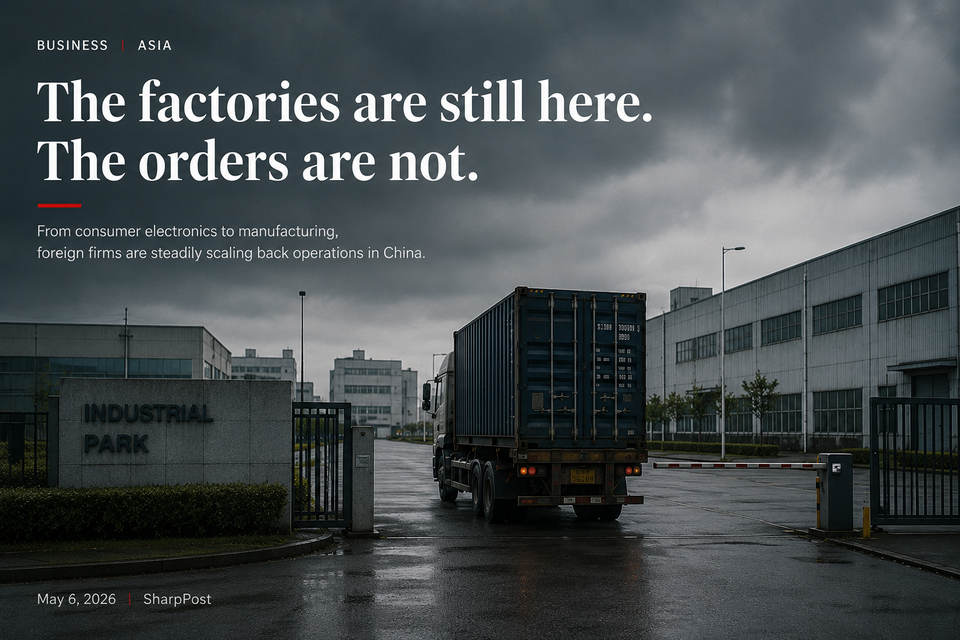
On May 6, Samsung Electronics issued a statement confirming the discontinuation of all home appliance sales in mainland China — televisions, monitors, air conditioners, refrigerators, washing machines, dryers, clothing care machines, and air purifiers. A less-noticed line in the same announcement: the refrigerator, washing machine, and air conditioner production lines in Suzhou will not close, and will be repurposed to supply the United States and Southeast Asia.
This is the latest stop on a fifteen-year retreat by foreign home-appliance brands from China. Samsung's "exit" carries a more complicated signal — multinationals no longer treat China as a terminal market, but still treat it as a manufacturing node in the global supply chain. Whether that positioning holds as U.S.-China competition continues to escalate is an open question.
What "Exit" Actually Means
Samsung operates 16 manufacturing entities and 13 R&D centers across mainland China — Beijing, Shanghai, Tianjin, Suzhou, Shenzhen, and Xi'an. The May 6 announcement covers sales only. Production lines, R&D centers, the semiconductor business, and the smartphone business all continue. Suzhou's appliance lines shift from domestic supply to export, with the United States and Southeast Asia as primary destinations.
The proximate cause is in Samsung's own filings: under sustained pressure from Haier, Midea, Gree, TCL, Hisense, and Xiaomi, Samsung's appliance share in China had been compressed year after year, and the unit had stopped delivering profit. Samsung is not unique. Japanese appliance brands began retreating along similar paths in 2011.
| Year | Company | Business | Disposition |
|---|---|---|---|
| 2011 | Panasonic | Sanyo white goods | Sold to Haier |
| 2015 | Panasonic | Sanyo brown goods | Sold to Changhong |
| 2016 | Toshiba | White goods (80.1%) | Sold to Midea for ¥52.7 bn yen |
| 2016 | Sharp | Whole company | Acquired by Foxconn for ¥388.8 bn yen |
| 2017 | Toshiba | TV business (China) | Sold to Hisense |
| 2023/12 | Toshiba | Parent company | Delisted from Tokyo Stock Exchange (74-year history) |
| 2025/2 | Panasonic | Television business | Global exit |
| 2026/5 | Samsung | Appliances & TVs | China sales halt; plants pivot to export |
Source: company filings
Different Sectors, Same Pressure
Appliances are not isolated. Looking at automotive and technology in parallel, the foreign footprint in China has contracted simultaneously over the past seven years.
Automotive joint ventures. In June 2018, Suzuki announced its exit from China — Changhe Suzuki and Chang'an Suzuki were both dissolved, with Chang'an acquiring Suzuki's stake in Chang'an Suzuki for one yuan. In July 2025, Mitsubishi Motors severed its joint venture with Shenyang Aerospace Mitsubishi, ending its automotive production presence in China. Stellantis took a different route — in October 2023, it invested €1.5 billion to acquire roughly 20% of Leapmotor, replacing in-house development with indirect ownership through a Chinese partner.
Technology and manufacturing reshuffling. The pace of foreign manufacturing departure accelerated from 2023 onward. Dell announced plans to complete 100% production relocation by 2027. Apple shifted part of its iPhone 15 orders to India. HP deregistered its Shanghai entity in early 2024 and moved its commercial laptop supply chain to Thailand and Mexico. Panasonic withdrew its Guangzhou compressor base in April 2024. Microsoft closed all licensed retail stores in China that July and cut nearly 2,000 R&D positions. IBM closed its China Development Lab and Systems Lab in 2024, affecting more than 1,800 staff.
| Date | Company | Sector | Action |
|---|---|---|---|
| 2018/6 | Suzuki | Auto | Full withdrawal; Changhe & Chang'an Suzuki dissolved |
| 2023/8 | Apple | Consumer electronics | Part of iPhone 15 production shifted to India |
| 2023/12 | Toshiba | Appliances | Parent company delisted |
| 2024/1 | HP | Tech | Commercial laptop chain to Thailand & Mexico; Shanghai entity deregistered |
| 2024/4 | Panasonic | Manufacturing | Guangzhou compressor base withdrawn |
| 2024/7 | Microsoft | Tech | All licensed retail stores closed in China |
| 2024 | IBM | Tech | China research labs closed; 1,800+ staff affected |
| 2024 | Dell | Tech | Committed to 100% production exit by 2027 |
| 2025/2 | Panasonic | Appliances | Global exit from television business |
| 2025/7 | Mitsubishi | Auto | Severed Shenyang Aerospace Mitsubishi JV |
| 2026/5 | Samsung | Appliances | Full appliance and TV sales halt in mainland China |
Source: company filings, MOFCOM, news reporting
Stacked on a single chart, the three timelines coincide with a historic break in FDI inflows.
(¥ billion)
Source: MOFCOM China FDI Statistical Bulletin (annual editions); NBS monthly FDI data Data: SharpPost Research|Design: SharpPost Visual
The 2024 figure of ¥826.25 billion is 83% of the 2020 level and 67% of the 2022 peak. The 27.1% year-on-year drop is the sharpest decline in decades since reform and opening. January 2025 fell another 13.4% — the weakest first-month reading since 2021.
From Factory Floors to Tax Receipts to Confidence Curves
The consequences of foreign exit fall across four layers, each with measurable scope.
Employment: from direct payrolls to upstream and downstream supply
Foreign-invested enterprises account for roughly 2% of China's market entities but contribute about one-tenth of urban employment (around 30 million direct positions). With supply chain effects included, indirect employment ranges between 100 and 150 million. IBM's China lab closure displaced 1,800 staff in a single round; Microsoft cut roughly 2,000 R&D positions; HP's laptop supply chain relocation involves more than 200 upstream and downstream component suppliers. Samsung's Suzhou plant currently employs several thousand workers — those positions are preserved by the export pivot, but sales, marketing, and after-sales staff tied to the domestic channel face restructuring.
Tax: a contribution share well above the capital share
Foreign-invested enterprises contribute about one-seventh (roughly 14%) of national tax revenue and about one-third of foreign trade. At the local level, industrial parks across the Yangtze and Pearl River Deltas — Suzhou Industrial Park and Shanghai's Caohejing among them — depend on foreign tax contribution to a meaningfully larger degree. The fiscal impact of anchor exits like Samsung Suzhou and HP Shanghai will not surface on the day of the announcement; it will appear in tax filing cycles two to three years out.
Supply chain: forced upward substitution
The other side of foreign exit is accelerated domestic substitution. Haier, Midea, and Hisense have each completed a round of internationalization through acquisitions of Japanese appliance assets; TCL and Xiaomi have absorbed part of the share Samsung is leaving behind. The upper layer of the supply chain has not kept the same pace, however — import dependence remains elevated for semiconductor manufacturing equipment, high-end industrial software, and specialty chemicals. Low-end foreign exit alongside constrained high-end supply produces an asymmetric reshuffle, not a clean substitution.
Foreign confidence and global division of labor
Harder to measure but with longer-running effects is the confidence signal. At the Berkshire Hathaway 2026 annual meeting, Buffett described the current market as "a church with a casino attached" and framed Berkshire's $397.4 billion cash pile as a valuation judgment, not a liquidity preference. The mirror of that framing shows up in multinational China asset allocation — Samsung keeping Suzhou open, Stellantis taking equity in Leapmotor, Apple retaining Chinese production while expanding Indian capacity. These are different executions of the same logic: preserve manufacturing capability, redistribute market exposure.
Vietnam is the largest beneficiary of this redistribution. The April 2026 Tech Tracker recorded Huawei's Ascend 950PR ramp, the HBM bottleneck, and the reversal of U.S. export controls. The same logic maps onto manufacturing: in 2024, China's exports to Vietnam grew 18% to a record $162 billion. Vietnam's imports from China are dominated by raw materials and components — economically, an extension of Chinese manufacturing rather than a replacement of it. "China + 1" has moved from rhetoric to measurable growth in Vietnamese ports, the Hai Phong industrial zone, and Ho Chi Minh City warehouse capacity.
China's official narrative on foreign capital outflow centers on structural upgrading. In 2024, FDI in medical instrument manufacturing rose 98.7% year-on-year, and in computer and office equipment manufacturing rose 21.9% — high-technology sectors saw foreign capital flow against the broader trend. The 2025 China Foreign Investment Statistical Bulletin reports that the foreign-investment access negative list shrank from 93 items in 2017 to 29 items in the 2024 edition, with foreign-access restrictions in manufacturing fully eliminated; the 2025 Foreign Investment Stabilization Action Plan formally opened pilot programs in telecommunications, healthcare, and education to foreign investment.
The narrative has data behind it — labor-intensive foreign capital is leaving while high-technology foreign capital is coming in. But the headline 27.1% drop is too large to be offset by the high-technology gains. Structural upgrading is real; aggregate contraction is also real; both coexist.
What to Watch Next
In February 2025, the Ministry of Commerce and the National Development and Reform Commission jointly issued the 2025 Foreign Investment Stabilization Action Plan, with 20 measures including expanded foreign-investment pilot programs in telecommunications, healthcare, and education, and the removal of restrictions on foreign-enterprise domestic borrowing. Whether the FDI decline can be halted will depend on whether 2025 full-year actual FDI returns above ¥800 billion.
A second observation point is the ceiling of Vietnam's intermediation. Vietnam imported $162 billion from China in 2024, processing the inputs for re-export to the United States and Europe. The processing-trade logic is plain, but Vietnamese costs in ports, electricity, land, and labor are rising fast. If Vietnam's cost curve peaks in 2026, where does "China + 1" relocate next? India, Mexico, and Indonesia are the three candidates currently on the watch list.
The moment Samsung's Suzhou plant flipped from domestic supply to export defines China's role differently — from "world factory and world market" to "part of the world factory, but no longer the world market." Haier and Midea have absorbed the domestic share Samsung leaves behind; Vietnam, India, and Mexico have absorbed part of the offshored capacity. The remaining question is whether the high-technology foreign capital coming in can fill the gap left by the labor-intensive capital leaving. The answer requires two more years of actual data — 2026 and 2027.
Sources: Samsung Electronics statement of May 6, 2026; MOFCOM China Foreign Investment Statistical Bulletin (2024 and 2025 editions); NDRC Special Administrative Measures on Access of Foreign Investment (Negative List) 2024 Edition; National Bureau of Statistics monthly FDI data; MOFCOM-NDRC 2025 Foreign Investment Stabilization Action Plan; Sina Finance, 21st Century Business Herald, Reuters, Wall Street Journal, RFA, Caijing on foreign exits by IBM / Microsoft / Dell / HP / Panasonic / Mitsubishi / Suzuki; Vietnam General Department of Customs 2024 trade data; TrendForce appliance market share data.
You read this far. You're not here for noise.
SharpPost delivers one weekly deep dive on geopolitics, finance, and tech — decoded for readers who want signal. Carefully selected, never noisy.