Chongqing Animal-Abuse Case Becomes a Dispute Over Police Use of Force
A Chongqing animal-abuse case has widened after videos appeared to show police clearing animal-rescue volunteers from outside a residential compound.

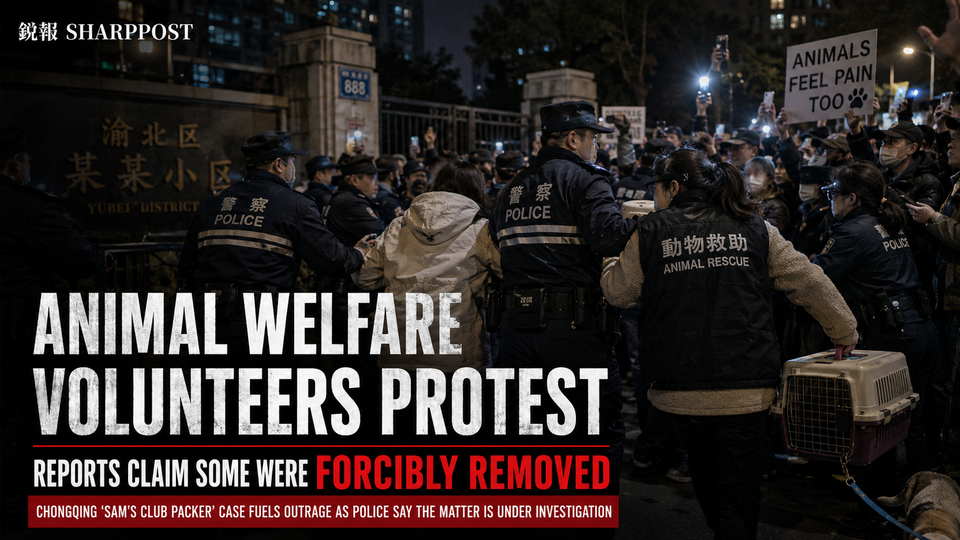
The case began with an allegation of cruelty to cats and dogs. By June 9, it had become something larger: a confrontation outside a residential compound in Chongqing, where animal-rescue volunteers said police dragged people away and took phones from those filming the scene.
The videos circulating online are brief and incomplete. They show uniformed personnel, crowds at the entrance of a compound in Jiangbei district, people shouting, and several moments of physical struggle. Officials have not yet given a full public account of what happened during the clear-out.

At the centre of the allegations is a man surnamed Li. Online, he is known by a nickname that roughly translates as “the Sam’s Club packer”, a reference to his alleged workplace identity. Volunteers say he entered animal-rescue groups, presented himself as an adopter, gained trust and took away kittens and puppies.
One name appeared again and again in rescue groups: Dongdong, a two-month-old puppy. Volunteers say it was found badly injured. Its mother, Xiaoman, had died. Screenshots and posts named other alleged victims, while former owners began going back through chat records and contacting rescuers or police.
What the footage appears to show
Hong Kong outlet on.cc reported that several hundred volunteers gathered outside the compound where Li was said to live, demanding that the alleged abuser be punished. Local police said they had intervened and were still verifying the case.


The clips do not show everything that happened before or after. That matters. But the absence of a full official explanation has left the online footage to carry the story on its own.
Volunteers at the scene were asking whether any animals were still alive inside, what progress police had made, and why earlier reports had not stopped the alleged abuse from continuing.
The legal gap
China does not have a national animal-cruelty law. Abuse of companion animals is not a stand-alone offence under criminal law or public-security law. In cases like this, police usually have to look for other legal hooks: throwing objects from height, damaging property, distributing illegal videos or disturbing public order.
If a cat or dog has a clearly identified owner, the case may be treated as damage to property. Stray animals, or animals that have already been handed over through an adoption arrangement, are harder. Under the existing framework, animals are usually treated as property or as objects of management, not as lives whose suffering can itself anchor a case.
Why rescuers fear fake adoptions
The accusation against Li is especially alarming for animal rescuers because it hits one of the weakest points in informal rescue work. Adoption often depends on chat records, home visits, deposits, follow-up checks and, in the end, trust. If someone is willing to lie carefully and wait patiently, the warning signs can be hard to spot.
Mainland media, including Xinhua, have reported in recent years on online markets for animal-abuse videos. Some groups price clips according to cruelty, while others use “entry proof” to screen members. Young animals are easy to obtain for free. Donors are often scattered across different cities. In that market, fake adoption can become a low-cost way to acquire victims.
From animal cruelty to public order
After June 9, many online comments accused police of “protecting the abuser”. From a local enforcement perspective, however, a residential entrance, residents trying to get in and out, livestreams and a growing crowd can all become a public-order problem. The longer the scene remains, the more people it may draw.


Public order may explain why police wanted the crowd to leave. It does not automatically explain how they removed people. If the dragging, phone-grabbing and carrying away alleged online happened as described, police still need to explain why those measures were necessary, whether less forceful options were available, and whether official records of the operation have been preserved.
How other Asian systems draw the line
Other Asian jurisdictions have taken a more direct route. Singapore’s Animal and Veterinary Service lists beating, kicking, abusing or terrifying an animal, as well as causing unnecessary pain or suffering, as forms of animal cruelty that may be investigated. A first-time offender can face a fine of up to S$15,000, or up to 18 months in prison.
Taiwan’s Animal Protection Act also makes “harm” concrete. Deliberately injuring an animal, causing disability or the loss of important organ function can bring criminal punishment and fines. In more serious cases involving drugs or firearms that cause the death of multiple animals, the sentence can reach one to five years. Japan, after a 2019 revision, raised the maximum penalty for killing or injuring protected animals without reason to up to five years in prison or a fine of up to five million yen.
South Korea has also written cruel killing into its animal-protection law. The Ministry of Agriculture, Food and Rural Affairs has said abuse leading to the death of a companion animal can be punished by up to three years in prison or a fine of up to 30 million won.
One comment widely shared on Chinese social media was blunt: “If people’s rights cannot be protected, what chance do animals have?” It captured why the case moved beyond animal cruelty. For many watching the June 9 footage, the question became not only whether the animals could be protected, but whether the people asking for that protection could be treated lawfully and with restraint.
The crowd outside the Chongqing compound will eventually disperse. Li will await the result of the police investigation. But the deeper problem is unlikely to leave with the crowd: in mainland China, abuse of companion animals still lacks a clear legal place, and the people trying to force a response can quickly find themselves treated as the problem.
Source note: This article draws on public reporting by on.cc and Sohu/Dahe Daily, videos and screenshots circulated on social media and Telegram on June 9, and public materials from Singapore’s AVS, Taiwan’s Ministry of Agriculture legal database, Japanese legal-translation and environment ministry materials, and South Korea’s Ministry of Agriculture, Food and Rural Affairs. The specific physical confrontations during the clear-out have not been fully explained by officials; this article describes them cautiously as claims and footage circulating online.
You read this far. You're not here for noise.
SharpPost delivers one weekly deep dive on geopolitics, finance, and tech — decoded for readers who want signal. Carefully selected, never noisy.