US strikes Iran for 13th straight night as Trump weighs wider attack
US forces have struck Iran for a 13th straight night as President Donald Trump weighs a larger operation. Officials say no final decision has been made and no new orders issued.

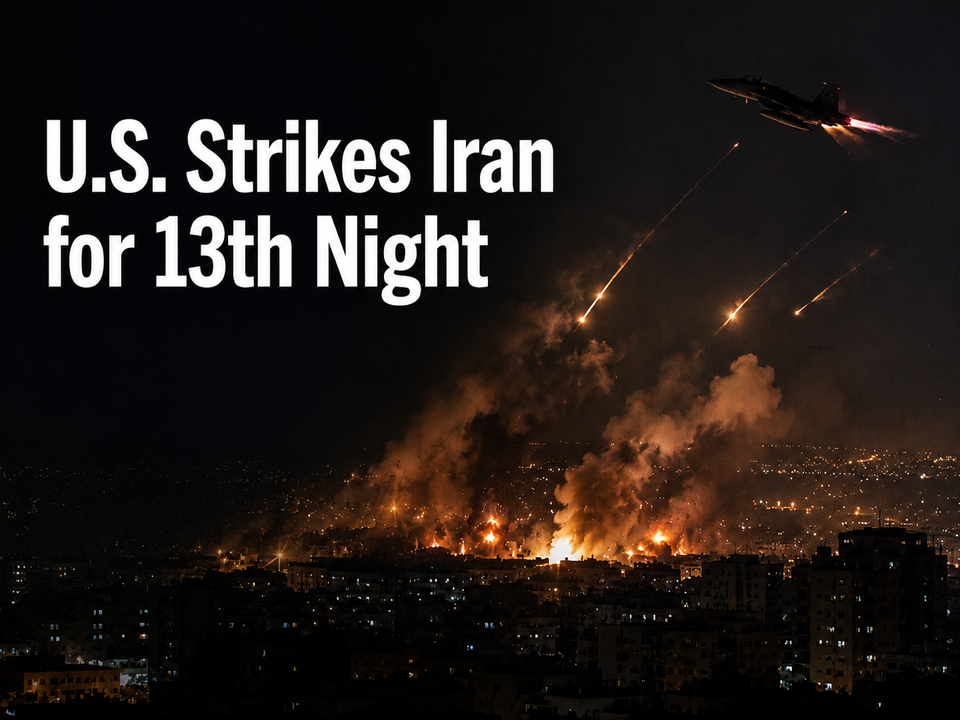
US Central Command says American forces have completed a 13th consecutive night of strikes on Iran. President Donald Trump says he is close to deciding whether to order a larger operation, but US officials say no final decision has been made and the military has received no new orders.
CENTCOM said late on July 23 that the latest targets included Iranian military command centres, drone storage sites, communications networks, coastal surveillance systems and maritime capabilities. The command said the operation was intended to reduce Iran's ability to threaten civilian crews and commercial shipping in the Strait of Hormuz. About 50,000 US military personnel are now stationed across the Middle East.

Iranian state media said one strike hit an Islamic Revolutionary Guard Corps naval base in the north of the country. The Associated Press also reported attacks in Qeshm, Isfahan, Khuzestan and Fars provinces. Claims made by either side about targets destroyed or military losses could not be independently verified in full.
Iran continued its own attacks across the region. Kurdish security forces said five explosive drones were intercepted over Erbil without causing casualties or damage. Bahrain reported additional interceptions, while Kuwait and Jordan also issued notices about incoming missiles or drones. Tehran says it is targeting US military facilities; governments hosting those bases have accused Iran of violating their airspace and sovereignty.
Iran's Health Ministry says 3,434 people have been killed since the conflict began on February 28, including 55 during the latest round of fighting in July. Those figures have not been independently confirmed. The Associated Press has reported that at least four US service members were killed after hostilities resumed this month.
A ceasefire reached in June began to unravel in early July. The White House notified Congress on July 7 that fighting had resumed. US strikes expanded on July 12, followed by a maritime blockade announced a day later. The target list has since moved beyond coastal and naval sites to include bridges, communications facilities, energy infrastructure and military positions farther inland.
Trump told Axios that he was seriously considering a larger attack and was close to making a decision. He did not set a deadline. Two US officials told the outlet that the president had not made a final choice and that no new military orders had been issued. Trump also said Iran was not ready to end the fighting and that Israel could join another operation if asked, although the United States could act alone.
The current campaign remains smaller than the opening US assault on February 28, and Israel has not taken part in the latest round. Washington has not announced an occupation, a campaign for regime change or a long ground war. There is also no public evidence that Trump has ordered such an operation. The widening target list, attacks close to civilian infrastructure and the presence of tens of thousands of US troops nevertheless leave little margin for a contained escalation.
CENTCOM says the Strait of Hormuz remains open and that US forces are supporting commercial traffic. The International Maritime Organization has given a different measure of the disruption: about 400 ships and 6,000 seafarers were stranded in or near the waterway. The strait may remain legally open while still being too dangerous or costly for some operators to use normally.

Brent crude briefly rose above $100 a barrel on July 24 before easing. Yemen's Houthi movement said the same day that it had attacked two Saudi oil tankers, renewing concern about shipping through the Bab el-Mandeb strait. Sustained attacks around both Hormuz and Bab el-Mandeb would place two of the Middle East's principal energy export routes under pressure at the same time.
As of publication, the White House had announced neither a new large-scale operation nor acceptance of a ceasefire proposal. Thirteen nights of US strikes, Iranian missile and drone attacks on neighbouring states, and the president's public discussion of a wider campaign show that the June truce no longer restrains the conflict.
Sources: US Department of Defense coverage of operations involving Iran; a reproduction of CENTCOM's July 23 statement; Axios's interview with President Trump; Associated Press reporting on the July 24 fighting and the widening US campaign; and the International Maritime Organization's statement on stranded crews. Casualty and battlefield claims from the parties to the conflict remain subject to incomplete independent verification.
You read this far. You're not here for noise.
SharpPost delivers one weekly deep dive on geopolitics, finance, and tech — decoded for readers who want signal. Carefully selected, never noisy.