A Real OTA-Lock Crisis and a Fake Watchdog List: Five Years of China's EVs
A CCTV-net article on April 17 cited 12,000+ OTA battery-lock complaints in March alone, up 273% year-on-year. Three weeks later, a fabricated regulator-summons list went viral; CAAM and eight automakers denied it the next day.
免费微软自然语音 · 推荐使用 Microsoft Edge
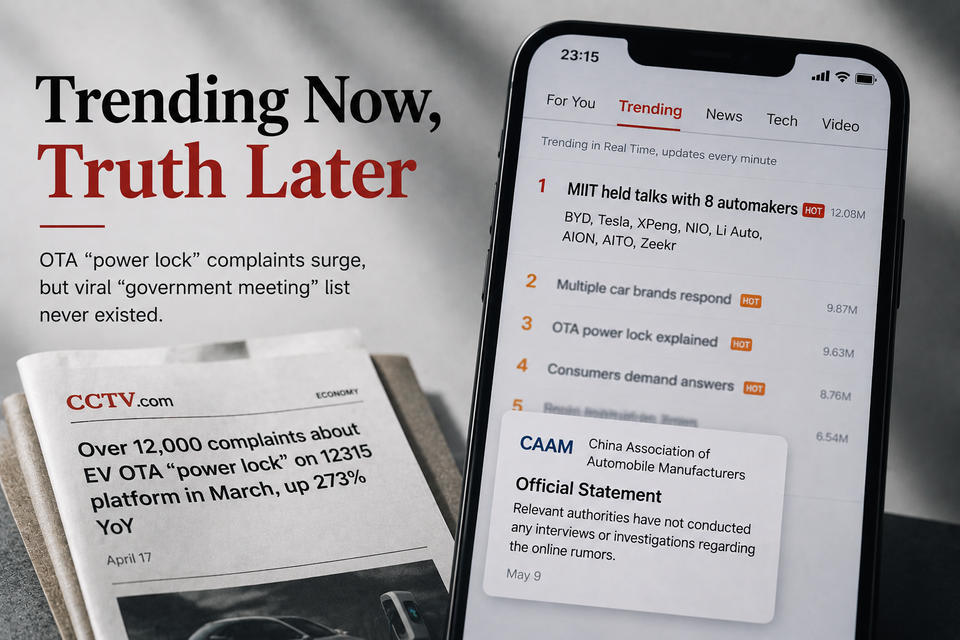
On April 17, CCTV-net's WeChat account reported that China's consumer hotline received over 12,000 complaints about EV OTA battery-locking in March 2026 alone, up 273% year on year. On May 8, a fabricated list claiming the Ministry of Industry had summoned eight automakers and opened investigations into three trended to the top of Weibo. On May 9, CAAM deputy secretary-general Liu Yan said in a public statement that "the relevant authorities have conducted no such summons or investigations; the online claims have no official source." All eight named companies issued denials the same day. CCTV-net then corrected its own wording, recasting "recent summons" as "cumulative since 2020." The OTA-locking problem is real. The summons story was not.
What battery locking actually is
Battery locking is not a new practice. In 2020, GAC Aion used an OTA update to cap AION S charging after welding defects raised overcharging risk. The CCTV-net piece offered a more recent owner case: an EV with a stated CLTC range of 510 km could not reach 300 km after one OTA update; a fast charge that previously took 40 minutes now took 70. Dealership staff cited "winter cold" and "system optimization" as explanations and refused to confirm whether battery management parameters had been changed.
The economic motive is simple. Chinese national standards require batteries to retain at least 80% capacity within eight years or 120,000 km, or the manufacturer must replace them at no charge. Locking a vehicle's usable capacity and charging power slows recorded physical degradation. For an automaker selling millions a year, that means tens of billions of yuan in saved warranty cost. Chinese lawyers' verdict on the practice is direct: under the Consumer Protection Law, unilaterally altering product specifications violates the buyer's right to informed choice, constitutes a breach of contract, and where it amounts to fraud, allows customers to claim a triple refund. In March 2026, the Ministry of Industry and the State Administration for Market Regulation issued joint rules prohibiting silent forced updates, stealth performance cuts, OTA used to mask recall-worthy defects, and any update filed without prior approval.
Locking is one slice
Locking is one slice. In August 2021, NIO ES8 owner Lin Wenqin died on a Fujian expressway after his car, in NOP highway-pilot mode, struck a maintenance truck. In April 2024 in Shanxi, a Huawei AITO M7 Plus rear-ended a maintenance vehicle at 115 km/h; the front caught fire, the doors did not unlock, three people died. In March 2025, three young women in a Xiaomi SU7 in NOA mode struck a concrete barrier in Anhui at 116 km/h; CEO Lei Jun apologized three days later. Liability remains unsettled in all three cases. They have nonetheless changed the rules. In April 2025, the Ministry of Industry summoned around 60 automaker representatives to a closed-door meeting (following the Wuhan Apollo Go suspension) and told them to stop using "autonomous driving" or "advanced smart driving" in marketing; "combined driving assistance" became the required term. Xiaomi recalled 116,887 SU7 standard models in September 2025 for L2 driver-assist deficiencies, the first such recall in China.
Hidden door handles surfaced in the same period. In April 2023, Yang Qinglan, a deputy presiding judge of a court division and a BYD Han owner, died on the Baomao Expressway after a collision and fire. According to a public letter from her family, the door handles failed to deploy and rescue was lost. In early 2024, a BYD Destroyer 05 caught fire on rollover impact and the doors again refused to open. In September 2025, the Daxing District Court in Beijing ordered Tesla to provide 30 minutes of pre-crash driving data to a plaintiff—the first such court-compelled disclosure in China.
The recall curve has shifted
NEV recalls totaled 830,000 vehicles in 2021, 1.21 million in 2022, 1.60 million in 2023, and 4.49 million in 2024. That is a four-fold expansion over four years. The 2024 figure alone was up 180.1% from 2023. Within that total, OTA-mode recalls reached 4.07 million units, up 246.8%. Hardware recalls are giving way to software recalls. The factory-floor mechanics are mature; the software layer is not. NEV recalls fell to 2.65 million units in 2025 across 105 separate actions, reflecting real progress on the three-electric (battery, motor, electronic control) hardware front.
Source: SAMR annual recall bulletins. 2024 single-year jump +180.1%; OTA-mode recalls within 2024 reached 4.07 million units.
The export-versus-domestic mirror
China's NEV exports have grown sharply: about 580,000 Chinese-brand EVs sold in Europe in 2024 and over 600,000 in 2025. The recall curve abroad runs very differently. In September 2024, BYD recalled 96,714 Yuan Plus (exported as Atto 3) and Dolphin units in China over a power-steering controller defect that could short-circuit and start a fire. In October 2025, it recalled another 115,738 Tang and Yuan Pro units. BYD's Australian importer EVDirect said local Atto 3 units were not affected. Overseas recalls on the public record are smaller and scattered: MG ZS in the UK over NOx-emission calibration (31,387 units), Chery Omoda 5 in Australia for loose brake-line bolts (5,901 units), GWM Ora in Australia over a charging-cable arc risk. BYD's two Chinese recalls in 2024 and 2025 alone totaled 212,000 units; overseas recalls that can be aggregated come to under 50,000. Whether export and domestic units share one recall standard or two has not been answered.
Sources: BYD recall notices (Sep 2024: 96,714 Yuan Plus + Dolphin units; Oct 2025: 115,738 Tang + Yuan Pro units); UK DVSA, Australia ACCC, Malaysia recall databases.
You read this far. You're not here for noise.
SharpPost delivers one weekly deep dive on geopolitics, finance, and tech — decoded for readers who want signal. Carefully selected, never noisy.