China's ethnic-unity law raises overseas-risk concerns
China's new ethnic-unity law takes effect on July 1. Article 63 extends legal responsibility to overseas organisations and individuals, raising concerns among scholars, rights groups and diaspora communities.
免费微软自然语音 · 推荐使用 Microsoft Edge
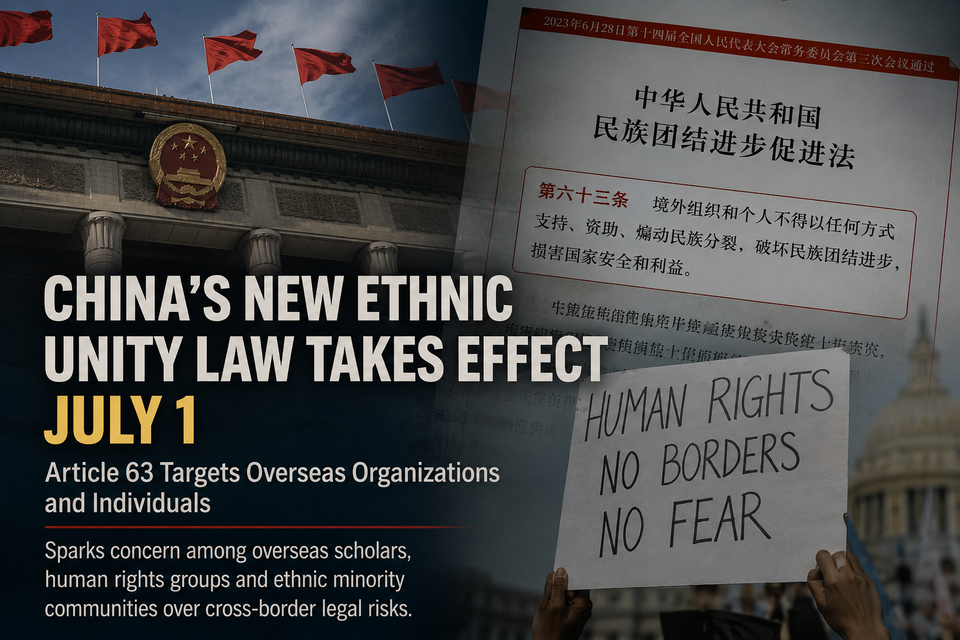
China's Law on Promoting Ethnic Unity and Progress takes effect on July 1. Article 63 says overseas organisations and individuals who carry out acts against China that "undermine ethnic unity and progress" or "create ethnic separatism" will be held legally responsible.
That wording gives the law a reach beyond China's borders. Overseas speech on Xinjiang, Tibet, Inner Mongolia, Taiwan and Hong Kong could face new uncertainty if Beijing treats it as undermining ethnic unity or promoting separatism.
A July law
Xinhua reported on March 13 that the law had been passed by the National People's Congress on March 12 and signed by Xi Jinping. It has 65 articles and will take effect on July 1, 2026.
The phrase that runs through the law is "forging a strong sense of community for the Chinese nation". Schools, media outlets, online platforms, government organs, social organisations and family education are all told to implement that requirement. Article 15 stresses the promotion of the national common spoken and written language. Article 31 requires online product and service providers to create a corresponding online environment.
The legal-liability section has drawn the most attention. Article 61 requires network operators to fulfil management duties. Article 62 refers to terrorism, ethnic separatism and religious extremism. Article 63 extends responsibility to overseas organisations and individuals.
How criminal liability connects
The law does not create a standalone offence called "undermining ethnic unity". Most of its liability provisions use phrases such as "punished according to law" and "where a crime is constituted, criminal responsibility shall be pursued". In practice, any criminal case would still have to connect with China's criminal law, anti-terrorism rules, national-security law or public-security provisions.
But the law still puts ethnic unity into statutory language. For people outside China, the more immediate risks may appear in travel, transit, visas, border checks and business dealings.
Reaction abroad
Criticism abroad has focused on two issues: minority languages, religion and cultural space may be further narrowed; and Article 63 may increase pressure on overseas critics, scholars, journalists and activists. The Guardian has described the law as the legalisation of Xi's "Chinese national community" line. AP reported that critics fear it could accelerate assimilation, especially for Uyghur, Tibetan and Mongolian communities.
UN human rights chief Volker Turk expressed concern after the law was adopted, saying it could restrict minority-language education and religious freedom. The European Parliament passed a resolution condemning the law in late April. China's mission to the EU said the resolution maliciously smeared China's laws and ethnic policies and interfered in China's internal affairs.
Comparable laws
Similar extraterritorial clauses already exist in other national-security systems. Article 38 of Hong Kong's national security law explicitly applies to non-permanent residents outside Hong Kong. Russia uses its "foreign agent" and "undesirable organisation" systems to place overseas media, universities and human-rights groups under restrictions; people linked to them may face fines, entry bans or criminal liability.
Turkey's anti-terror law has long been criticised for its use against speech, publishing and social-media expression linked to Kurdish issues. The Guardian has reported that writer Yavuz Ekinci faced "terrorist propaganda" charges over a novel about Kurdish life. Such examples show that laws of this kind do not necessarily begin with large-scale cross-border arrests. They often first change how journalists, scholars and community organisations assess what they can say.
Democratic countries also have anti-terrorism, hate-crime, foreign-interference and national-security laws. The United States, Britain, France, Germany and Australia can prosecute terrorist propaganda, incitement to violence or foreign-agent activity. The difference is that such laws usually require clearer offences, evidentiary thresholds and judicial review, and political expression is protected by constitutional or human-rights law. Criticising a government, discussing minority communities or advocating a political position is generally not criminalised merely because of the content itself.
After July 1
The law does not explain in detail how overseas liability would be enforced. It does not directly mention global arrest warrants, Interpol red notices or extradition. There are currently no public cases showing that anyone has been pursued overseas under Article 63.
After July 1, the law is likely to appear first in departmental documents and local propaganda systems. How internet regulators ask platforms to handle related content, whether police or state-security organs cite Article 63 in public notices, and how united-front bodies use it in overseas Chinese-community work may matter before any court judgment appears. For overseas individuals, the first practical effects may come through visas, border checks, publishing review, academic cooperation and community activities.
Source note: This article is based on Xinhua's report on the adoption and effective date of China's Law on Promoting Ethnic Unity and Progress, the full text of the law, reporting by The Guardian and AP, and public statements by the UN high commissioner for human rights and the European Parliament. The comparison section refers to Article 38 of Hong Kong's national security law, Russia's "foreign agent" and "undesirable organisation" systems, and public reporting on Turkey's anti-terror law. The legal-risk section is news analysis based on the text of the law and existing cross-border enforcement practices; it is not legal advice. References: Xinhua, full text, The Guardian, AP, Axios, AP, The Guardian.
You read this far. You're not here for noise.
SharpPost delivers one weekly deep dive on geopolitics, finance, and tech — decoded for readers who want signal. Carefully selected, never noisy.