China's Acquittal Rate Plunges to 0.021% — the Lowest Since 2000
Chinese courts handled 1.0555 million criminal cases in 2025 and acquitted just 294. Twenty-five years ago, that figure was 1% — 6,617 acquittals a year. SharpPost traces the mechanisms behind the collapse, and the gap with UN 1985 principles on judicial independence.
免费微软自然语音 · 推荐使用 Microsoft Edge
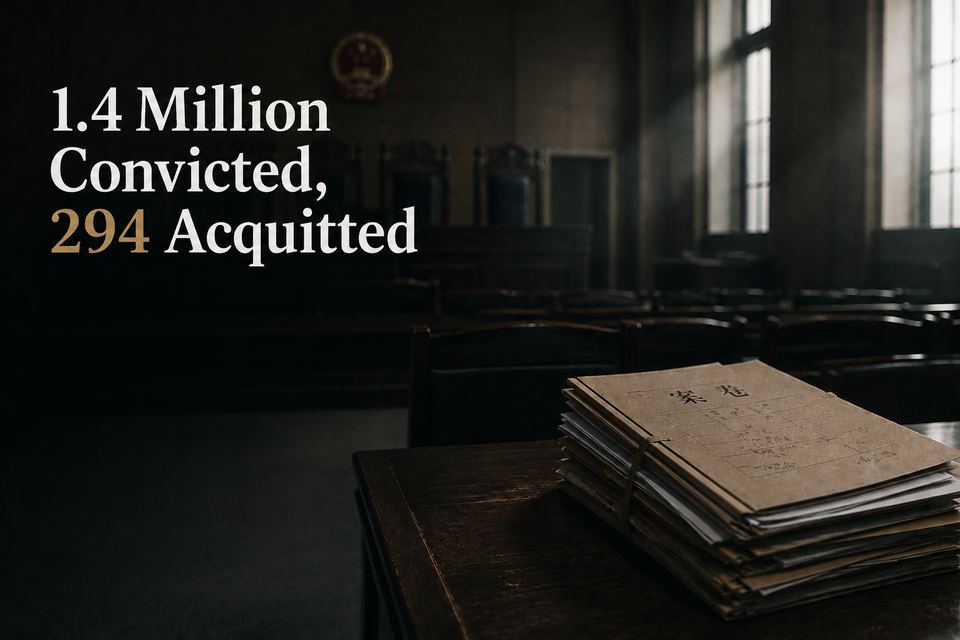
In 2025, Chinese courts handled 1.0555 million criminal cases and sentenced more than 1.4 million defendants. Only 294 were acquitted.
Peking University law professor Chen Yongsheng calculates the acquittal rate at roughly two in ten thousand — 0.021%. It is the lowest figure recorded since 2000. Twenty-five years ago, the rate stood at 1%, with 6,617 acquittals in a single year. Today, across roughly 3,500 courts nationwide, that averages out to one acquittal every twelve courts per year. The figures were compiled by Caixin on 15 April 2026.
The Supreme People's Court reports 3,221 acquittals over the past five years, down 41.2% from the previous five-year period — and the trend shows no sign of reversing.
For cases that actually reach trial after public prosecution, the acquittal rate drops even lower, close to one in ten thousand. In practice, an indictment has become almost synonymous with conviction. Officials credit the result to "improved case quality." Chen Yongsheng and other in-system scholars, including Han Xu, see something different. This is not sharper filtering. Several forces are working in tandem to drive the rate down.
Sources: Chen Yongsheng 55-jurisdiction study (2000: 6,617); Supreme People's Court 2025 work report (2025: 294; 2021–25 cumulative 3,221); 2016–20 cumulative back-derived from the 41.2% decline. Mid-points are five-year averages.
Plea leniency shifts real power to prosecutors
The plea-leniency system, written into the Criminal Procedure Law in 2018 and rolled out nationwide from 2019, now applies in over 85% of cases — and more than 90% at the procuratorate stage. Defendants admit guilt during the review-for-prosecution phase and accept the prosecutor's sentencing recommendation. Courts adopt those recommendations at rates as high as 98.3%.
In effect, the real decisions on guilt and sentencing now happen inside the procurator's office. The courtroom has become little more than procedural confirmation.
Performance reviews reinforce the pressure. For procurators, an acquittal is treated almost like a professional accident. A wrong indictment can trigger error-case accountability that affects both the department and the individual. Prosecutors therefore prefer to drop questionable cases rather than risk letting a judge acquit. In 2024 alone, prosecutors declined to indict roughly 400,000 suspects — a non-indictment rate of 20%. Those cases never reach court, and neither does any chance of acquittal.
Judges face similar constraints. Anyone seeking to acquit must navigate layered approvals and extra scrutiny from adjudication committees and higher courts. Conviction is the safe choice. Acquittal carries a career cost.
0.021% remains the global floor
Low acquittal rates are not unique to China, but the Chinese figure still stands out.
Japan's acquittal rate on indicted cases is about 0.22%. In the US federal system, the overall acquittal rate is 0.4%, but rises to 17.4% among defendants who actually go to trial. Most jurisdictions worldwide fall between 10% and 30%.
China's post-indictment rate of roughly one in ten thousand remains the lowest anywhere. Japan faces its own criticism for "hostage justice," yet Japanese prosecutors filter out more than half of suspects before filing charges. In the United States, about 90% of defendants plead guilty before trial; only the small minority who proceed to trial produce that 17.4% acquittal rate. Both systems shrink the courtroom's role in correcting errors. But 0.021% is still in a league of its own.
Outcomes are often decided before the trial even starts
Several procedural gates effectively lock in the result long before a hearing begins.
In 2017, five central agencies jointly issued protocols for pre-trial conferences. The original goal was to handle recusal requests, witness lists, and motions to exclude unlawful evidence. In practice, these meetings have turned into pre-filters that strip away contested issues. Motions to exclude illegal evidence are often reduced to procedural formalities rather than genuine challenges.
Major or difficult cases are routinely sent to an adjudication committee. The court president signs off on the minutes, which are then handed down to the trial panel for execution. Scholars Chen Ruihua and He Weifang have long criticised this practice with the phrase "the adjudicators do not judge; the judges do not adjudicate."
Adoption rates for prosecutors' sentencing recommendations have stayed extremely high: 96.85% in 2021, 98.3% in 2022, and 95.6% in 2024. The substantive sentencing decision rests with the procuratorate. The court's role is largely formal confirmation.
The 2014 Fourth Plenum launched a "trial-centred" reform meant to make hearings more substantive. Ten years later, the adoption rate of sentencing recommendations has risen, not fallen.
Behind the numbers are real people
Three well-known wrongful conviction cases tell the human cost. On average, it took 22 years from original verdict to exoneration.
Huugjilt was executed in 1996 and exonerated in 2014. Nie Shubin was executed in 1995 and exonerated in 2016. Zhang Yuhuan entered prison in 1993 and walked free in 2020 after 27 years — 9,778 days — in custody.
None of these cases was uncovered by internal review. All three relied on chance: another suspect caught in a separate case, a fellow defendant later confessing, or lawyers and journalists pressing for decades.
The acquittal rate has fallen to 0.021%, but wrongful convictions have not disappeared. They have simply become harder to surface, harder to acknowledge, and harder to reverse. Over the ten years since the 18th Party Congress, Chinese courts have corrected 66 major wrongful criminal cases involving 130 defendants. Against an annual caseload of over a million cases, that correction corridor has narrowed to a pinhole.
Judicial independence may be the only real fix
The 1985 UN Basic Principles on the Independence of the Judiciary state clearly: "The judiciary shall decide matters before them impartially, on the basis of facts and in accordance with the law, without any restrictions, improper influences, inducements, pressures, threats or interferences."
China's official position, set out at the 2014 Fourth Plenum, reads: "Adhere to the organic unity of the Party's leadership, the people as masters of the country, and rule of law." Judicial bodies exercise their authority independently — but under the leadership of the Party. The Central Political and Legal Affairs Commission steers political direction, coordinates agencies, and oversees compliance.
The gap between "without any improper influence" and "the leadership of the Party" is exactly what the data point to.
What can still be done
Officials read the 99.979% conviction rate as proof of system efficiency. In-system scholars read the same number as evidence that prosecutorial dominance, distorted incentives, squeezed defence space, and political pressure have hollowed out trial power.
If the biggest structural issues cannot be touched, technical adjustments can still make a difference. Allow defence lawyers earlier access to clients and case files during the investigation stage. Remove individual cases from adjudication committee review so that those who actually hear the evidence decide the outcome. Stop treating sentencing-recommendation adoption rates as performance targets. Raise the threshold for Article 306 of the Criminal Code — the offence of "obstruction of testimony by defence counsel" — so lawyers no longer have to weigh their licence against every sensitive case.
None of this amounts to structural reform. But it would widen the narrow corridor for correction by a meaningful fraction.
Sources: Caixin coverage (15 April 2026); Supreme People's Court 2025 work report; Supreme People's Procuratorate criminal-prosecution white papers; Chen Yongsheng 55-jurisdiction comparative study; public international comparison data. 709 incident details drawn from public human-rights archives.
You read this far. You're not here for noise.
SharpPost delivers one weekly deep dive on geopolitics, finance, and tech — decoded for readers who want signal. Carefully selected, never noisy.