Japan says it knew of stair gap before Takaichi stepped off plane in China
Japan's government said it knew in advance of the gap between Takaichi's plane door and the boarding stairs at Shenzhen airport, and that she got off the plane safely.

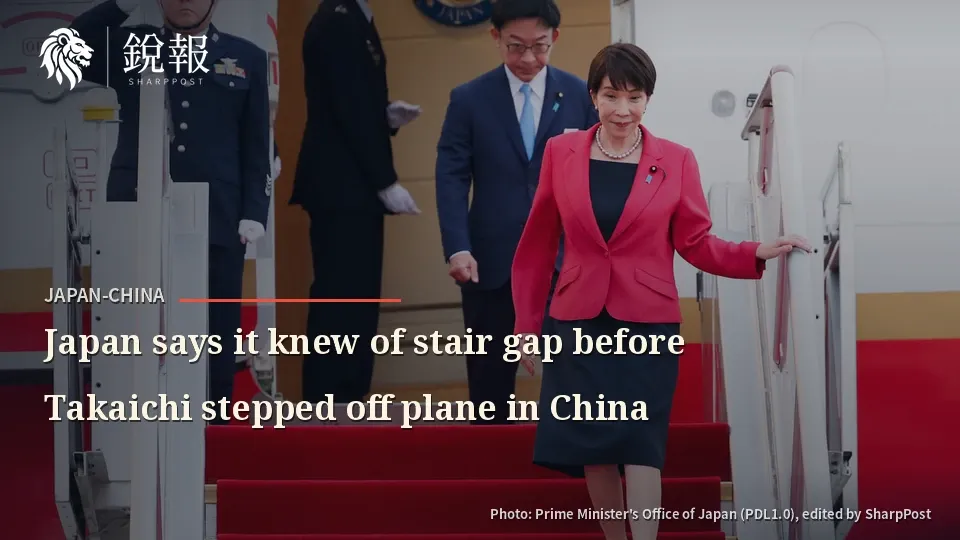

Japan said on Nov. 20 that it had known in advance about a gap between Prime Minister Sanae Takaichi's plane door and the boarding stairs at Shenzhen's airport, and that staff took safety measures so she could disembark without incident. Takaichi was in China for the Asia-Pacific Economic Cooperation summit, her first visit since taking office in October 2025, and received a lower-level welcome than U.S. President Donald Trump and other leaders.
Arriving on Nov. 18, Takaichi held the door frame as she stepped down onto the stairs China had provided. Taiwan's EBC television estimated from footage that the drop was about 40 centimeters. Takaichi has rheumatoid arthritis and an artificial joint in one knee.
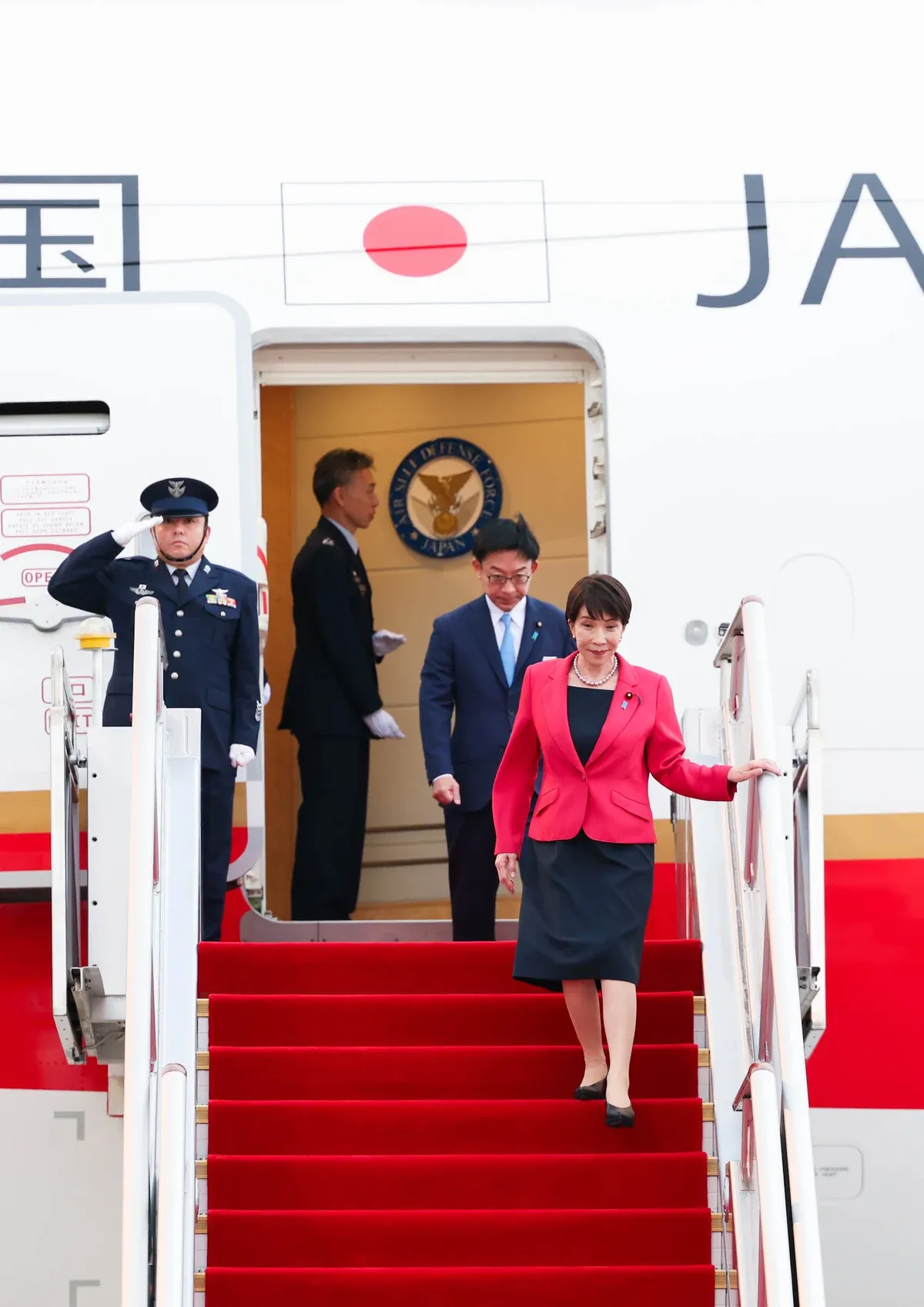
She was met by Zhang Qiyue, a Chinese Foreign Ministry protocol official and former ambassador to Greece, and an honor guard. There were no youth welcome groups or music of the kind laid on for other leaders. Chinese President Xi Jinping greeted Trump at the airport the same day. Australian Prime Minister Anthony Albanese was handed a bouquet and Philippine President Ferdinand Marcos Jr. was met by dancers, Reuters reported.
After TV Asahi broadcast the footage, Yasuhide Nakayama, a Liberal Democratic Party lawmaker and former vice minister for foreign affairs and for defense, shared it on X. A host country is responsible for a visiting leader's safety even amid a diplomatic rift, he wrote, and Japan should ask China to explain how the stairs were set up and whether safety checks were done.
At a regular briefing in Beijing on Nov. 19, Chinese Foreign Ministry spokesperson Guo Jiakun said: "As the host, China makes appropriate protocol arrangements for all participants in accordance with international practice." Asked whether the two countries' leaders would meet, he said: "Our position on China-Japan relations is clear."
In Tokyo that morning, Chief Cabinet Secretary Minoru Kihara declined to comment on another country's protocol. Xi had greeted Takaichi and shaken her hand at the Nov. 18 welcome dinner, he said, and she received the same customary courtesies as the leaders of other economies. That afternoon, Kihara confirmed there had been no Japan-China summit. Asked about the stairs on the afternoon of Nov. 20, Kihara said the government was aware of the gap, that staff on site had acted with the utmost attention to safety, and that the prime minister got off the plane safely.
Takaichi told a news conference in Shenzhen on Nov. 19 that she had shaken hands with Xi twice, at the dinner and at the leaders' session, and thanked him for the invitation and the arrangements. China is "an important neighbor," she said, and unresolved issues make dialogue more necessary. Japan's basic position on Taiwan is as set out in the 1972 Japan-China Joint Communique, and "there has been no change whatsoever," she said. She declined to say when Japan might become militarily involved in a Taiwan conflict, calling the question hypothetical.
Guo responded on Nov. 20 that abiding by the four political documents between the two countries "should be not just reflected in remarks, but more importantly, implemented with concrete actions," and that Japan's pressing priority was "to correct the erroneous words and moves on the Taiwan question immediately."
Relations soured after Nov. 7, 2025, when Takaichi told a Lower House committee that a Taiwan contingency involving force could be a "survival-threatening situation" allowing Japan to exercise collective self-defense. Beijing demanded a retraction, told its citizens that month to avoid travel to Japan, and later restricted exports of dual-use items and critical minerals to Japan. Japan's 2026 Diplomatic Bluebook, released in April, dropped its description of ties with China as "one of the most important bilateral relationships" and called China "an important neighbor." Takaichi's only formal talks with Xi were held at the APEC summit in Gyeongju, South Korea, on Oct. 31, 2025. The handshakes in Shenzhen were their first face-to-face encounters since then.
A senior Japanese government official told the Asahi Shimbun the reception was "hardly the way a mature nation should behave." A senior Foreign Ministry official told the paper that "reacting to it would play right into China's hands," and an official at the prime minister's office said that, given the state of relations, "that level of treatment is probably what we should expect." Noriyuki Kawamura, professor emeritus at Nagoya University of Foreign Studies, told AFP that Takaichi's loyal supporters would see her as having refused to give in to the snub and shaken Xi's hand twice "with dignity." Yu Uchiyama, a political scientist at the University of Tokyo, told AFP the cool reception was unlikely to cost her support at home.
At the Nov. 19 leaders' photo, Takaichi stood near one end of the back row, and at the summit table she sat seven seats from Xi, Reuters reported. Her only bilateral meeting at APEC, according to Reuters, was with Russian President Vladimir Putin, a conversation Takaichi said lasted more than 30 minutes. The same day, Xi held a three-way summit with Trump and Putin.
You read this far. You're not here for noise.
SharpPost delivers one weekly deep dive on geopolitics, finance, and tech — decoded for readers who want signal. Carefully selected, never noisy.