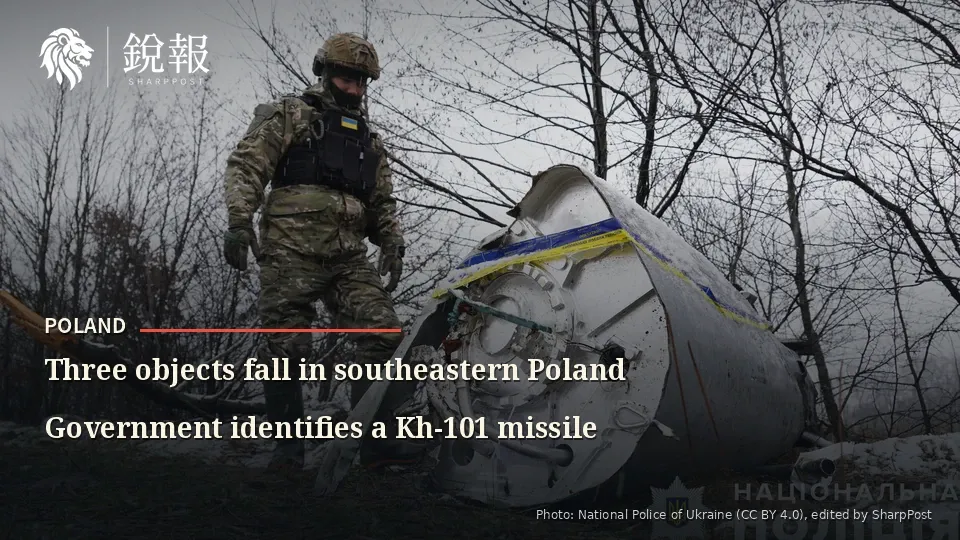
Three objects fall in southeastern Poland; government identifies a Kh-101 missile
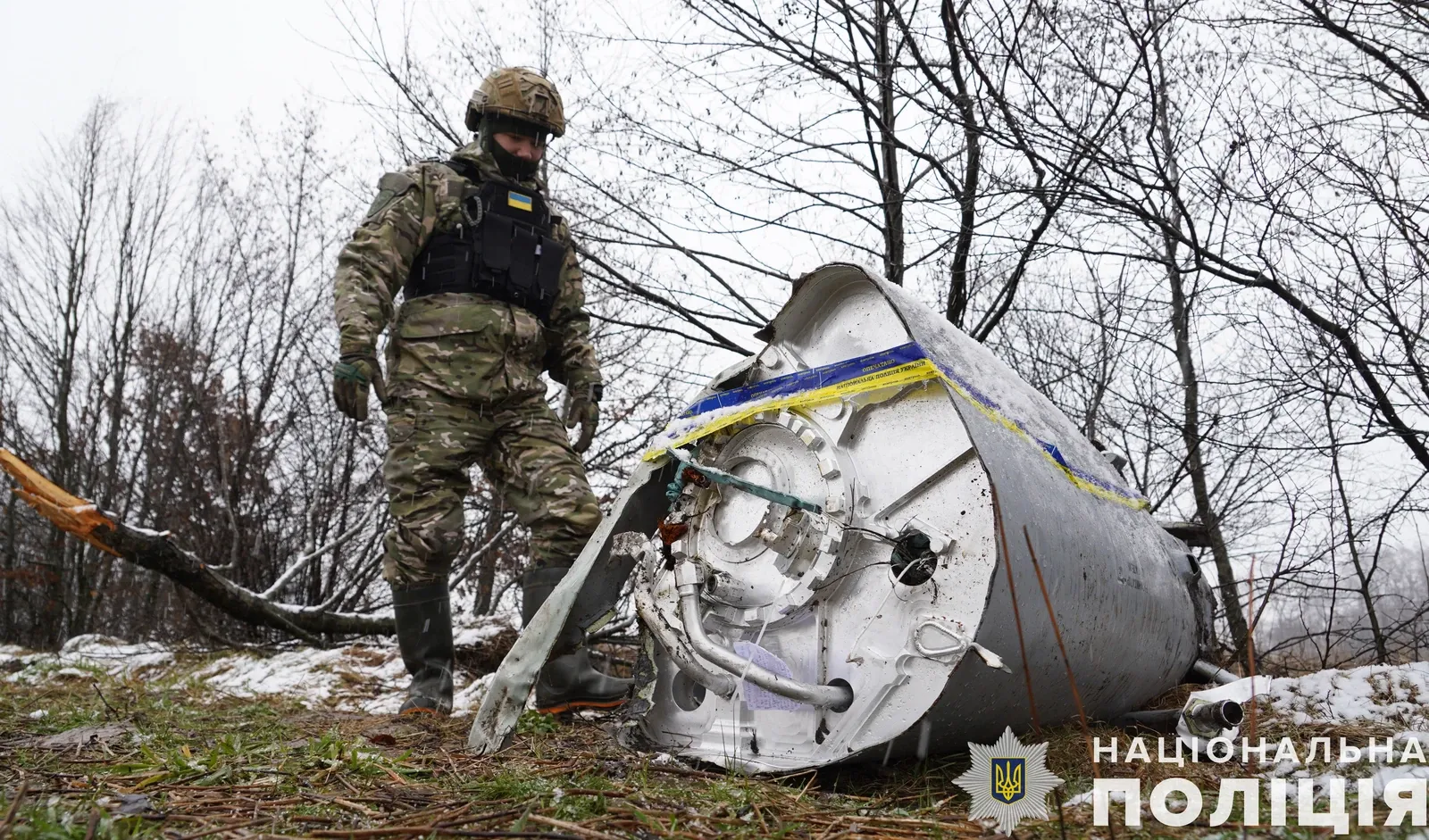
Three flying objects came down near villages in southeastern Poland on 20 November, during a large-scale Russian air attack on Ukraine. One caught fire in a field. There were no casualties. The government identified the object at Nowy Lipowiec as a Kh-101 cruise missile.


Three flying objects came down near villages in southeastern Poland's Lublin and Podkarpackie provinces on 20 November, during a large-scale Russian air attack on Ukraine. One landed in a field beside woodland at Nowy Lipowiec, in Biłgoraj County, and caught fire. No one was hurt and nothing was damaged. The Polish government identified the object at Nowy Lipowiec as a Kh-101, a cruise missile launched from Russian long-range bombers, that had entered Polish airspace.
From 9:30 a.m. to 4:48 p.m. Singapore time (2:30 a.m. to 9:48 a.m. in Poland), the Government Centre for Security, which issues national emergency alerts, sent repeated warnings to parts of both provinces. They said Russia was attacking Ukraine and that Poland's air defences were on higher alert, and at one point told residents to find a safe place. The last alert said there was no threat in Poland. Polish F-16s and Swedish Gripen fighters flew overnight, and Patriot air-defence batteries near Rzeszów-Jasionka airport and Świdnik were activated.
A second object was found the same day in woodland near Rudnik nad Sanem, in Nisko County, Podkarpackie. Debris from a third was scattered across unused farmland at Mołodycz, in Jarosław County. Police, firefighters and military police worked at the sites. The prime minister's office said the parts at Mołodycz appeared, on preliminary findings, to come from a jet-powered drone. The Regional Prosecutor's Office in Lublin sent military prosecutors to Nowy Lipowiec.
Prime Minister Donald Tusk and Defence Minister Władysław Kosiniak-Kamysz held separate news conferences on 20 November. Tusk said it was certain that what fell on Polish soil came from Russia, and that the incident did not look like an accident but appeared to be an intentional Russian provocation, a view he said his foreign partners shared. Kosiniak-Kamysz called the attack on Ukraine, which had effects in Poland, one of the largest since the start of the full-scale war. Forces of the Coalition of the Willing, a group of countries backing Ukraine, were holding exercises that day at Nowa Dęba, near the sites, with about a dozen countries taking part and Polish soldiers assisting. Kosiniak-Kamysz said that in his view the timing was not accidental; the prime minister's office said a possible link remained a hypothesis at this stage.
Kosiniak-Kamysz said he would ask NATO Secretary General Mark Rutte for additional forces and assets for Eastern Sentry, the alliance's operation on its eastern flank. Tusk spoke with Rutte and European leaders that day. Rutte later wrote on X that he had spoken with Tusk about serious overnight violations of Polish airspace, that NATO jets were scrambled in response, and that the alliance stood with Poland and would continue to strengthen its ability to deter and defend.
In a 21 November update, the prosecutor's office still described the finds at all three sites as unidentified flying objects, saying their nature and origin could be established only after on-site inspections and laboratory tests. The sites had been sealed off overnight, and nearby residents were not in danger.
You read this far. You're not here for noise.
SharpPost delivers one weekly deep dive on geopolitics, finance, and tech — decoded for readers who want signal. Carefully selected, never noisy.