Why the FDA Turned Down Akeso's Ivonescimab: 93% of Cancer Progressions and Deaths Were in China
The FDA has rejected Akeso's lung cancer drug ivonescimab. Its 13 November letter says 93% of the cancer progressions and deaths in the key trial occurred among patients enrolled in China, finds no significant survival gain and recommends a new multi-country trial.

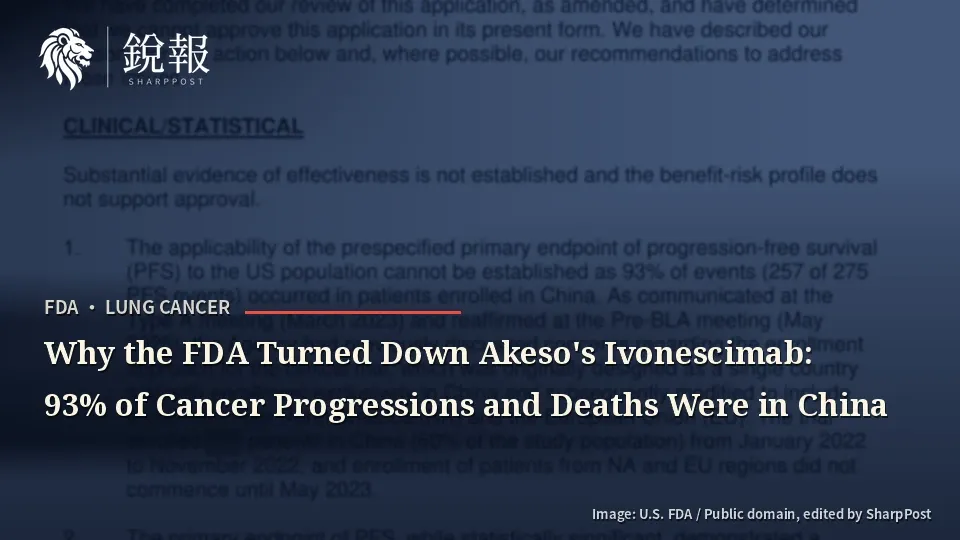

The U.S. Food and Drug Administration has rejected Akeso's lung cancer drug ivonescimab, saying 93% of the cancer progressions and deaths in the pivotal trial occurred among patients enrolled in China. The agency set out its decision in a complete response letter dated 13 November to Summit Therapeutics, Akeso's U.S. partner, which filed the application. Such a letter is the FDA's formal refusal, listing its reasons and possible fixes.
HARMONi, the late-stage trial behind the application, began recruiting in China in January 2022. It enrolled patients with advanced non-small cell lung cancer whose tumours carry a mutation in the EGFR gene and had stopped responding to EGFR-targeted pills, including a third-generation one. Patients received platinum-based chemotherapy plus either ivonescimab or a placebo. The drug blocks two targets. Blocking PD-1 frees the patient's immune cells to attack the tumour. Blocking VEGF curbs the new blood vessels that feed it. By November 2022, patients enrolled in China made up 60% of the eventual trial.
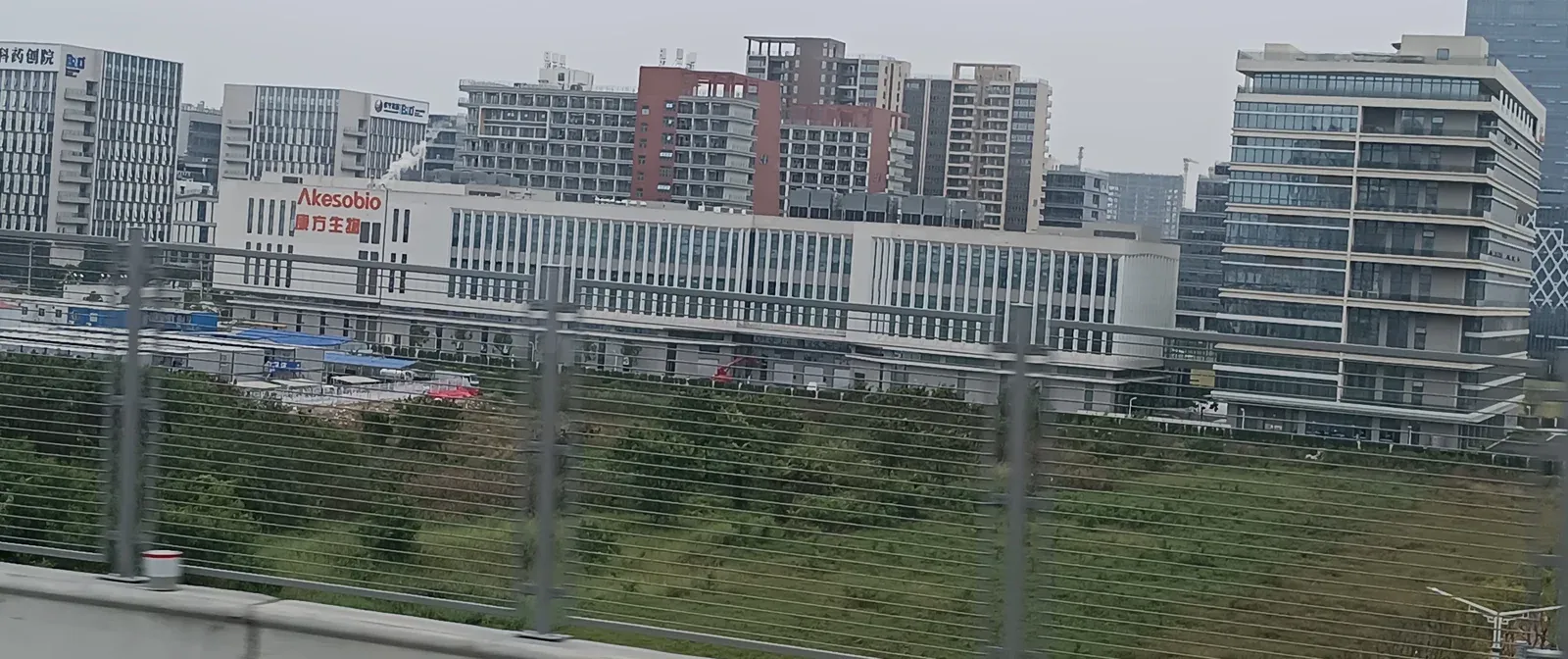
In December 2022 Akeso licensed rights in markets including the United States, Canada, Europe and Japan to Summit for $500 million upfront, in a deal worth up to $5 billion. Akeso kept China.
At a formal meeting with Summit in March 2023, the FDA raised concerns about the China-first enrolment. Recruitment in North America and the European Union began two months later. The trial eventually enrolled 438 patients, 165 of them from North America and Europe.
In May 2024 China's drug regulator approved ivonescimab with chemotherapy for the same group of patients, based on HARMONi-A, a separate trial run only in China. Akeso says the drug won a second Chinese approval in April 2025, as a first treatment for another form of advanced lung cancer.
The FDA repeated its enrolment concerns at a pre-filing meeting in May 2025. On 30 May, Summit released top-line HARMONi results. The trial had two main measures, set in advance: progression-free survival, or how long patients went before their cancer worsened, and overall survival, or how long they lived. Summit disclosed that the FDA had told it approval required a statistically significant survival benefit, meaning a gap between the groups too large to put down to chance.
Fuller data released later showed that half the patients on ivonescimab had their cancer worsen or died within 6.8 months, against 4.4 months on chemotherapy alone, a 48% lower risk. Half the ivonescimab patients lived beyond 16.8 months, against 14.0 months. That 2.8-month gap missed the statistical bar set before the trial. The survival data ran to April 2025, when patients in North America and Europe had been followed for a median of only 9.2 months. Tumours shrank substantially in 44.7% of patients on the drug and 34.2% of those on chemotherapy alone.
Summit filed for U.S. approval on 14 November 2025, giving the FDA a year to decide.
On 22 July 2026, Summit released longer follow-up. Data to June 2026 showed a roughly 24% lower risk of death on ivonescimab, both across the trial and among Western patients. Data from Asian patients stayed frozen at April 2025. Summit said it had shared the figures with the FDA.
The letter's first objection concerned where the patients came from. Of 275 cancer progressions or deaths in HARMONi, 257 were among patients enrolled in China, and the agency said it could not tell whether the result applied to Americans.
The second concerned efficacy. Survival did not improve significantly, and the share of patients whose tumours shrank did not differ substantially between the groups. "The modest improvement in median PFS does not outweigh the risks of ivonescimab as an add-on to chemotherapy," the letter says, citing serious immune-related side effects and others linked to blocking VEGF. The agency called the July follow-up figures after-the-fact analyses that were exploratory only. It noted that data were cut off at different times in different regions, apparently because Chinese trial sites closed during 2025 and follow-up ended there earlier.
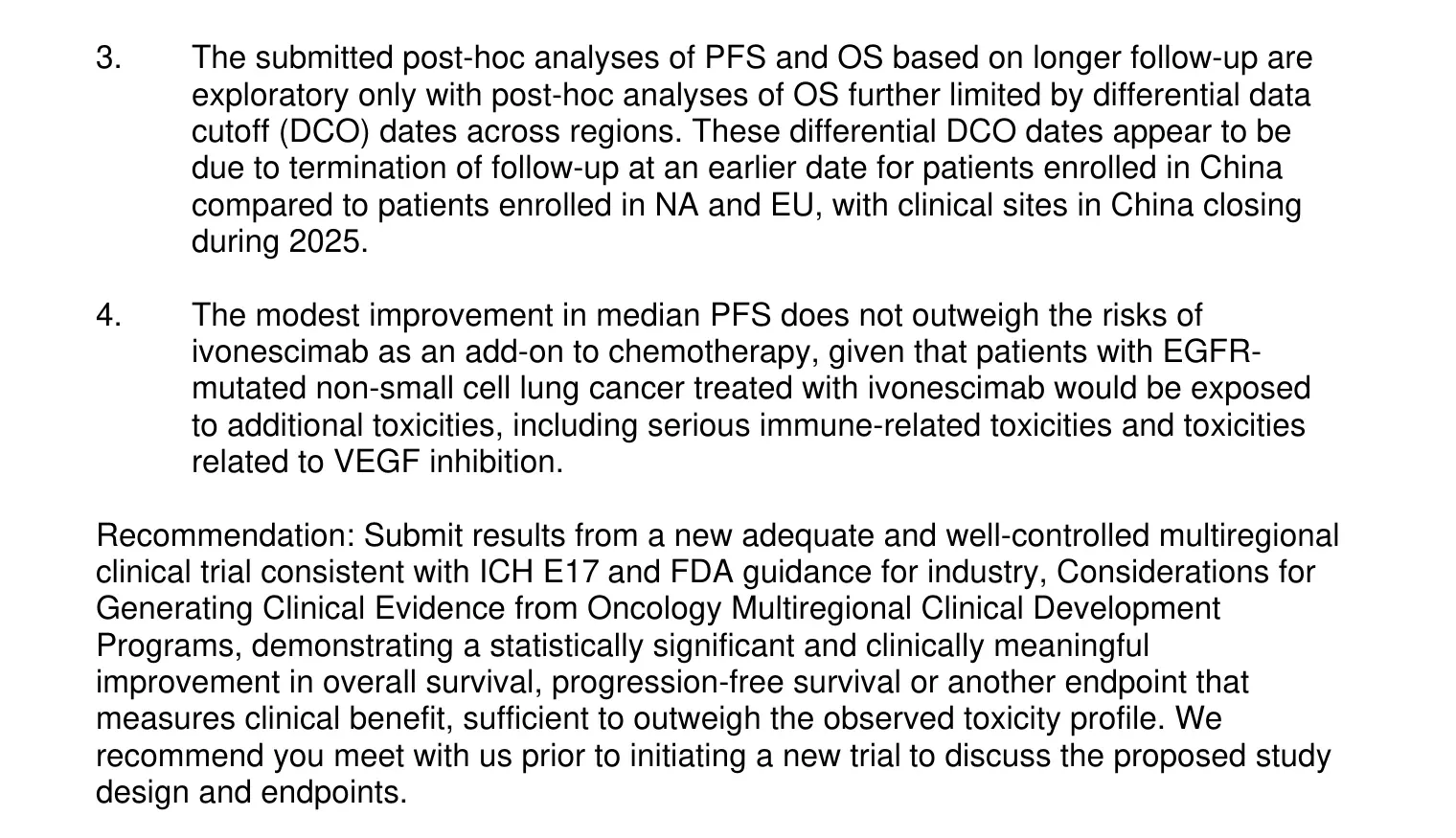
The FDA recommended a new trial recruiting patients across several regions, under international standards for such studies. It would need to show that the drug clearly extends survival, delays the cancer worsening or brings another measurable benefit that outweighs its side effects. The agency suggested meeting Summit before any new trial starts to agree on its design.
Summit announced the decision on the evening of 15 November, Singapore time. Its statement said the FDA had found the evidence of effectiveness insufficient without a statistically significant survival gain, and that no FDA-approved treatment has been shown to extend survival significantly for these patients. It said 7.3% of patients on ivonescimab stopped the drug because of side effects, against 5.0% on placebo. It did not mention the share of patients from China. The FDA later posted the letter online with some passages blacked out.
On an investor call that evening, Akeso chair Xia Yu said Akeso and Summit had persuaded the FDA to accept the China-first design, and that the agency had required a statistically significant survival result from the start, Fierce Biotech reported.
The same night, a user of the Chinese investor forum Xueqiu posting as Pifu Hancong compared the case with Johnson & Johnson's Rybrevant, which the post said had been approved for the same patients without a survival result. The post argued that Chinese drugmakers bringing global trial data to the United States faced a different review standard, even though the rules were the same on paper.
Akeso shares closed 22% lower at HK$64.10 in Hong Kong on 16 November. At the exchange's request, Akeso said its board knew of no reason for the unusual trading other than the letter. The same day, the trustee of an Akeso share award scheme bought 336,000 shares for about HK$21 million. In New York, Summit shares closed at $11.82, down 16%.
On 18 November, Akeso told Jiemian, a Shanghai news site, that the trial protocol went ahead only with FDA agreement and that Summit led the study. Another Xueqiu writer, posting as Rui Bio, disputed the Rybrevant comparison that day. Rybrevant's final survival analysis had not yet been done when it was approved and became a post-approval requirement, the post said, while ivonescimab's formal survival test was complete and had failed, and Summit filed knowing the FDA's requirement.
On 20 November, an article posted by a contributor account on the Shanghai news platform The Paper, citing the Financial Times, said some U.S. politicians had pressed the FDA not to accept drug trial data from China, and that many Americans online suspected the decision was driven by politics and commercial interests. On 20 August, John Moolenaar, chairman of the House Select Committee on China, and Representative Ben Cline wrote to the acting FDA commissioner urging the agency to reject data generated in China unless it had inspected the trial site in person within the previous 12 months.
The FDA approved Akeso's penpulimab for nasopharyngeal cancer in April 2025. In July that year it granted accelerated approval, a conditional clearance based on early results, to Dizal's sunvozertinib for lung cancer with EGFR exon 20 insertion mutations.
Under the letter, Summit has one year to resubmit or take other steps allowed under federal rules, and may ask for more time. If it does neither, the FDA may treat that as a request to withdraw the application. A resubmission must address every problem in the letter and include updated worldwide safety data. Until the FDA approves it in writing, ivonescimab cannot legally be sold in the United States.
You read this far. You're not here for noise.
SharpPost delivers one weekly deep dive on geopolitics, finance, and tech — decoded for readers who want signal. Carefully selected, never noisy.