Nvidia reinstates Jensen Huang as CEO; shares jump more than 30% in early trading
Nvidia’s board has reinstated Jensen Huang as president and CEO, effective immediately, 11 days after he resigned, saying input from senior U.S. officials left it confident his return posed no national security risk. Nvidia shares rose more than 30% in early trading and the Nasdaq more than 6%.

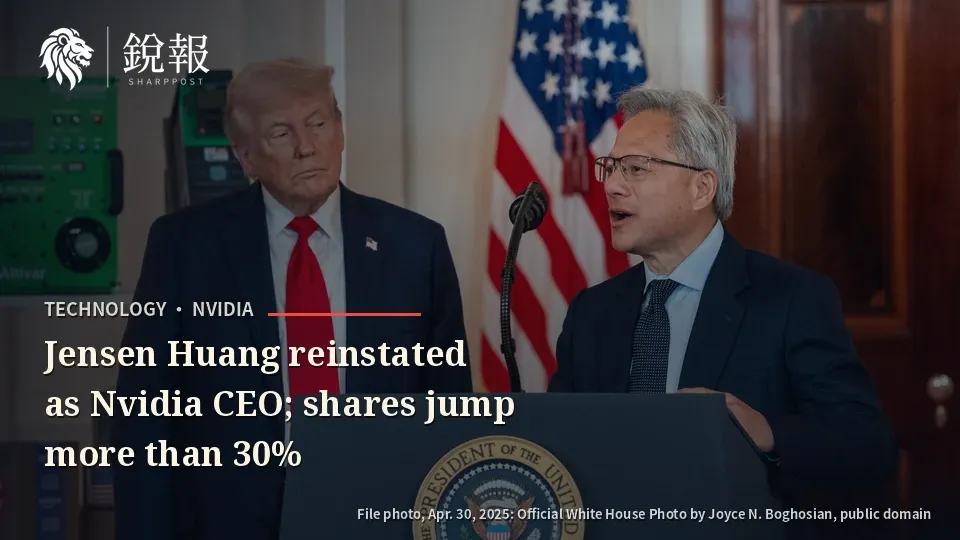

Nvidia said on Monday that its board had reinstated founder Jensen Huang as president, chief executive and a director, effective immediately, 11 days after he resigned. The board said it had received input from senior levels of the U.S. government and was confident his return posed no national security risk.
U.S. technology stocks rebounded sharply when trading opened on Monday. As of 11:08 a.m. in New York (12:08 a.m. in Singapore), Nvidia shares were up 33.7% at $167.86, after rising as much as 37% shortly after the open. The Nasdaq Composite was up 6.8%, and the Philadelphia Semiconductor Index, which tracks 30 chip companies, had gained 14.1%. Last week the Nasdaq fell 10%, and Nvidia had its worst week since 2008, according to Reuters.
On Nov. 8, Huang admitted in an email to employees that he had been unfaithful to his wife. The same day, Nvidia’s board opened an independent investigation, citing reports that he had been the target of a foreign intelligence effort. Coverage has centered on his relationship with businesswoman Alice Huang, whom U.S. authorities suspect of spying for China; Beijing denies the allegation. On Nov. 11, U.S. time, the board accepted Huang’s resignation from all of his posts. Chief Financial Officer Colette Kress became interim CEO, and director Harvey C. Jones became board chair.
On Nov. 17, U.S. time, Huang said in a statement on X that he would be honored to come back as CEO if the board decided that was in the best interest of shareholders, employees, the company and America. Nvidia reported quarterly results the same day, and Jones opened the earnings call by saying the board had unanimously accepted the resignation, did not intend to reinstate Huang and had hired a search firm to find a permanent chief executive. The board also set up a national security and export control oversight committee that day. Separately, the House Select Committee on China, the Foreign Affairs Committee and the Intelligence Committee announced that Huang had agreed to a transcribed interview on Dec. 1, with Nvidia General Counsel Tim Teter to follow on Dec. 2. A transcribed interview is a recorded session with committee staff, not a public hearing.
On Nov. 22, U.S. time, The New York Times reported, citing people familiar with U.S. intelligence reports, that Alice Huang had been in contact with an officer of China’s Ministry of State Security during at least part of her relationship with Huang. President Donald Trump wrote on Truth Social at 10:54 a.m. Singapore time on Monday (9:54 p.m. Sunday in Washington) that he hoped the board would rehire him, saying that would be best for the company and for the United States.
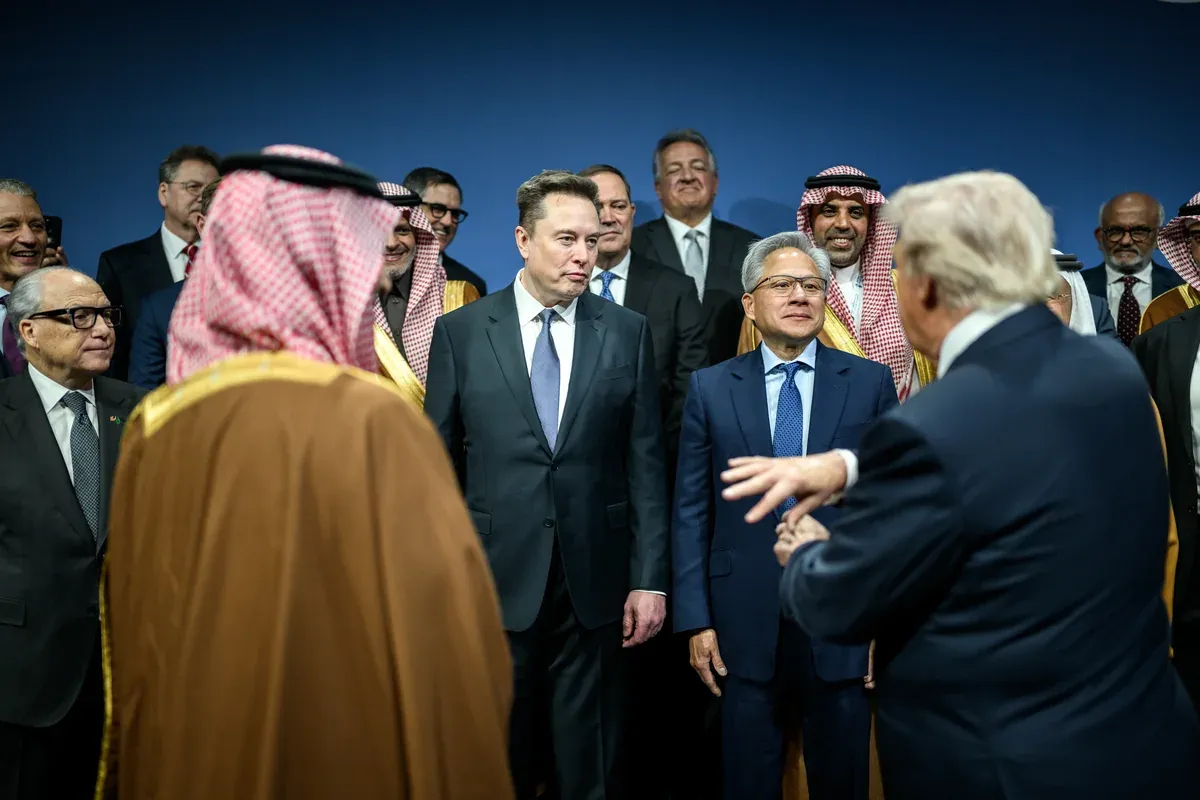
An 8-K filing with the U.S. Securities and Exchange Commission shows the board acted on Nov. 22, U.S. time. An 8-K is the report a listed company must file promptly after major events such as executive changes. SEC records show the filing was accepted at 9:57 p.m. Singapore time on Monday, and Nvidia issued a press release the same day. The board said it voted unanimously after a series of discussions and meetings with Huang, which left it satisfied with his candor and ability to lead the company. Kress remains chief financial officer, and Jones stays on as chair. “I am honored to return to NVIDIA and lead one of the most consequential technology companies in the world at the beginning of a new industrial revolution,” Huang said in the release.
The board said the independent committee’s investigation into the foreign intelligence reports will proceed to its conclusion and that Huang supports it and will cooperate. Nvidia will create a chief compliance officer position to oversee compliance across the company, and it will keep cooperating with ongoing government investigations and inquiries.
At 10:07 p.m. Singapore time, Trump posted again, calling the board’s move “the correct and proper decision.” He wrote that the government had no reason to believe Huang’s return posed a national security risk and that the attorney general had confirmed the government had no evidence he had engaged in unlawful conduct. He added that Nvidia should continue its internal investigation into the company’s compliance with U.S. export controls.
Stock futures had already surged before the opening bell. Futures are contracts to buy or sell at a set price on a later date and are widely watched as a gauge of sentiment before the market opens. At 9:02 a.m. in New York (10:02 p.m. in Singapore), Nasdaq 100 futures were up 6.53% and Nvidia had gained 29.5% in premarket trading, Reuters reported. Earlier, at 9:45 p.m. Singapore time, Yahoo Finance had reported Nvidia up 9% before the bell after Trump publicly urged the board to bring Huang back. Reuters, CNBC and Yahoo Finance all tied the day’s rally to the board’s decision, while Yahoo Finance also noted that buyers were returning after a steep sell-off in which the S&P 500 had fallen for seven straight sessions.
Once regular trading began, the gains spread across the artificial intelligence supply chain. As of 12:08 a.m. Singapore time, U.S.-listed shares of TSMC were up 16.0%, Micron 19.3%, chip designer Arm 16.6%, AMD 8.1% and chip-equipment maker ASML 10.1%. Among the largest technology companies, Google parent Alphabet rose 6.3%, Meta 5.8%, Microsoft 3.1% and Apple 1.8%. The S&P 500 was up 5.0% and the Dow Jones Industrial Average 3.1%. Anthropic, which listed last Thursday, was down 1.0%.
Nvidia closed at $125.53 on Friday, about 48% below its record close on Oct. 6. U.S. markets are shut on Thursday for Thanksgiving. Under the schedule the three House committees announced earlier, Huang is due to sit for his interview on Dec. 1.
You read this far. You're not here for noise.
SharpPost delivers one weekly deep dive on geopolitics, finance, and tech — decoded for readers who want signal. Carefully selected, never noisy.