COP31 closes without Antalya Pact as EU objects to text with no mention of fossil fuels
The UN climate summit in Antalya, Türkiye, closed without adopting the Antalya Pact, its overarching decision, as the EU and others objected to a text that made no mention of fossil fuels. Countries still adopted narrower decisions on a just transition, climate finance and adaptation.

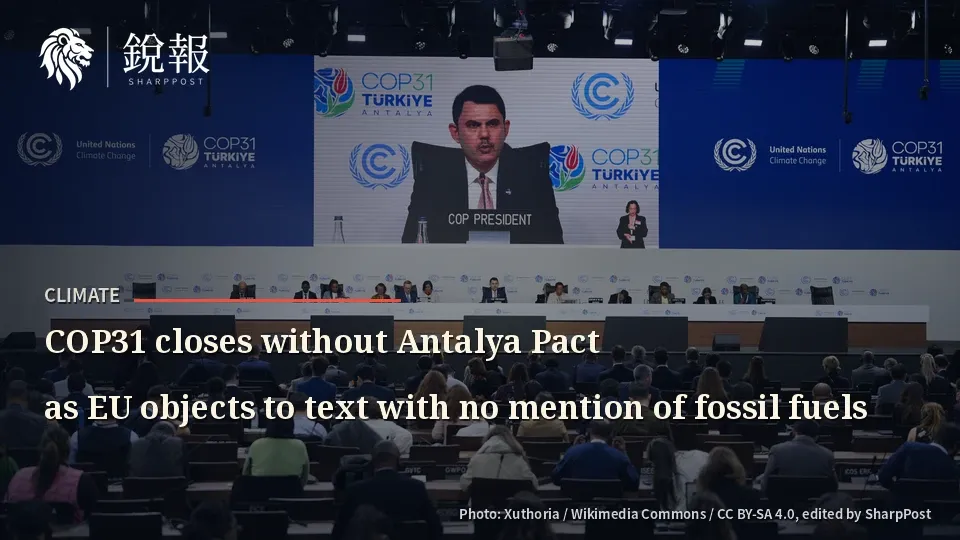

The UN climate summit in Antalya, Türkiye, closed on Sunday evening local time, early on Monday 23 November in Singapore, without adopting the Antalya Pact, the presidency's proposed overarching decision for the conference. The pact was not a treaty but a pair of draft decisions, one for the parties to the UN climate convention and one for the parties to the Paris Agreement. Neither of the final texts used the words "fossil fuels", and the European Union formally objected on that ground.
Negotiators did adopt narrower decisions on a just transition, a climate finance work programme and the global goal on adaptation. UN Secretary-General António Guterres said he was "deeply disappointed" that the meeting had ended without consensus on an overarching outcome.
COP31 had been scheduled to end on the evening of Friday 20 November and finished almost 50 hours late. According to UN News, a draft released on 19 November had already dropped explicit references to moving away from coal, oil and gas. Climate-vulnerable countries and those pushing for a stronger commitment on fossil fuels could not bridge their differences with countries whose economies depend heavily on fossil fuel exports. Türkiye and Australia shared the presidency, with Turkish environment minister Murat Kurum as COP31 president and Australia's Chris Bowen as president of negotiations. Several compromise drafts failed to win consensus.
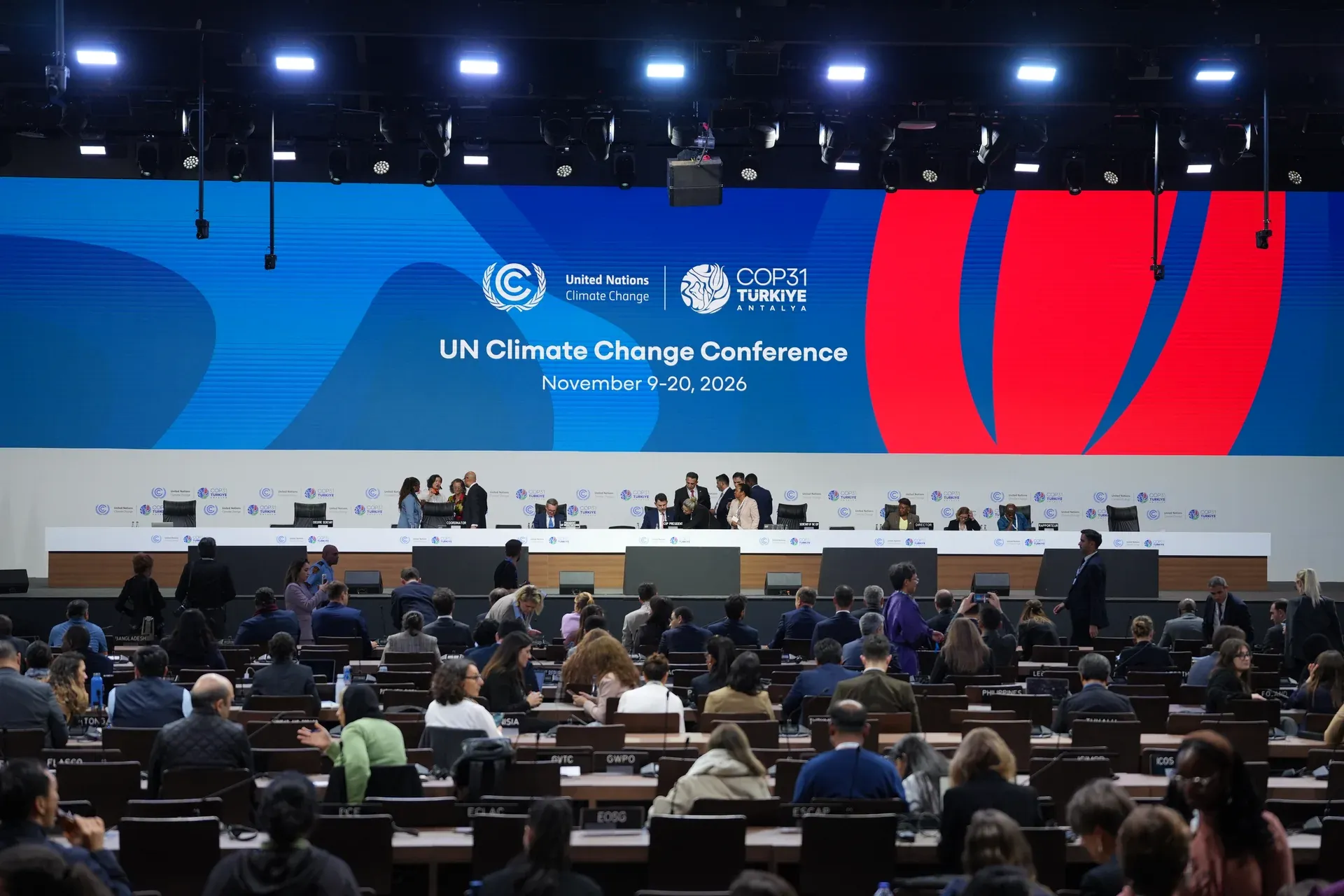
The final drafts were posted at 5:45 p.m. Singapore time on 22 November, or 12:45 p.m. in Antalya. The Paris Agreement version expressed deep concern that peak warming is expected to exceed 1.5C above pre-industrial levels within the next few years. It set out a goal of raising electricity's share of final energy consumption to 35 per cent globally by 2035, described gigatonne-scale deployment of carbon capture, utilisation and storage by 2035 as a "collective global aspiration", and proposed an Antalya-Addis Ababa road map on adaptation and resilience finance. Its preamble recalled the UAE Consensus reached at COP28 in Dubai in 2023 "in its entirety", but the text did not repeat that agreement's language on transitioning away from fossil fuels.
Several parties and negotiating groups objected at the closing plenary. UN News reported that the EU formally opposed the cover decision, saying it could not accept a text that omitted any reference to fossil fuels or a transition away from them. Panama said the text weakened previously agreed decisions, and the Marshall Islands said it failed countries on the front line of climate change; neither would back it. Ghana, speaking for the African Group, said the text fell short on climate finance, loss and damage and the just transition, but that the group would not block consensus. Saudi Arabia, speaking for the League of Arab States, defended the text's references to carbon capture and storage.
Kurum then announced that there was no agreement on the text and that the decisions had therefore not been adopted. "Unfortunately, some countries failed to demonstrate the effort and flexibility required by this historic responsibility," he said. He added that Türkiye had exhausted every option to secure consensus and pointed to the summit's Action Agenda, partnerships and cooperation initiatives as lasting results. According to the Earth Negotiations Bulletin, he gavelled the conference to a close at 7:33 p.m. local time, or 12:33 a.m. on 23 November in Singapore.
Under the draft just transition decision released on the final day, the existing work programme will run for three more years, with a review in November 2029. The just transition mechanism that governments decided last year to develop will operate under the authority of the Paris Agreement's governing body. Governments and other stakeholders have until 15 March 2027 to submit views on how it should work, and UN subsidiary bodies will draft its arrangements in June 2027 for a decision that November.
The climate finance work programme will run through 2027 and 2028, gathering submissions and holding workshops and virtual dialogues under two co-chairs, one from a developed and one from a developing country. The adaptation decision sets up a technical task force that will work until November 2027 on better data and methods for the Belém Adaptation Indicators, a set of measures for tracking countries' progress on adapting to climate change; its outputs are voluntary. UN climate chief Simon Stiell told the closing session that key negotiating decisions had been made, including on a just transition, and that the Action Agenda had delivered results across six areas.
In a statement issued later in New York, Guterres noted that all countries agreed at COP28 to transition away from fossil fuels in a just, orderly and equitable manner, and said the task now was to accelerate and finance that shift. He urged developed countries to make good on their commitment to lead on tripling adaptation finance. "There may be no consensus in the negotiating room. There is no ambiguity in the science," he said. In a question-and-answer briefing, the British government said the UK, like many others, could not support an outcome that fell far short of the scale of the challenge, but that the Paris Agreement remains in place and what has previously been agreed is still agreed.
COP32 will be held in Addis Ababa, Ethiopia. UN climate documents schedule it for November 2027.
You read this far. You're not here for noise.
SharpPost delivers one weekly deep dive on geopolitics, finance, and tech — decoded for readers who want signal. Carefully selected, never noisy.