Lithuania would fight back if Russia attacked, prime minister says
Lithuania’s PM says the country would resist a Russian attack. Evacuation plans include help for older residents as officials investigate a drone incursion.
免费微软自然语音 · 推荐使用 Microsoft Edge
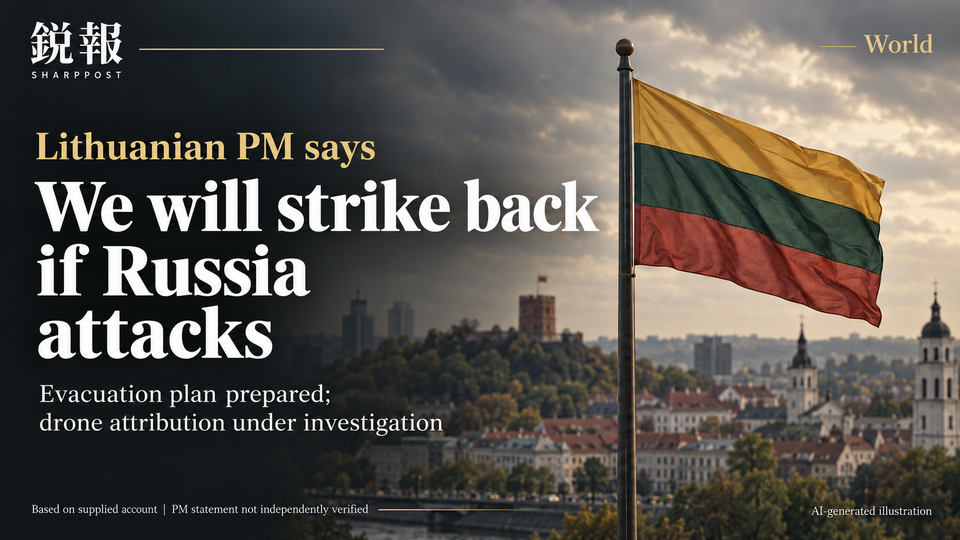
Lithuania would fight back if attacked by Russia and “will not surrender”, Prime Minister Mindaugas Sinkevičius told the BBC. His government has also prepared civilian evacuation plans, including assistance for older people leaving cities and measures to prevent traffic jams.
In an interview with Newsnight, Sinkevičius said drone incursions had contributed to Lithuanians' sense of a continuing Russian threat. The government was planning for several scenarios, some of which had not been discussed publicly, according to the BBC's report published on 22 September and carried by AOL.

The Interior Ministry announced on 14 July 2026 that a national evacuation plan had been approved. It estimates that about 75% of residents could leave independently if necessary. Municipalities would assist others, prioritising families with young children, people with disabilities and older residents.
The plan covers warnings, transport, temporary accommodation and basic assistance. Routes are to be coordinated with the military and police to avoid disrupting troop movements, and tested through civil defence exercises. The announcement did not order an evacuation.
Lithuania, a NATO member, borders Russia's Kaliningrad exclave and Belarus. Italian Eurofighter Typhoons serving on a NATO air defence mission intercepted and neutralised a drone in Lithuanian airspace overnight on 14–15 September, according to a Lithuanian Foreign Ministry statement updated on 18 September. The military recovered the wreckage and neutralised an explosive device it had carried.
The ministry said preliminary findings indicated that the drone had entered from Belarus, prompting a diplomatic protest. Its origin, ownership and purpose remained under investigation.
President Gitanas Nausėda suggested the drone may have been heading for Ukraine before electronic warfare diverted it, rather than deliberately targeting Lithuania, Reuters reported on 16 September. That was his assessment at the time.
Sinkevičius has also urged Europe to fund stronger air defences. In a government account of his 7 September meeting with EU foreign policy chief Kaja Kallas, he pledged to maintain defence spending at no less than 5% of GDP and called for joint European funding for air and missile defence and critical infrastructure protection.
Lithuania is also building facilities to host German forces. A 16 July government account of talks between the two countries' prime ministers reaffirmed plans to deploy a German brigade in 2027, with Lithuania providing infrastructure and host-nation support.
You read this far. You're not here for noise.
SharpPost delivers one weekly deep dive on geopolitics, finance, and tech — decoded for readers who want signal. Carefully selected, never noisy.