China’s pension divide in numbers
Official figures show how China’s pension payments are split, and how fiscal pressure could affect government retirees, enterprise workers and resident pensioners.

About 23 million retirees from China’s government agencies and public institutions received basic pensions at the end of 2024. They made up 7% of recipients across the country’s three basic pension schemes but received nearly a quarter of total payments that year.
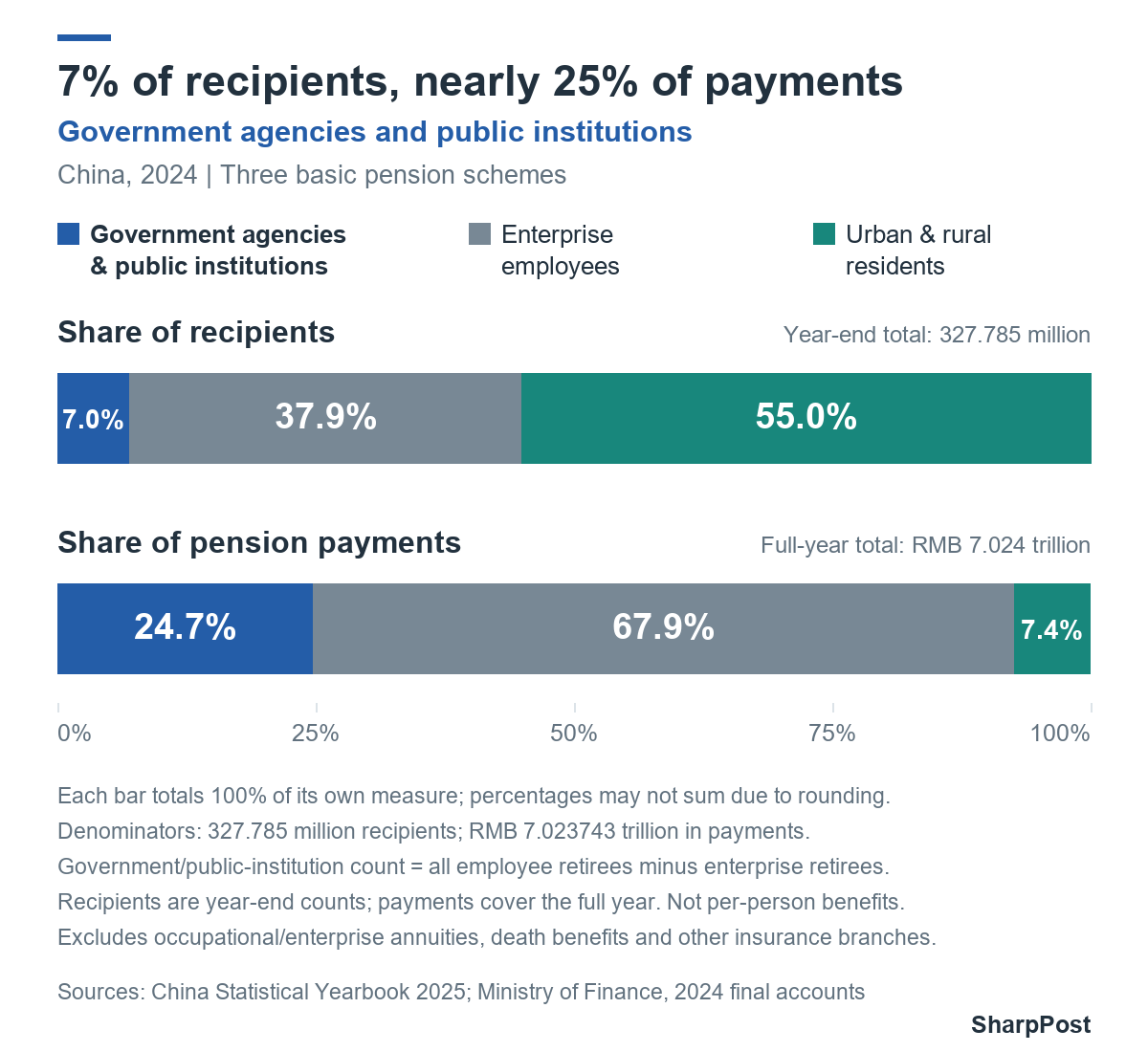
Payments to retirees from government agencies and public institutions reached 1.83 trillion yuan in 2025, or 24.6% of the three schemes’ combined pension payments, according to the Ministry of Finance’s final accounts. The share was little changed from 2024. The urban and rural resident scheme paid 606.9 billion yuan, or 8.1%.
The 2025 revenue accounts record government subsidies of 760.9 billion yuan for the fund covering government agencies and public institutions, 518.7 billion yuan for the resident fund and 872.9 billion yuan for the enterprise fund. These budget transfers are recorded separately from employers’ pension contributions.
Subsidies made up 40.1% of revenue for the fund covering government agencies and public institutions, compared with 14.5% for the enterprise fund and 54.8% for the resident fund. Subsidies to the resident fund rose 19.4% from 2024, faster than the 14.0% increase for the fund covering government agencies and public institutions, but the resident fund still received about 242.2 billion yuan less in subsidies.
China’s Social Insurance Law requires governments at county level and above to subsidize social insurance funds when they cannot cover benefit payments. It also requires administrators to pay benefits in full and on time. Those obligations apply to all three basic pension schemes.
The State Council’s 2015 decision kept existing benefit rules for people who had already retired from government agencies and public institutions, while allowing them to receive later pension increases. Employees who started work before the reform and retired afterward receive a transitional pension if they meet the requirements. Employers and employees both contribute to the fund, which is managed separately from the enterprise pension fund.
Government agencies and public institutions must also provide supplementary retirement savings plans known as occupational annuities. Employers contribute 8% of the payroll used to calculate pension contributions; employees pay 4% of their eligible wages. Participants draw on these savings in retirement alongside their basic pensions. These annuities are excluded from the chart and from the 1.83 trillion yuan paid in basic pensions in 2025.
For institutions financed entirely by government, the annuity rules allow employer contributions to be recorded on the books before cash is paid in. The government responsible for funding the institution must supply that cash before the employee retires. A tighter budget makes this payment harder to fund. For annuity money already invested, lower returns mean less accumulated savings to support future retirement income.
The enterprise pension scheme has operated under nationwide pooling since 2022. Transfers between provinces help cover local funding shortfalls. If contributions fall while more people draw pensions across several regions, there may be less money available to transfer. Pension funds would then need more government support or have to draw more heavily on reserves.
Enterprise annuities—supplementary retirement savings plans for company employees—are voluntary arrangements established by employers and employees. They covered 33.43 million workers in 2025, according to the Ministry of Human Resources and Social Security. A policy issued in late 2025 allows employers with limited resources to start at lower contribution rates and encourages smaller businesses to join pooled plans. Retirees without an annuity or much other income rely more heavily on their monthly basic pension.
Workers who stop contributing after losing a job retain the years they have already paid in, but a gap can delay when they qualify for a pension. Under the retirement reform, the minimum contribution period for an employee pension will rise from 15 to 20 years starting in 2030, increasing by six months a year. The change covers both enterprise employees and government and public-institution employees. People who reach retirement age before meeting the requirement may have to continue contributing under the rules before they can draw an employee pension. Those still out of work must cover living costs while finding money for further contributions.
Participants in the urban and rural resident scheme choose an annual contribution level. They have no employer making regular contributions based on their wages. Under State Council rules, the government pays the basic benefit. A separate payment comes from the participant’s individual account, built up through contributions, subsidies and investment returns. Local governments finance any increase they grant above the national minimum. If local budgets remain tight, those increases may become harder to afford.
The 2026 budget report proposed raising the national minimum resident pension by another 20 yuan a month, equivalent to 240 yuan over a full year. An increase of 100 yuan a month for the 188.2 million recipients recorded at the end of 2025 would cost about 225.8 billion yuan a year, equivalent to 43.5% of that year’s government subsidy to the resident fund. This estimate assumes no change in the number of recipients.
Older people already drawing a resident pension have little to supplement the basic benefit if their individual accounts hold only modest savings. If pension increases lag behind the cost of food and other essentials, the same monthly payment buys less. People with annuities or savings can draw on those resources. Those living mainly on a small resident pension may have to cut everyday spending or ask their children for more financial help.
You read this far. You're not here for noise.
SharpPost delivers one weekly deep dive on geopolitics, finance, and tech — decoded for readers who want signal. Carefully selected, never noisy.