China Traces Formaldehyde-Treated Cabbage Shipments
China is tracing napa cabbage shipments after Hebei officials confirmed buyers used formaldehyde solution during loading. Laboratory results and the full route remain pending.

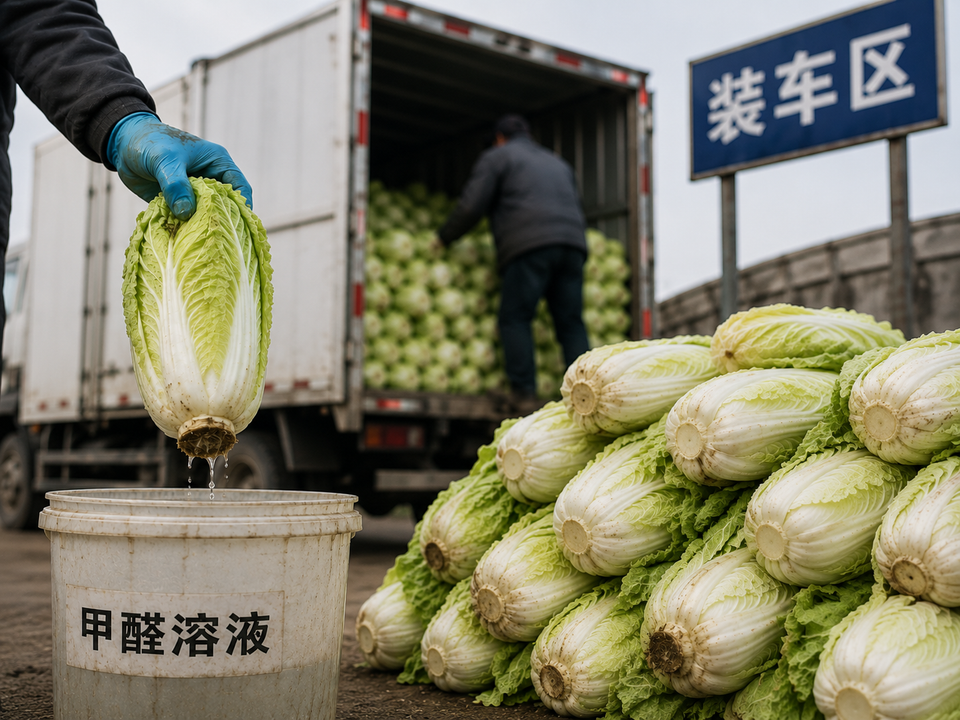
Officials in Kangbao County, Hebei province, said on Aug. 22 that vegetable buyers in Tunken township had dipped the roots of napa cabbages in formaldehyde solution while loading them for shipment. Agriculture, market-regulation and police officers inspected the site and described the practice as an illegal attempt to preserve produce in transit. Police have imposed compulsory measures on people and vehicles connected to the case.
A video posted that day by the blogger Yulie Qige showed workers placing cabbage roots in a basin of liquid before moving the vegetables onto a truck. A container labeled “Formaldehyde Solution” was visible nearby, and people at the site said the treatment could extend freshness by two or three days. The county then began inspecting vegetable purchasing and transport operations and tracing loads that had already left.

The State Council Food Safety Office, the Ministry of Agriculture and Rural Affairs and the State Administration for Market Regulation intervened on Aug. 23. They told Hebei authorities to establish where the cabbages had gone and keep affected produce off the market. Local regulators across China were also instructed to increase sampling and inspections of cabbage and other perishable vegetables.

Beijing's Xinfadi wholesale market said on Aug. 22 that the implicated cabbage had not entered its facilities. The video mentioned destinations in Suqian, Jiangsu province, and Hefei, Anhui province, but officials have not published a final account of the distribution route. Shanghai Vegetable Group said on Aug. 24 that its checks had found none of the affected Kangbao produce.
China's Food Safety Law and Agricultural Product Quality and Safety Law do not permit formaldehyde to be added to food. Its ability to suppress microbial growth has led some traders to use it illegally on seafood and vegetables. The International Agency for Research on Cancer classifies formaldehyde as carcinogenic to humans, although the risk in any exposure depends on dose, duration and route.
A court in Kunshan, Jiangsu province, sentenced a vendor surnamed Sun to 11 years in prison in 2023 for soaking silverfish in industrial formaldehyde. The operation ran from 2018 to 2021 and recorded more than 1.29 million yuan in sales. Sun was also fined 3 million yuan; an employee involved in treating and selling the fish received a five-year sentence and a 200,000 yuan fine. China's top court and procuratorate included the judgment in a 2024 collection of food-safety precedents.
Sun's operation continued for three years before it was uncovered. Vegetable harvesting and loading sites are scattered, transactions move with the trucks, and routine testing often concentrates on pesticide residues. Severe sentences offer limited deterrence when the chance of detection remains low. Whether the Kangbao conduct amounts to a criminal offence will depend on laboratory results, quantities, sales and evidence of intent. If the case ends with only a routine fine, regulators will also need to explain whether the penalty is proportionate to the proceeds.
As of Aug. 24, regulators had not disclosed the volume involved, formaldehyde residue levels or a complete distribution route. No evidence had been published showing that the shipments were exported. Kangbao's notice confirms the handling practice, but laboratory findings and legal responsibility remain under investigation.
Reporting is based on statements from the Kangbao County government, China's market regulator and wholesale-market operators in Beijing and Shanghai. RuiBao also reviewed material from the agriculture ministry, IARC and a food-safety case published by the Supreme People's Court and Supreme People's Procuratorate. Officials have not released laboratory data or a complete distribution route. Information checked through Aug. 24, 2026.
You read this far. You're not here for noise.
SharpPost delivers one weekly deep dive on geopolitics, finance, and tech — decoded for readers who want signal. Carefully selected, never noisy.