China’s New Corruption Law Mandates Reporting, Restricts Evidence Sharing Abroad
China requires reports of suspected cross-border corruption. Sharing evidence abroad requires consent under the new law and existing evidence controls.

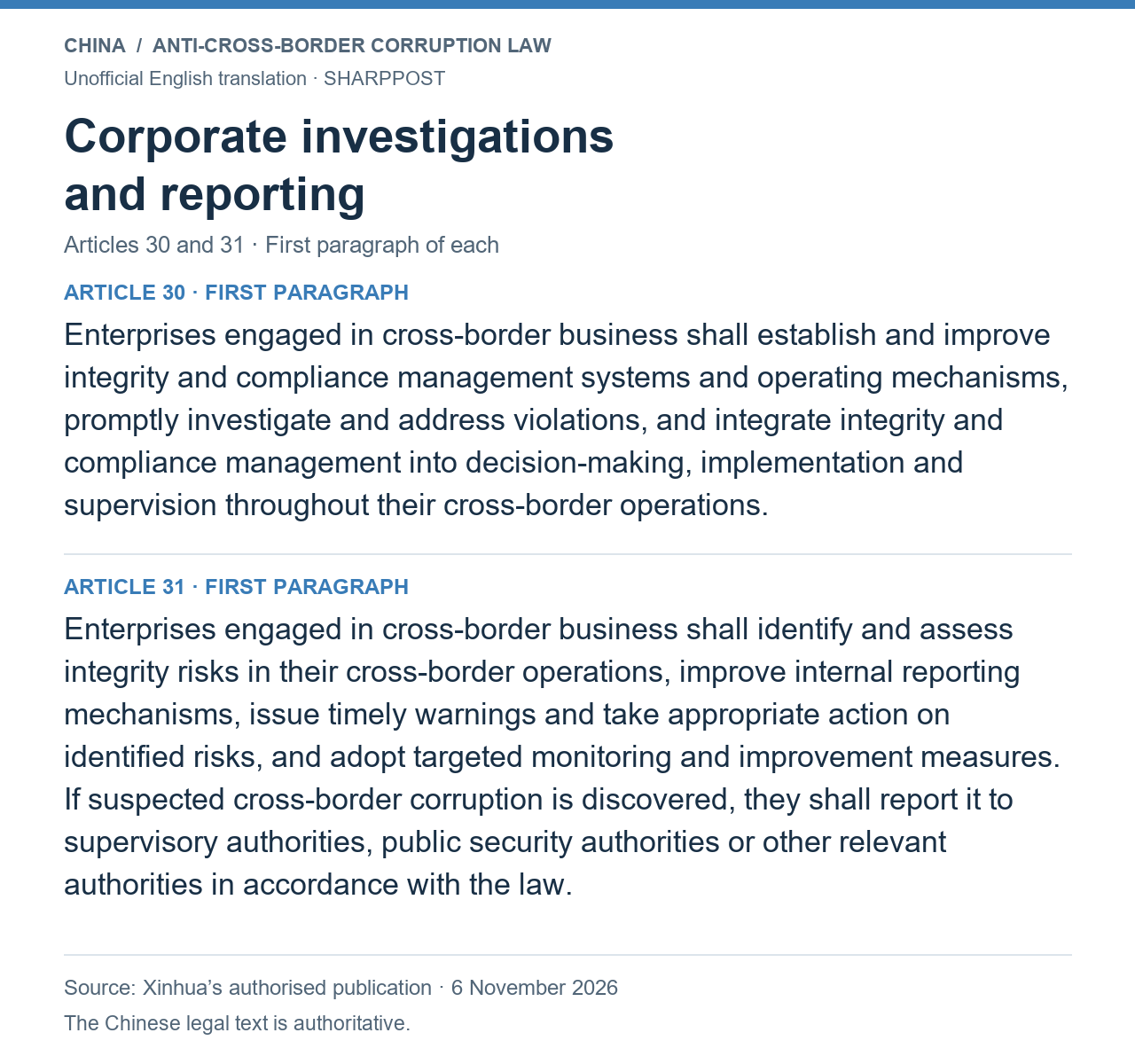
China’s Anti-Cross-Border Corruption Law took effect on November 6, 2026, the day it was passed. It requires companies to report suspected cross-border corruption to Chinese supervisory authorities, police or other relevant agencies. The duty applies to Chinese companies with overseas branches, subsidiaries or investments, and to foreign companies’ branches and subsidiaries in China.
An employee’s report of a suspicious commission paid to an agent could prompt a company to examine contracts, payment records and internal emails. The new law requires companies to maintain internal reporting channels, promptly investigate and address misconduct, keep accurate and complete accounts, and conduct due diligence on third parties acting for them.
Companies that fail to meet their compliance obligations can be ordered to correct the deficiencies. Those that refuse may have the relevant business activities suspended, be ordered to halt operations and make corrections, or lose the relevant business licence.
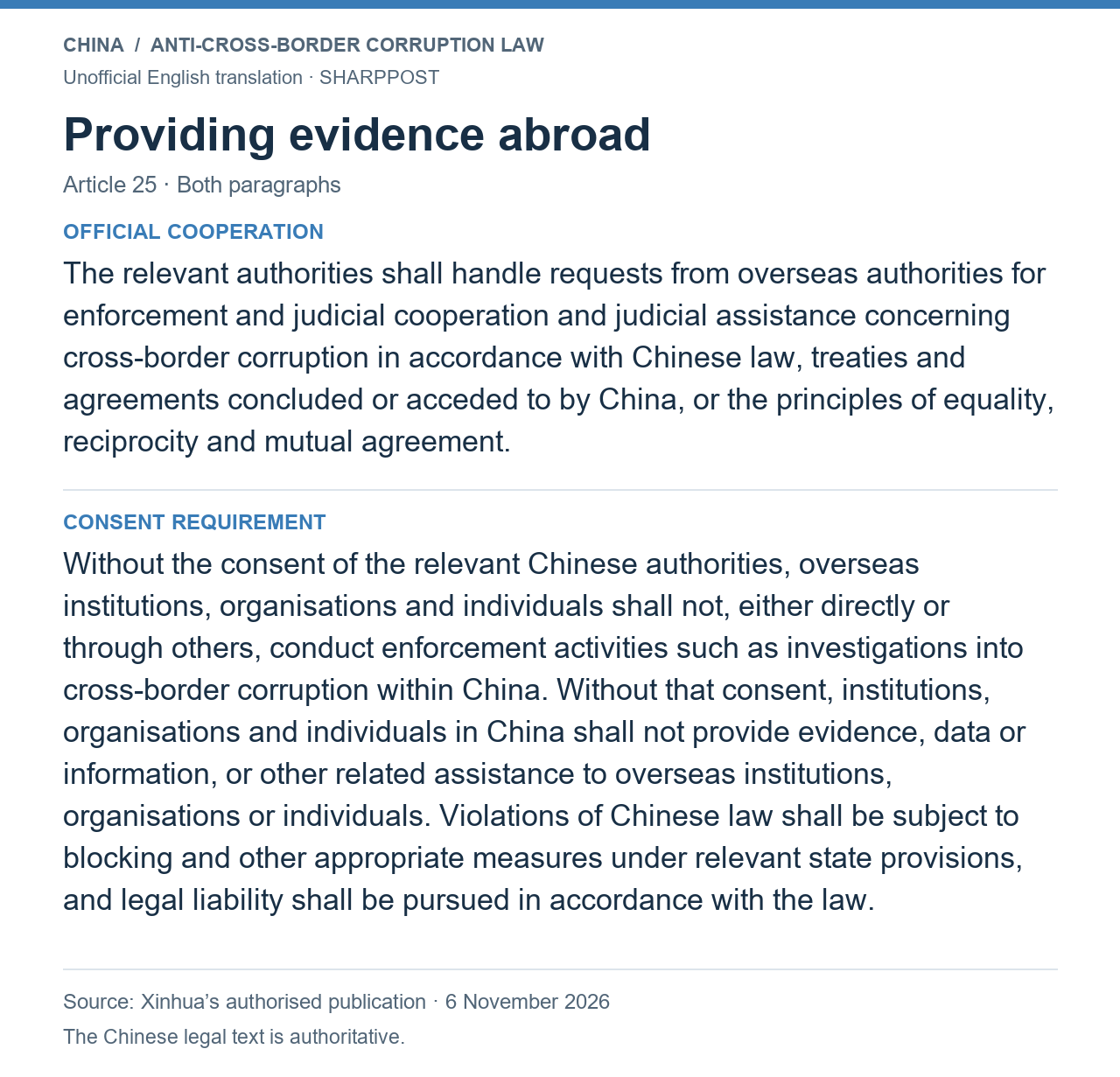
If foreign prosecutors investigate the same payment, sending them the records requires Chinese consent. Article 25 prohibits organisations and individuals in China from providing relevant evidence, data or assistance abroad without that consent. It also prohibits foreign parties from conducting anti-corruption enforcement investigations in China, either directly or through others, without permission.
A company’s report to the Chinese authorities does not authorise it to send the same files abroad. Foreign authorities can request enforcement cooperation or judicial assistance under Chinese law, applicable treaties or arrangements agreed with China.
China’s 2018 International Criminal Judicial Assistance Law already barred organisations and individuals in China from providing evidence or assistance covered by that law to foreign countries without official consent. The 2021 Data Security Law also requires approval before data stored in China is provided to foreign judicial or law-enforcement agencies.
Under rules issued by seven Chinese agencies in 2024, organisations and individuals in China seeking to provide criminal evidence abroad voluntarily—to protect their interests, for example—must apply in writing to an office at the Ministry of Justice. They must explain the case, what they intend to provide and why, and address confidentiality, data security and the protection of personal information.
The office must communicate its decision within 60 days of accepting the application. It can extend that period for complex cases or consultations with other departments. Separately, anyone in China receiving a direct foreign request for criminal evidence or assistance outside official cooperation channels must report the request to the office within 30 days of receipt.
The US Justice Department’s corporate enforcement policy announced on March 10, 2026 encourages disclosure as early as possible, even before an internal investigation is complete. Whether prosecutors decline to bring charges or reduce a penalty also depends on cooperation, corrective action and the circumstances of the case.
The department’s 2023 non-prosecution agreement with Albemarle said the US chemicals company had learned of allegations concerning its Vietnam business about 16 months before reporting them. Its internal investigation had produced evidence of potential misconduct roughly nine months or more before disclosure. Prosecutors found that the disclosure was not timely enough to qualify under the policy then in force. Albemarle nevertheless received credit for its cooperation, corrective action and other factors.
Under the department’s current policy, a company citing foreign legal restrictions on disclosing overseas records must establish that those restrictions exist. It must also identify reasonable, lawful alternatives that would help prosecutors preserve and obtain the evidence. The timing, quality and practical value of its cooperation remain factors in how much leniency it receives.
You read this far. You're not here for noise.
SharpPost delivers one weekly deep dive on geopolitics, finance, and tech — decoded for readers who want signal. Carefully selected, never noisy.