SNP, Plaid Cymru and Sinn Féin: the politics of returning to the EU
Three parties link leaving the UK to a European future. Their electoral calculations differ, as do the legal routes to referendums and EU membership.
免费微软自然语音 · 推荐使用 Microsoft Edge
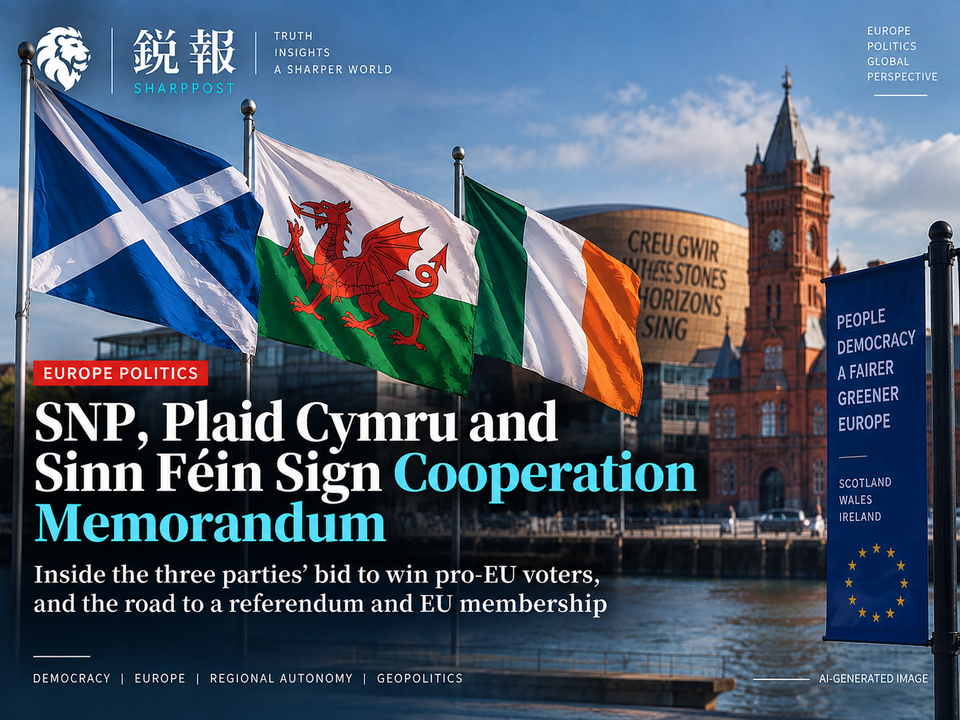
Leaders of the Scottish National Party, Plaid Cymru and Sinn Féin signed a memorandum of understanding in Cardiff on 14 September, acting as party representatives. They pledged to work together to secure public votes on leaving the United Kingdom and backed a return to the European Union.

In the 2016 Brexit referendum, 62% of Scottish voters backed Remain, but Scotland left with the rest of the UK. That gives the SNP grounds to challenge how much autonomy the union offers when Scottish voters cannot determine their country's relationship with Europe. Linking independence to EU membership also gives the party a way to appeal to pro-European voters who have not previously supported independence.
Wales voted differently: 52.5% backed Leave in 2016. Plaid Cymru cannot make the same argument that Brexit overrode its electorate's wishes. In an interview before the meeting, First Minister Rhun ap Iorwerth emphasised unfair funding and the powers needed to build the Welsh economy. His party must persuade voters that an independent Wales could rely less on London while finding markets and partners in Europe.
Sinn Féin seeks Irish reunification. Northern Ireland also voted Remain in 2016, while the Republic of Ireland remained an EU member. Linking unity to a return to the EU could help the party reach beyond questions of national identity to trade, cross-border life and European citizenship rights, appealing to voters outside its traditional base. Northern Ireland's First Minister Michelle O'Neill attended on behalf of Sinn Féin; its power-sharing partner, the Democratic Unionist Party, supports remaining in the UK and opposed her signing in a governmental capacity.
Electorally, all three parties are trying to answer a difficult question for campaigns to leave the UK: what comes next? EU membership offers voters a destination beyond separation from London. But the parties still need concrete plans showing whether access to European markets could offset new trade barriers with the rest of the UK. Support for the EU does not necessarily translate into a willingness to bear the costs of leaving the union.
How would referendums be held?
The UK Supreme Court ruled unanimously in 2022 that the Scottish Parliament could not legislate for an independence referendum under its existing powers. The relevant constitutional matters are reserved to Westminster. The parties' agreement does not change those powers.
Swinney wrote to Prime Minister Andy Burnham on 10 September, seeking talks on a lawful route to a referendum. He would need agreement at UK level to change the allocation of powers before proceeding.
Northern Ireland already has a statutory mechanism for a vote. Under the Northern Ireland Act 1998, the Northern Ireland Secretary must call a referendum if it appears likely that a majority of voters would support leaving the UK and joining a united Ireland. Sinn Féin's call to prepare for unity does not establish that this threshold has been met.
EU accession is a separate process. Even after independence, Scotland and Wales would have to apply, meet the membership conditions and complete negotiations, securing unanimous agreement from member states and ratification of an accession treaty. Sinn Féin's proposed route is reunification with the Republic of Ireland, an existing EU member, rather than a separate Northern Irish membership application.
You read this far. You're not here for noise.
SharpPost delivers one weekly deep dive on geopolitics, finance, and tech — decoded for readers who want signal. Carefully selected, never noisy.