Hezbollah’s funding: US targets Iran-linked networks
SharpPost examines sanctions on Hezbollah financing and Iran’s BitBank, alongside procurement records and the roles of China-based firms and Russian fundraisers.
免费微软自然语音 · 推荐使用 Microsoft Edge
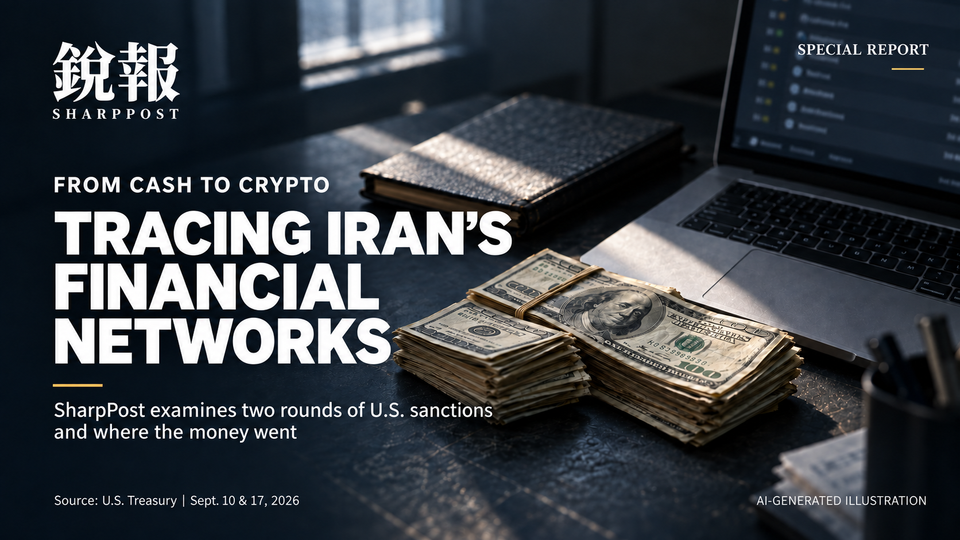
The United States imposed sanctions on September 10 on money exchangers, cash couriers and gold businesses accused of moving funds for Lebanon’s Hezbollah. The Treasury Department said Iran’s Islamic Revolutionary Guard Corps–Quds Force used front companies and exchange houses to send oil revenue into Lebanon, where Hezbollah used it to buy weapons, manufacture equipment and pay its members.
A week later, the Iranian cryptocurrency platform BitBank, its developer and three associates were also placed under sanctions. That action concerned Bitcoin transfers to the Islamic Revolutionary Guard Corps (IRGC). The announcement did not say the money subsequently reached Hezbollah.
View the US Treasury Department’s post on BitBank sanctions
Both actions are part of Operation Economic Outcast, launched by Washington on August 24. Treasury is targeting Iran’s oil revenue, overseas procurement and financial intermediaries, warning that businesses helping to evade sanctions could lose access to the US financial system.
Money exchangers accused of transferring hundreds of millions
The transfers described in the September 10 announcement took place between May and September 2025. US authorities have not released complete transaction records, and SharpPost has not independently verified the amounts.
| Activity / source | Findings or allegations |
|---|---|
| Transfers through money exchangersUS Treasury · September 10, 2026 | Treasury said two Lebanese money exchangers transferred hundreds of millions of dollars from the Quds Force to Hezbollah between May and September 2025. |
| Gold brought in from DubaiUS Treasury · September 10, 2026 | Treasury said financier Hamdi Zaher El Dine ran exchange businesses through relatives, bought gold in Dubai and used couriers to bring it into Lebanon. Gold Pro SARL was sanctioned. |
| BitBank Bitcoin transfersUS Treasury · September 17, 2026 | Treasury said businessman Babak Zanjani used the platform to transfer hundreds of millions of dollars’ worth of Bitcoin to the IRGC in June and July 2026. |
| Hezbollah training for Houthi personnelUN Panel of Experts on Yemen · 2024 report, paragraph 20 | The panel found that Hezbollah provided the Houthis with military training, weapons-assembly expertise and financial support for military activities. |
The UN panel’s 2024 report also documented Iranian support for the Houthis, including weapons, training and funding.
China and Russia oppose unilateral sanctions on Iran
Washington wants other countries to help restrict Iran’s transactions. China and Russia publicly oppose unilateral sanctions. In a joint statement issued in Beijing in March 2025, the three countries called for an end to what they described as “illegal unilateral sanctions” and urged negotiations over Iran’s nuclear programme. At a meeting with Iran’s foreign minister in May 2026, Wang Yi said China was willing to deepen cooperation and supported a diplomatic resolution to the conflict.
The comprehensive strategic partnership treaty signed by Russia and Iran in January 2025 covers military training, joint exercises and military-technical cooperation. It also proposes payment infrastructure independent of third countries and greater use of national currencies. In March that year, the Chinese, Russian and Iranian navies held the Security Belt joint exercise near Iran’s port of Chabahar.
In a May 2022 announcement, Treasury said RPP LLC had been used to transfer millions of dollars from Russia on behalf of the Quds Force. Afghan businessman Nabizada, who had previously managed the company, was accused of coordinating with senior Russian government officials and intelligence agencies to raise funds for the Quds Force. The announcement did not include complete financial records.
China-based firms accused of procurement and money transfers
Treasury announcements from 2015, 2022 and 2024 also named energy and logistics businesses in mainland China and Hong Kong, as well as China-based companies allegedly controlled by Hezbollah procurement agents.
| Company | Alleged transactions or role | Source and basis for sanctions |
|---|---|---|
| Aero Skyone Co. Limited; Le-Hua Electronic Field Co. LimitedBoth described by Treasury as China-based | Treasury said a procurement agent used Aero Skyone to buy drone engines and other equipment for Hezbollah. Le-Hua’s controller was accused of procuring dual-use technology for Hezbollah and helping obtain electronics from China for shipment to Yemen, for use in Houthi improvised explosive devices. | November 5, 2015 announcement. Both companies were sanctioned for being owned or controlled by the procurement agents concerned. |
| China Haokun Energy LimitedHong Kong; parent company based in Beijing | Treasury said the company bought millions of barrels of Iranian oil, worth tens of millions of dollars, from the Quds Force, with an intermediary arranging payment to the force. | May 25, 2022 announcement. The named recipient was the Quds Force; the announcement did not trace individual payments onward to Hezbollah. |
| Guangzhou Alshahari United Corporation Limited; Hongkong Alshahari United Corporation LimitedGuangzhou company and its Hong Kong parent | Treasury said the Guangzhou company helped a Yemeni logistics firm arrange shipments from China to Yemen. The logistics network was accused of transporting missile and drone components for the Houthis. | July 31, 2024 announcement. The Guangzhou firm was sanctioned for providing support; its Hong Kong parent was sanctioned for owning or controlling it. |
These announcements did not disclose evidence that the Chinese government had ordered the purchases.
Britain and the EU list Hezbollah differently
| Country / institution | Action taken | Source |
|---|---|---|
| United States | Designated Lebanon’s Hezbollah in its entirety as a Foreign Terrorist Organization in 1997. | Treasury’s September 2026 announcement |
| United Kingdom | Extended its ban from parts of Hezbollah to the entire organisation in March 2019. | Home Office announcement |
| European Union | The EU-level list names Hezbollah’s military wing, rather than the entire organisation. A July 2026 review left the list unchanged. | February regulation and annex; statement on the July review |
| United States and six Gulf countries | In May 2018, Saudi Arabia, the UAE, Bahrain, Kuwait, Qatar and Oman joined the US in sanctioning Hezbollah’s leadership and associated individuals and businesses. | Joint action announcement |
The Houthis were separately designated a Foreign Terrorist Organization by the US on March 4, 2025.
US convenes financial institutions over Iranian funds
On September 16, the US Financial Crimes Enforcement Network convened global financial institutions to discuss how Iran and groups it supports use US correspondent banking relationships to move money and procure weapons.
Under the sanctions rules, designated parties’ property in the United States, or held or controlled by US persons or entities, must be blocked. Unless authorised or exempt, US transactions involving that property are generally prohibited. Neither announcement disclosed the amount of assets actually frozen.
You read this far. You're not here for noise.
SharpPost delivers one weekly deep dive on geopolitics, finance, and tech — decoded for readers who want signal. Carefully selected, never noisy.