AfD’s state election victory tests Germany’s European policy
AfD won 43.8% in Saxony-Anhalt but lacks a majority. Coalition talks test the CDU as Merz defends Ukraine aid.

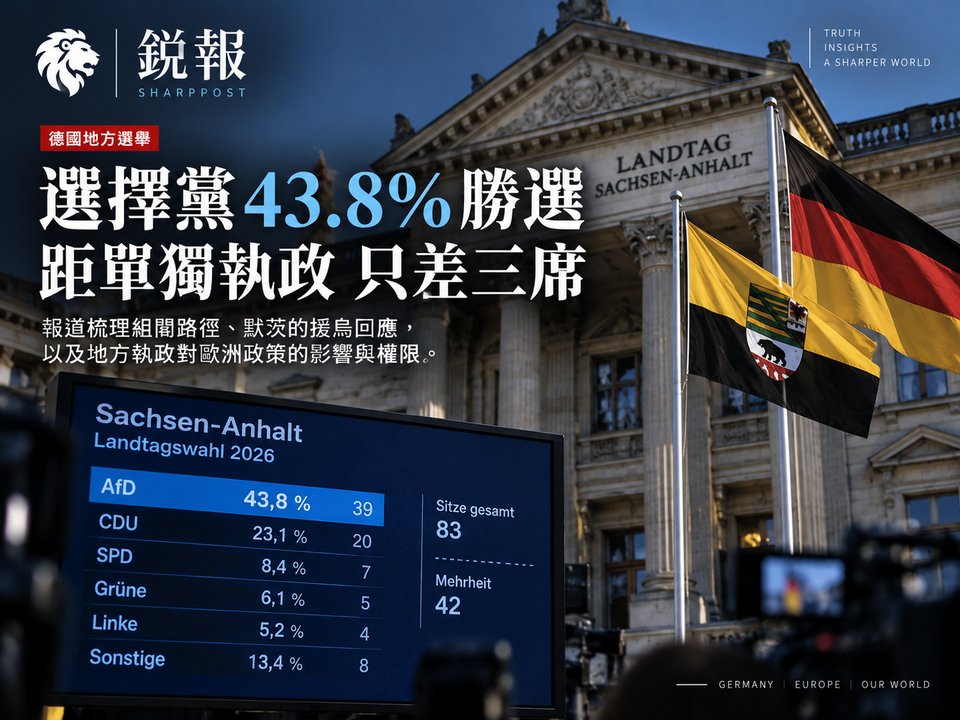
Germany’s Saxony-Anhalt state voted on September 6. Preliminary official results gave Alternative for Germany (AfD) 43.8% of the vote, far ahead of the Christian Democratic Union (CDU) on 17.2%. The AfD became the largest party in the state parliament but fell three seats short of an outright majority.
The following day, its candidate for state premier, Ulrich Siegmund, joined the party’s two federal co-leaders at a press conference in Berlin. Co-leader Alice Weidel set a target of at least 40% at the next federal election. Siegmund offered talks with other political forces while ruling out compromises on principle. According to Deutsche Welle, the leadership wants a stable government rather than having to negotiate parliamentary support vote by vote.

The AfD’s vote share rose by about 23 percentage points from 2021, while the CDU lost about 20 points. Turnout reached 77.8%, an increase of roughly 17.5 points.
| Party | Vote share | Seats |
|---|---|---|
| AfD | 43.8% | 39 |
| CDU | 17.2% | 15 |
| SPD | 9.3% | 8 |
| Greens | 8.9% | 8 |
| The Left | 8.6% | 8 |
| Sahra Wagenknecht Alliance (BSW) | 5.3% | 5 |
The arithmetic of a coalition
The CDU, Social Democrats and Greens have only 31 seats between them. Adding The Left brings the total to 39. A majority coalition excluding the AfD would also need the BSW’s five seats. A minority administration offers another route, but would have to find additional support for budgets and legislation. No existing bloc has the seats to govern comfortably on its own.
As Euronews reports, the state’s domestic intelligence agency has classified the local AfD as a confirmed right-wing extremist organisation, a designation the party disputes. Accepting its support would breach the CDU’s own barrier against cooperation; keeping it out would require compromises across party lines.
The BSW favours left-wing economic policies and a friendlier approach to Russia. Its seats and the AfD’s would together make a majority, but areas of agreement do not amount to a coalition deal. Taking on a partner would require concessions from the AfD, just as Siegmund has been insisting that he will not compromise.
Spanish Prime Minister Pedro Sánchez described the result on September 7 as a warning about the spread of the far right and stressed the need for Spain’s progressive coalition government, according to The Associated Press.
The dispute over Russia
The AfD’s 2025 federal election manifesto calls for economic sanctions against Russia to be lifted and for Ukraine to remain neutral, outside both NATO and the EU. By campaigning against aid to Ukraine and for restored relations with Russia, the party made Germany’s European security policy an issue in a state contest.
EU sanctions decisions under the Common Foreign and Security Policy require unanimity among member states, with Germany represented by its federal government. Saxony-Anhalt has four of the Bundesrat’s 69 votes and can participate in federal and European affairs, but it has no separate veto over EU sanctions.
On September 7, after a CDU leadership meeting, Chancellor Friedrich Merz warned that withdrawing support for Ukraine would make the security situation worse. He acknowledged the need to explain government decisions more clearly to the public, including its Russia policy, EFE reported.
On domestic reform, Merz continued to defend the government’s course. Vice-Chancellor and Finance Minister Lars Klingbeil, a Social Democrat, called for reflection on parts of the reform programme, describing the result as a signal to Berlin. Their responses offered no common answer on how policy should change.
What a state government can do
Siegmund campaigned for more deportations and cuts to what he describes as incentives for immigration. Reception and accommodation, administrative enforcement and local policing fall much closer to a state government’s daily responsibilities than sanctions against Russia do. In office, the AfD would encounter budgetary limits, the courts and existing law as it pursued those proposals.
The party has also proposed cutting funding for democracy projects and changing public broadcasting arrangements. These measures concern state budgets and regional institutions. They do not depend on first gaining control of Germany’s foreign policy at EU level, though they still require the relevant legislative and administrative procedures.
Mecklenburg-Western Pomerania holds its state election on September 20, just two weeks after the Saxony-Anhalt vote.
You read this far. You're not here for noise.
SharpPost delivers one weekly deep dive on geopolitics, finance, and tech — decoded for readers who want signal. Carefully selected, never noisy.