EU sanctions Singapore fintech ALT Capital, saying restricted-goods payments ran through its Glider platform
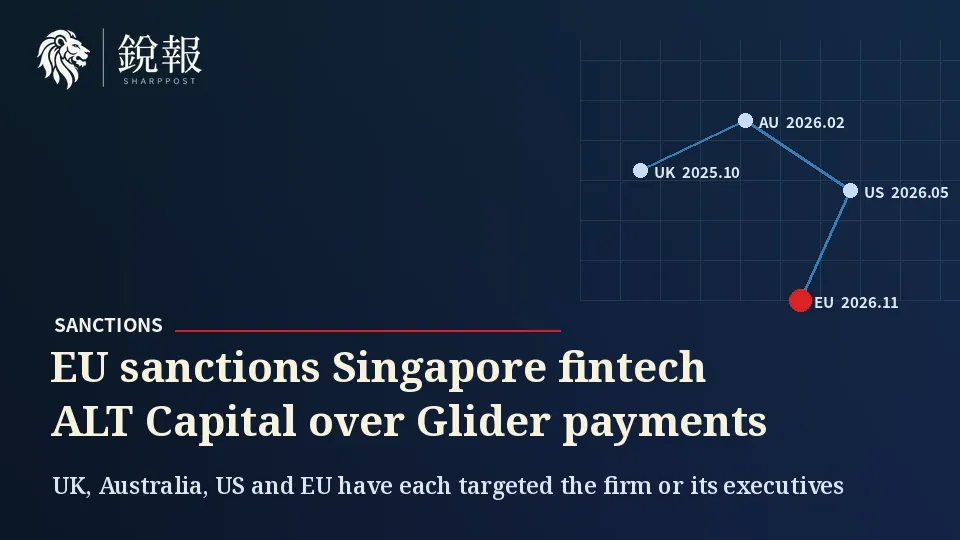
The EU has added Singapore fintech ALT Capital to its Russia sanctions list, saying payments for exports of restricted goods ran through its Glider trading platform. Britain, Australia and the United States had already sanctioned the company or its two executives.

The European Union on Nov. 16 added Singapore-based ALT Capital to its Russia sanctions list, saying the fintech company's online trading platform, Glider, acts as a "financial hub for transactions, in particular regarding the export of goods" under EU restrictions. "Payment for those transactions is made via 'Glider'," the listing says. The EU concluded that ALT Capital "provides key financial infrastructure to circumvent Union restrictive measures" and is facilitating breaches of the anti-circumvention ban in Regulation 833/2014, the bloc's main legal basis for trade and export restrictions on Russia.
The entry is one of 113 in Council Implementing Regulation 2026/2574, a package that also covers nearly 50 Russian banks and financial institutions, refiners and energy companies, and foreign buyers of Russian crude and vessel owners. It gives ALT Capital's registration date as September 2016 and its address as High Street, Singapore. The listing freezes the company's assets in the EU and bars anyone from making funds or economic resources available to it. Its executives were not listed.
Britain had sanctioned both executives, along with the company, on Oct. 15, 2025. Its notice named Narmina Dadashova as ALT Capital's owner and said Vladislav Gromov manages the firm, and the government placed all three in a group it described as supporting Russia's defence sector or supplying equipment critical to it. The British statement of reasons said the company was making available goods or technology "that could contribute to destabilising Ukraine."
On Feb. 23, Australian Foreign Minister Penny Wong signed an instrument imposing Russia-related sanctions on Gromov and Dadashova. It identifies Gromov as "Director of GLIDER ST PTY LTD, registered in Australia" and chief investment officer of ALT Capital, and Dadashova as ALT Capital's director and beneficial owner. Australian business records show Glider ST registered in Queensland in March 2022 and still active.
The U.S. State Department designated ALT Capital on May 28, U.S. time, under Executive Order 13846, an Iran sanctions order, for "knowingly engaging in a significant transaction for the purchase, acquisition, sale, transport, or marketing of petrochemical products from Iran." The Treasury's Office of Foreign Assets Control added it to the Specially Designated Nationals list the same day. The State Department's fact sheet said the company was "involved in the export of over $900,000-worth of Iranian-origin petrochemical products," and the same entry cited Britain's earlier designation.
Washington sanctioned Dadashova on Aug. 24, U.S. time, as a director of ALT Capital. This time the State Department gave a timeframe: "Between March and April 2024, ALT CAPITAL conducted multiple transactions for the export of approximately $900,000 worth of Iranian-origin petrochemical products." The U.S. listing records an Azerbaijani passport for her, with Azerbaijani nationality and Singapore as an alternative.
On Nov. 10, Britain amended all three designations. For the company and Gromov, it added "funds, economic resources" to the goods and technology they were suspected of supplying. For Dadashova, it added a second ground: that she worked as a manager of Mechel Carbon Pte Ltd, an entity "carrying on business in a sector of strategic significance to the Government of Russia, namely the Russian extractives sector," and in doing so was "obtaining a benefit from or supporting the Government of Russia." The revised entry lists her as owner of ALT Capital, Metaflare Pte Ltd and Mechel Carbon (Singapore) Pte Ltd, and adds a Singapore passport, a birthplace of Baku, Azerbaijan, and a Singapore identity number that matches the one in the U.S. listing.
A FinCEN analysis published in October 2025 traced about $9 billion in 2024 activity, reported by U.S. financial institutions, that was potentially linked to Iranian shadow banking. Singapore-based companies handled about $2.2 billion of it, or 24%, the third-largest share by jurisdiction, and oil companies accounted for 81% of that amount. FinCEN said Singapore's prominence was likely due to its role as a major financial hub, its place in international oil shipping and its low barrier to forming companies. The same Aug. 24 U.S. action that targeted Dadashova also named Singapore ship managers Arc Chartering and Azure Shipping and trading firm Wellbred Capital. Citing the FinCEN figures in October, the advisory firm Secretariat wrote that the concentration of activity in Hong Kong, Singapore and the UAE "does not mean that every transaction or entity in those jurisdictions presents sanctions risk," but that for investors, "weak sanctions controls may also affect deal timing, lender appetite, valuation, contractual protection and post-acquisition remediation."
In a peer review published May 6, the Financial Action Task Force placed Singapore on "regular follow-up," the track for members that have done well. The Monetary Authority of Singapore and the home affairs and finance ministries said in a joint statement that the country would keep an effective anti-money-laundering regime to protect its reputation as a trusted financial centre "while remaining welcoming to legitimate businesses and investors." In an Oct. 21 commentary in The Business Times, Ramkishen S. Rajan, a professor at the National University of Singapore's Lee Kuan Yew School of Public Policy, wrote that banks in Singapore are exposed to U.S. secondary sanctions, and that when the cost of checking a customer's payments exceeds the fees it brings in, refusing a payment or closing an account may be cheaper, "even without establishing a sanctions breach." If law-abiding firms cannot obtain routine payment services, he wrote, "the resulting difficulties can weaken the appeal" of Hong Kong and Singapore as places to do business. On Nov. 12, in a statement on the Nvidia server case and its investigation of Megaspeed, Singapore's Home Affairs Ministry said the country does not enforce other countries' unilateral export controls but expects companies operating there to take them into account, and "does not condone companies using their association with Singapore to circumvent or violate other countries' export controls through fraud or dishonest practices." The next day, police charged a fifth person in the server case, which now involves five people and six companies.
Singapore corporate registry records cited by The Straits Times in August show ALT Capital's primary registered business as management consultancy, with software and app development as a secondary activity. The Singapore FinTech Association's member directory lists it as a financial institution in the fund manager category, with membership running to August 2027 and a fintech certification marked June 2026 and expired. The Monetary Authority of Singapore's public directory of financial institutions has no entry for ALT Capital or Glider.
You read this far. You're not here for noise.
SharpPost delivers one weekly deep dive on geopolitics, finance, and tech — decoded for readers who want signal. Carefully selected, never noisy.