China explores military humanoids. How close are they to the battlefield?
China is exploring military humanoids. US and Japanese programmes show the gap between prototype tests and battlefield deployment.

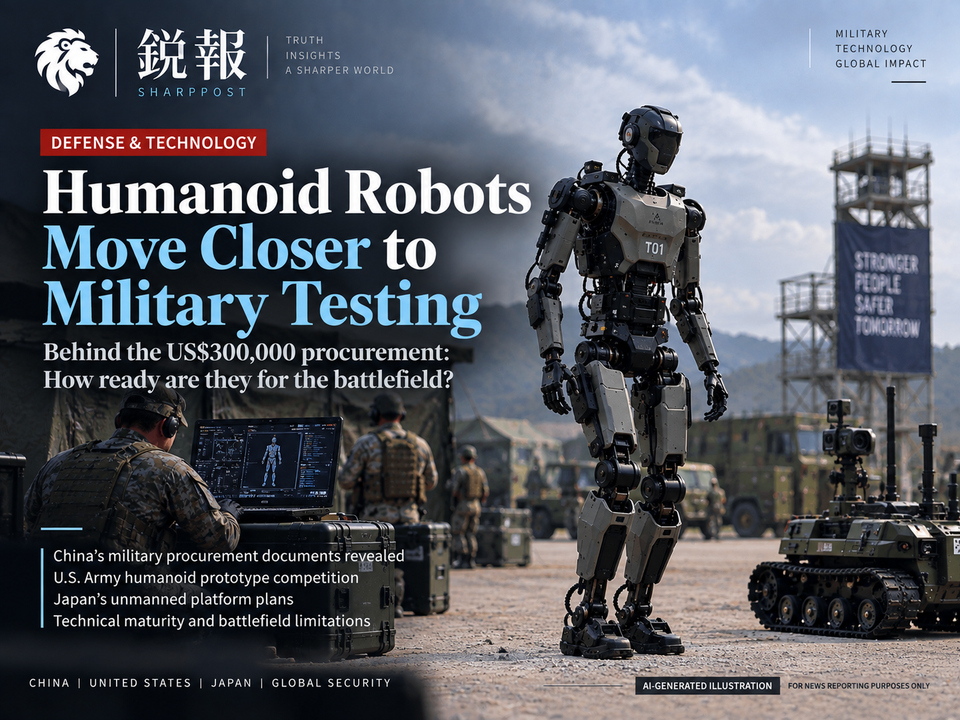
In June, a Chinese military procurement document set a budget of about $300,000 for a system to collect and label data for humanoid robots. It would process camera, radar and movement data, including information on terrain the machines could traverse.
Reuters disclosed the budget on September 7. Its review of more than 100 procurement notices, papers, patents, official records and company materials found that China’s defence establishment accelerated its exploration of military uses for humanoids in 2025 and 2026. Reuters could not establish whether the tenders had been fulfilled and found no evidence of armed humanoids deployed with operational People’s Liberation Army units. China’s defence ministry and the National University of Defense Technology did not respond to its requests for comment.
Where the human form helps—and where it does not

At the US Defense Advanced Research Projects Agency’s 2013 Robotics Challenge trials, robots had to drive vehicles, cross obstacles and operate equipment in simulated disaster-response tasks. The tests assessed their mobility and their ability to use equipment designed for people.
Stairs, narrow passages and existing tools also offer potential uses for military humanoids. But walking on two legs requires balance control, while two arms add joints and maintenance demands. For transport tasks, that design still needs to be compared with wheeled and tracked alternatives.
The University of Bonn’s Momaro robot combined wheels, legs and two arms to compete in the DARPA disaster-response challenge. It retained the ability to manipulate tools without making bipedal walking a requirement.
Are they ready for the battlefield?
Prototypes have demonstrated carrying objects, operating equipment and walking under remote control. Those capabilities can be tested in military settings where tasks are defined, communications are available and people supervise. In a complex combat environment, machines must also cope with lost communications, faults and unexpected obstacles. A demonstration of an action does not establish how long a robot can keep working or how often a person must intervene.
On that evidence, humanoids have a technical basis for trials in limited support roles, but there is insufficient public evidence that they can reliably replace infantry. The gap concerns sustained performance and handling the unexpected, not just walking speed. Experience with wheeled vehicles, quadrupeds and drones cannot substitute for tests of humanoid platforms.
The US Army seeks military prototypes
The US Army launched its xTechHumanoid competition in 2025 to solicit humanoid technologies for military use. The announcement offered up to $490,000 in cash prizes and $1.25 million in potential follow-on awards. Assessment covers complete systems as well as artificial intelligence, sensors and power systems.
Under the announcement, finalists would take part in live experiments with defence experts and end-users to validate readiness and refine performance. Results would also inform investment, training and force-structure work. The programme selects and tests prototypes; it does not establish that the Army has fielded humanoids with its units.
Japan selects platforms by task
Honda’s Avatar Robot project uses teleoperation for settings that people find difficult to enter, including disaster sites. The HRP-5P research at Japan’s National Institute of Advanced Industrial Science and Technology addresses heavy physical work in construction. Both are civilian research efforts, not evidence of equipment entering service with the Self-Defense Forces.
In a 2023 request for information and proposals on unmanned vehicles, Japan’s Ground Self-Defense Force listed reconnaissance, attack-support and transport platforms, walking platforms, and autonomous patrol platforms. Walking systems were expected to move steadily and conduct reconnaissance in areas difficult for wheeled or tracked vehicles to enter. The document did not require a human-like arrangement of two legs and two arms.
Japan’s Defense Buildup Program also calls for unmanned ground vehicles and aircraft to work together in protecting garrisons, bases and critical facilities. These documents define requirements by mission; they do not document the deployment of humanoid combat robots.
The proposal request asks companies to set out manufacturing and maintenance arrangements, technical risks, and quantitative comparisons of life-cycle costs across alternative solutions.
You read this far. You're not here for noise.
SharpPost delivers one weekly deep dive on geopolitics, finance, and tech — decoded for readers who want signal. Carefully selected, never noisy.