Von der Leyen proposes EU associate status for Canada
Canada and the EU already have free trade and defence procurement ties. What would associate membership add? Its rights and obligations remain undefined.
免费微软自然语音 · 推荐使用 Microsoft Edge
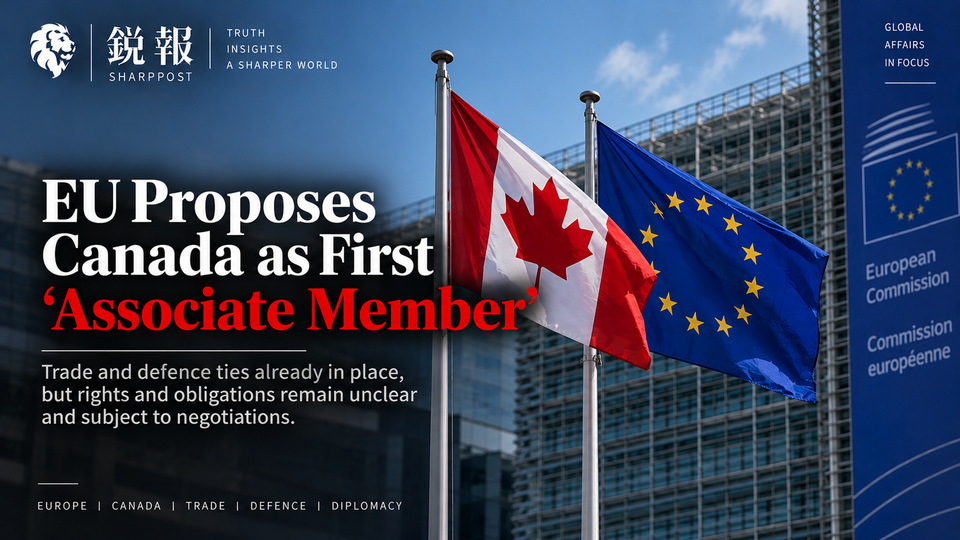

European Commission President Ursula von der Leyen proposed making Canada the EU’s first “associate member” during her State of the Union address in Strasbourg, France, on September 16. She told Canadian Prime Minister Mark Carney, who was in the audience, that she wanted to work with him on the proposal, Reuters reported.
A readout issued by Canada’s Prime Minister’s Office that day listed cooperation on minerals, energy, defence, research and development, and advanced technologies. It did not announce acceptance of associate membership. Earlier in the week, Carney had said Canada was seeking a unique alliance with the EU, not membership.
What is left to negotiate beyond tariffs?
Most tariffs between Canada and the EU have already been removed. According to the Commission’s trade records, the Comprehensive Economic and Trade Agreement (CETA), provisionally applied since 2017, has eliminated duties on about 99% of tariff lines. That figure refers to product classifications, not the share of trade by value.
At the Canada Investment Summit on September 15, Carney said his aim in building international partnerships was to strengthen Canada’s strategic autonomy. He sought closer industrial cooperation in artificial intelligence, payments, space, critical minerals and clean energy, while maintaining partnerships with the United States in important areas.
Von der Leyen proposed cooperation in intelligent manufacturing, a technology alliance, integration of defence industries and closer work in the Arctic. Their published agendas suggest that Canada wants more market options for its industries, while the EU wants closer production and supply ties with Canada.
Some cooperation already concerns procurement. On June 15, the Council of the EU approved an agreement allowing Canadian companies and products to participate in procurement under Security Action for Europe (SAFE). The instrument supports joint defence purchases and increased production by member states. It gives Canadian companies a chance to compete for relevant orders without Canada first becoming an EU member. Removing tariffs on goods alone cannot provide that kind of access.
Member states still have a say
The EU’s existing treaties do not define an “associate member” category, and von der Leyen cannot confer that status on Canada herself. The two sides have yet to announce specific rights, obligations or arrangements for implementation.
Ratification of their existing trade agreement has taken years. Commission records show that 10 member states have yet to complete national ratification of CETA, including France, Italy and Belgium. Most of the agreement already applies, but it has not fully entered into force. The approval process for any new agreement would depend on its final terms; CETA’s procedures cannot simply be assumed to apply.
Canada is scheduled to host the next Canada–EU summit on October 29–30. Carney said discussions on a new security and economic alliance would begin next month.
You read this far. You're not here for noise.
SharpPost delivers one weekly deep dive on geopolitics, finance, and tech — decoded for readers who want signal. Carefully selected, never noisy.