After Rescuing the Colonel: One Rescue Mission, Three Cracks in the War Narrative
An F-15E was shot down over western Iran on April 3 — the first crewed U.S. aircraft lost in 36 days of war. The pilot was extracted the same day;
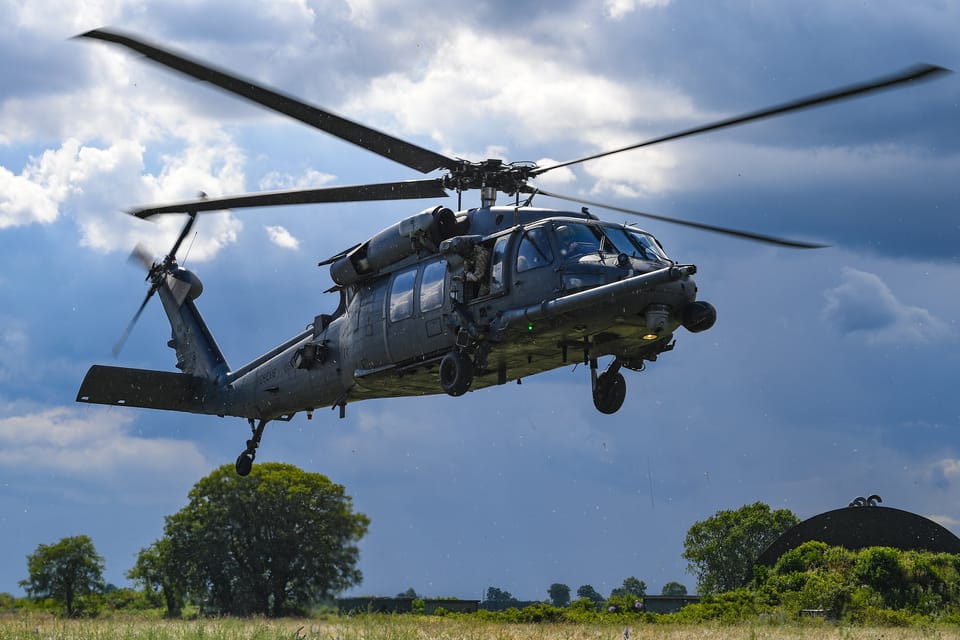
On Sunday, Trump posted two words on Truth Social: "We got him." The man recovered was a colonel — the weapons systems officer (WSO) of an F-15E Strike Eagle, the backseater who operates radar, targeting, and missile launch systems. Two days earlier, the jet, assigned to the 494th Fighter Squadron out of RAF Lakenheath and deployed to Jordan, had been shot down over Iran's Kohgiluyeh province by air defense fire. It was the first crewed U.S. aircraft lost in 36 days of Operation Epic Fury. The pilot was extracted the same day by two HH-60G Pave Hawk helicopters. The colonel was not as fortunate. He spent over 36 hours evading Iranian pursuers alone in mountainous terrain before being pulled out at dawn on Sunday.
Trump called it "one of the most daring search and rescue operations in U.S. history," said the colonel was "behind enemy lines in the treacherous mountains of Iran, being hunted down by our enemies," injured but "will be just fine." He added it was "the first time in military memory that two U.S. Pilots have been rescued, separately, deep in Enemy Territory." The phrasing was precise — a military loss, re-encoded as a heroism narrative.
Saving One Man Cost More Than Losing the Jet
The rescue operation itself became a war of attrition. The extraction helicopter took small arms fire, injuring crew members. An A-10 Thunderbolt dispatched for close air support was hit near the Strait of Hormuz; its pilot ejected over Kuwaiti airspace and survived, but the aircraft was destroyed. Two additional Black Hawk helicopters were struck by Iranian fire during the search. One F-15E lost; to recover two people, the U.S. military lost another aircraft, had two helicopters damaged, and suffered multiple crew injuries.
The F-15E carries a unit cost of roughly $90 million; the A-10, about $19 million. Equipment losses alone exceeded $100 million — before counting the operational cost of deploying "dozens of aircraft" and hundreds of special operations troops. The arithmetic of air warfare is losing coherence. Losing a jet is one cost. Rescuing its crew is a second. The second is often larger than the first.
A CIA Deception, a $60,000 Bounty, and the Asymmetry Problem
The colonel survived because the CIA intervened. According to reports, the agency launched a deception campaign before the Pentagon began its rescue — spreading word inside Iran that U.S. forces had already located the officer and were moving him on the ground. Iran's search teams took the bait. Simultaneously, the CIA used what officials described as "unique, exquisite capabilities" to locate the colonel hidden inside a mountain crevice, then passed the exact coordinates to the military. That the intelligence community's tactical role was publicly disclosed is itself unusual — the White House needed the "successful rescue" narrative maximized.
On the Iranian side, the governor of Kohgiluyeh province posted a bounty within hours of the crash. A local merchant consortium offered the equivalent of $60,000 for the live capture of American crew members. This was not a military operation. It was civilian mobilization for a manhunt. After ejecting over Iran, American pilots face not only a degraded but still lethal conventional military — they face bounty hunters. The oldest weapon in siege warfare is not fire; it is a price on a man's head.
Rubio's Other War: Green Cards as Wartime Weapons
While the military was pulling a colonel out of an Iranian mountain crevice, the State Department opened a different front. On April 4, Secretary of State Marco Rubio announced the revocation of green cards held by Hamideh Soleimani Afshar — niece of assassinated IRGC Major General Qasem Soleimani — and her daughter, both living in Los Angeles. Federal agents arrested the two women the same evening. According to the State Department, Afshar had been "pushing propaganda for Iran's terrorist regime while enjoying a lavish lifestyle in Los Angeles," promoting Iranian regime talking points on her since-deleted Instagram account, celebrating attacks on American soldiers, praising the new Supreme Leader, and calling America "the Great Satan." DHS officials added that Afshar's original asylum claim appeared fraudulent: she had traveled to Iran four times after claiming she could not safely return.
This was the second such action in April. Earlier in the month, Rubio revoked the legal status of Fatemeh Ardeshir-Larijani — daughter of Ali Larijani, secretary of Iran's Supreme National Security Council until his assassination by an Israeli airstrike on March 17 — and her husband Seyed Kalantar Motamedi. Ardeshir-Larijani had worked in oncology at Emory University; after Iran's crackdown on protesters, demonstrators gathered at Emory's cancer institute demanding her removal. A Change.org petition collected over 157,000 signatures. Both she and her husband have left the country and are barred from re-entry.
The pattern is deliberate. The message: Iran's ruling class cannot wage war on America while their relatives enjoy American residency. Whether this constitutes principled enforcement or wartime collective punishment depends on where you stand. What is clear is that immigration status has become a weapon of war — deployed in parallel with airstrikes, not after them.
From "Total Decimation" to a Downed Jet: Four Days
Four days. That is the distance between triumphalism and wreckage. On April 1, the president told the nation the U.S. had "beaten and completely decimated Iran." Defense Secretary Hegseth claimed total air dominance over Iranian skies. By April 5, an F-15E was burning in an Iranian mountainside and a colonel was being hunted on foot — the most concise rebuttal to the quick-war thesis.
- Apr 1 National address: the U.S. has "beaten and completely decimated" Iran
- Apr 3 F-15E shot down over Kohgiluyeh province — first crewed U.S. aircraft loss in 36 days of war
- Apr 3 A-10 destroyed during rescue; pilot ejects over Kuwait
- Apr 4 State Dept. revokes Soleimani niece's green card; federal agents arrest her and daughter in L.A.
- Apr 4 48-hour Hormuz ultimatum: reopen or "all Hell"
- Apr 5 WSO extracted at dawn. "We got him."
According to Air & Space Forces Magazine, 36 days of air war have cost the U.S. at least three F-15Es, one A-10, eight KC-135 tankers, sixteen MQ-9 drones, and two E-3D AWACS aircraft — over $30 billion in hardware. The Pentagon confirms 365 service members wounded, 13 killed. Strait of Hormuz traffic has collapsed from 150 vessels per day to fewer than 20. Brent crude broke $126 in early April and continued climbing past $140. Iran rejected the ultimatum. Its central military command called Trump's threat "a helpless, nervous, unbalanced, and stupid action."
The White House reframed the rescue as "the most daring operation in military history." But heroism, however real, cannot outrun arithmetic: retrieving the colonel was good news; putting him in a position that required retrieval was the problem. As the ancients knew, the costliest victory is the one that must be rescued from itself. Operation Epic Fury enters its sixth week sliding from a script of "precision strikes, quick resolution" into an attrition spiral — every sortie risks another shootdown, every shootdown demands a larger rescue. The April 6 Hormuz ultimatum expires tomorrow. Whether the president executes or stays silent, the menu of good options is empty.
读到这里,说明你关注真正重要的事
锐报每周深度分析直送邮箱——财经、地缘、科技,穿透表象。零广告,零废话。